- 29 Nov 2025

To earn bizSAFE Level 2, you must develop a risk management plan that meets Singapore’s WSH requirements. This guide shows you how to form the team, identify hazards, assess and control risks, document actions, communicate changes, and maintain the plan for certification—without drowning in jargon.
Why this matters (and why now)

If you run an SME, you don’t have spare headcount for accidents. One injury can derail a delivery, delay a client handover, and spark costly investigations. Singapore’s WSH framework asks every employer to identify hazards, assess risks, and control them—not because it’s paperwork, but because it keeps people safe and the business running. The Workplace Safety and Health (Risk Management) Regulations make this a legal duty, defining risk assessment and the need to control or reduce risks at source.
bizSAFE Level 2 recognises companies that have trained a Risk Management (RM) Champion and produced a Risk Management Implementation Plan aligned to the Code of Practice on WSH Risk Management (RMCP). The WSH Council also publishes official guidance and training materials specifically for “Develop a Risk Management Implementation Plan,” the competency behind Level 2.
What bizSAFE Level 2 actually requires
At Level 2, your company must:
- Appoint and train an RM Champion able to lead the risk management process; the accredited course issues a WSQ Statement of Attainment titled WPH-WSH-4075-1.1 Workplace Safety and Health Control Measures.
- Develop a practical risk management plan that lists hazards, assessed risk levels, chosen controls, action owners, and completion dates—mapped to the RMCP.
Think of Level 2 as the “design and build” phase for your risk controls, before you go on to Level 3 audits and beyond.
Build the right team (before you build the plan)
A robust plan starts with the right voices at the table. MOM’s guidance is blunt: risk assessment is a team sport. Include management, facility or process engineers, supervisors, production operators, maintenance, safety staff—and, where relevant, contractors or suppliers. Appoint a trained team leader (your RM Champion) to run workshops and keep the work on track.
Checklist to kick off next week
- Nominate RM Champion (trained or booked for the course).
- Confirm core team by work area (warehouse, fabrication, office, customer-facing).
- Block two half-day workshops: one for hazard ID + assessment, one for controls + action plan.
Identify hazards systematically (skip the guesswork)
Your plan stands or falls on hazard identification. Don’t rely on memory—use structure:
Sources to sweep
- Walkthroughs of each activity and location (receiving, storage, line operations, dispatch, cleaning, maintenance).
- Incident & near-miss reports and service logs.
- Manufacturer manuals (machinery guarding, chemical SDS, maintenance instructions).
- Worker input—frontline staff spot unsafe shortcuts and “work-arounds.”
Log hazards by category (physical, chemical, biological, ergonomic, psychosocial/organisational). Record who is exposed, how exposure happens, and when (routine vs non-routine tasks). The RMCP frames this as the starting point: identify hazards, then evaluate and control risk.
Assess risk with a simple, defendable method
For each hazard, rate Severity × Likelihood to derive a risk level. Use a 3×3 or 5×5 matrix—what matters is consistency, not complexity. The team agrees on initial risk ratings (before controls) to prioritise the next actions.
- Severity: Worst credible outcome (fatal, major, minor).
- Likelihood: How often exposure or failure occurs (frequent to rare).
- Initial risk: Combine into Low/Medium/High (or numerical bands).
Document the basis for your rating (e.g., “unguarded nip point near operator hands during startup”). That transparency is what an auditor (and your future self) needs. The WSH Regulations and council materials emphasise evaluating probability and consequences and then taking steps to reduce risk as low as reasonably practicable.
Choose controls using the Hierarchy (and aim for ALARP)
Controls are not all equal. The RMCP and WSH guidance set the order:
- Elimination, 2) Substitution, 3) Engineering, 4) Administrative, 5) PPE. You aim to engineer out exposure first, then rely on procedures and PPE only where higher-order options aren’t feasible.
Examples you can lift straight into your plan
- Elimination: Outsource a high-risk step; design out a hazardous manual lift.
- Substitution: Replace solvent with low-VOC alternative.
- Engineering: Fixed guards, interlocks, local exhaust ventilation, anti-slip surfacing, bollards at pedestrian-vehicle interfaces.
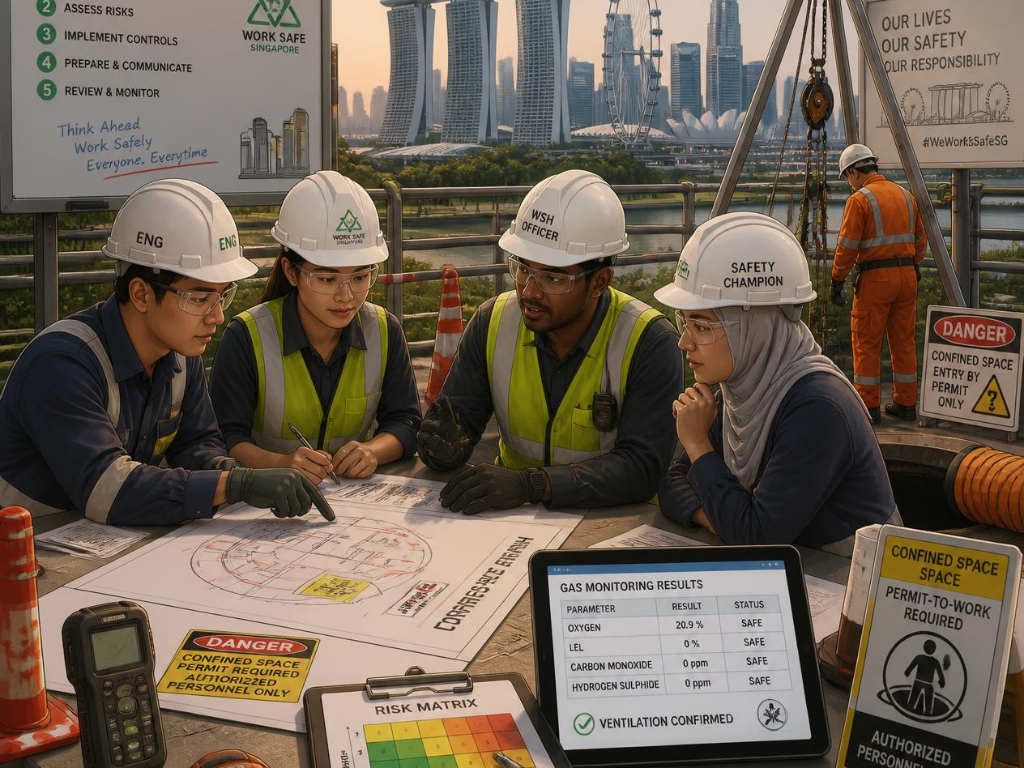
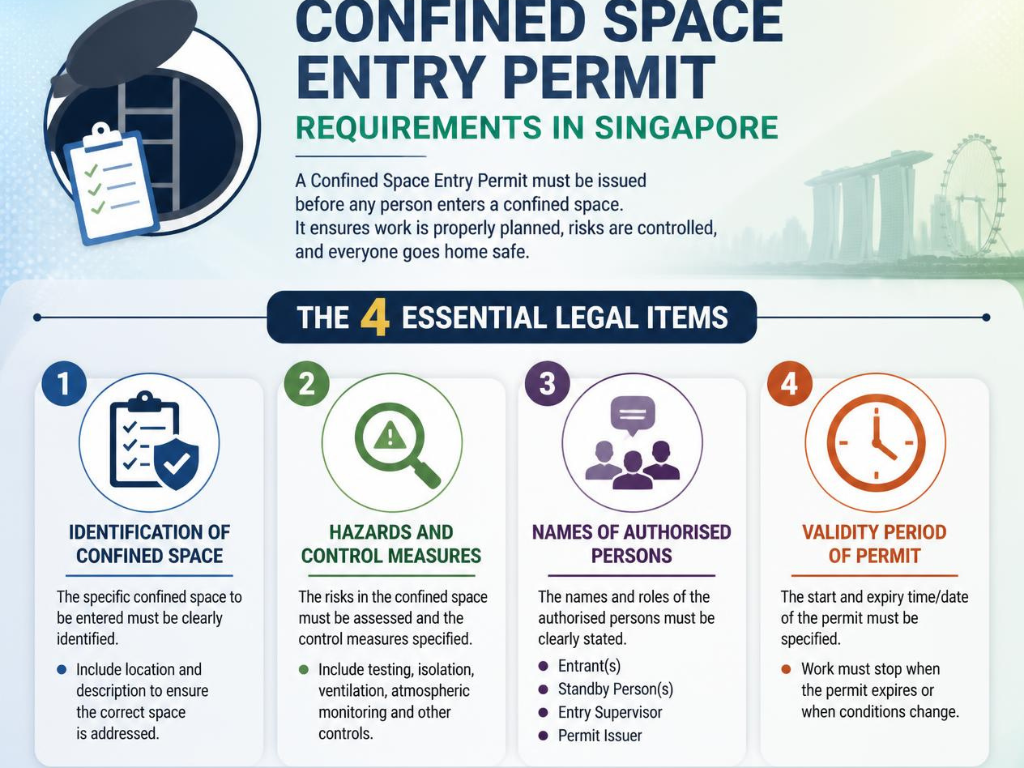
- Administrative: Permit-to-work for confined space/hot work, SOPs, signage, zoning and traffic plans, scheduled maintenance.
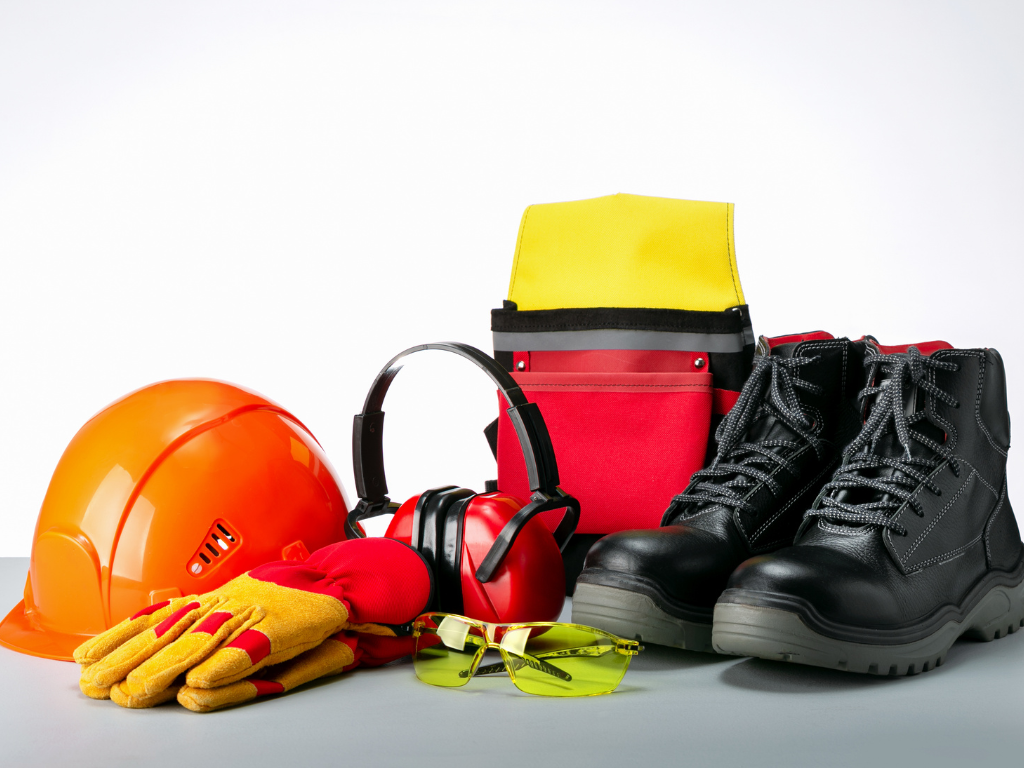
- PPE: Cut-resistant gloves, hearing protection, respirators—with fit-testing and training, not just issue.
Select controls until residual risk is ALARP—“as low as reasonably practicable”—balancing risk reduction with feasibility. Record why a higher-order control was not chosen (technical, operational, or disproportionate cost). This is straight out of the RMCP’s risk-reduction logic.
Put it together: your Risk Management Implementation Plan
Your plan is more than a register; it’s a project list with owners and deadlines. The Level-2 competency materials and accredited course descriptions are explicit: a practical plan “identifies specific actions to be taken, by whom, and time for completion.”
Minimum contents that satisfy both operations and auditors
- Hazard & Activity Register (inventory of work activities, hazards, affected persons).
- Risk Assessment Table (initial risk, chosen controls, residual risk).
- Action Plan (action item, control type, owner, due date, status).
- Supporting documents (SOPs, PTW templates, maintenance schedules, training records).
Communicate and implement (this is where plans succeed)
Controls only work when people know what changed and why. The RMCP expects you to communicate risks and controls, update procedures, and train affected staff.
Tight execution loop
- Brief supervisors first; then cascade toolbox talks on the floor.
- Update SOPs and PTW forms the same week a control goes live.
- Walk the line: verify guards are fitted, signage installed, PPE stocked, traffic routes marked.
- Record who was briefed and when; attach photos for evidence.
Monitor, review, and improve (or drift happens)
Two failure modes are common: controls degrade (guard removed, alarm bypassed) or the work changes (new machine, new chemical) and the plan doesn’t. The Regulations and MOM guidance require monitoring control effectiveness and reviewing risk assessments at least every three years—or sooner if work changes or after incidents.
Build a minimalist cadence
- Monthly: spot-checks on critical controls (guards, LEV, reversing alarms).
- Quarterly: sample two risk assessments; verify actions are closed.
- Event-driven: refresh RA on change (process, layout, equipment) or after an incident/near-miss.
- 3-year full review: formal sign-off with management, updated registers and training.
How this maps to bizSAFE Level 2 training and outcomes
When your RM Champion attends the WSQ “Develop a Risk Management Implementation Plan” course (the competency now coded WPH-WSH-4075-1.1), they are trained to lead exactly the steps above—team formation, hazard ID, assessment, control selection, communication, and monitoring—and to compile a plan that stands up to Level-2 recognition. The Statement of Attainment is issued under WSQ/SSG, and providers explicitly state its use for Level-2 application.
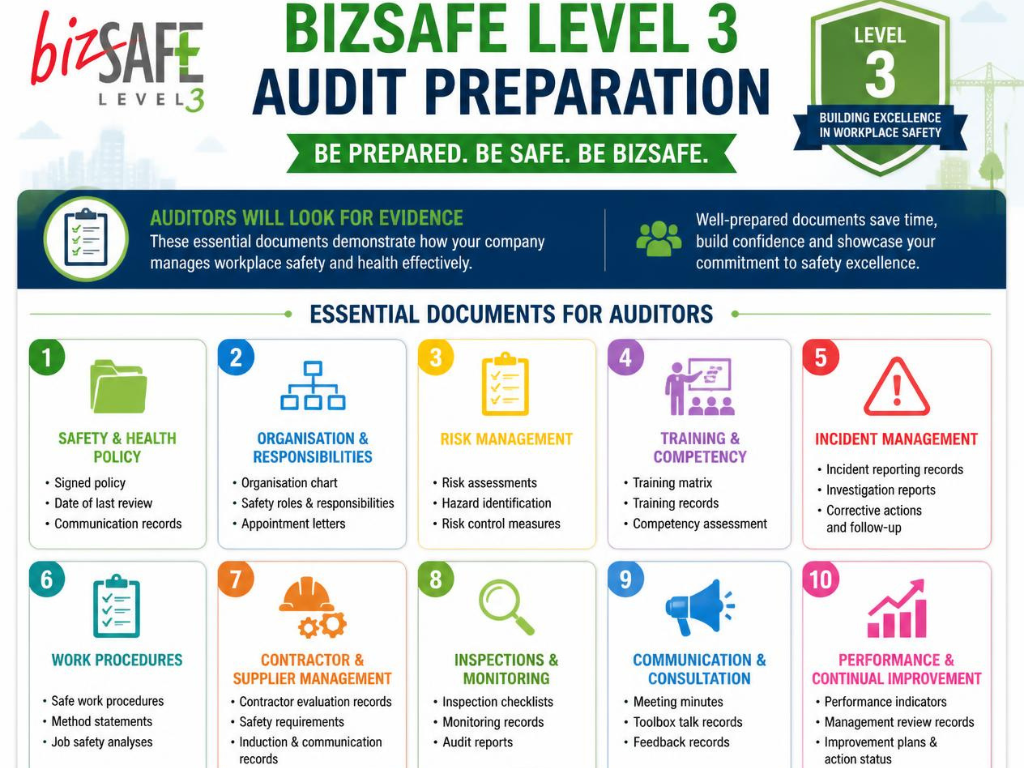
From there, you can progress to Level 3, where an MOM-registered auditing organisation checks that your risk management system is implemented.
Conclusion
A bizSAFE Level 2 risk management plan isn’t a compliance trophy it’s a working playbook that keeps people from getting hurt and keeps your operations steady. If you form the right team, hunt hazards with structure, rate risk consistently, choose controls by the hierarchy, and track actions to closure, you’ll satisfy the Code of Practice and more importantly build a workplace your staff trust. From there, Level 3 isn’t a leap; it’s the natural next step.If your company is preparing for bizSAFE Level 2 or needs help developing a clear, audit-ready risk management plan, our WSH consultants can support you through every stage — from risk assessment workshops to documentation and MOM submission.
FAQ About bizSAFE Level 2 Risk Management Plan
What is bizSAFE Level 2 and what does it prove?
It shows your company has a trained RM Champion and a documented risk management implementation plan aligned to Singapore’s WSH Risk Management framework—ready for Level-3 audit.
Who should be on the risk assessment team?
Include management, engineers, technical staff, supervisors, operators, maintenance, safety staff—and relevant contractors/suppliers. The team leader should be trained in RA.
What’s the right way to pick controls?
Follow the Hierarchy of Controls (elimination to PPE) and aim for ALARP. Document why a higher-order control wasn’t feasible.
How often must we review the risk assessment?
Review at least every 3 years, and whenever processes change or after an incident. Monitor control effectiveness in between.
What certificate code should my RM Champion receive?
The WSQ SOA is WPH-WSH-4075-1.1 Workplace Safety and Health Control Measures—the updated title used for Level-2 applications.