- 22 Apr 2026

The bizSAFE Level 2 course for supervisors in Singapore is meant for one specific role in your company: the Risk Management Champion. That person can be a supervisor, a team leader, or the business owner themselves. Choosing the wrong nominee wastes the seat. This blog will walk you through who actually belongs in the room.
What bizSAFE Level 2 is really about, and why role fit decides the outcome
bizSAFE Level 2 is not a general safety awareness course. It trains one appointed person to build and maintain the company’s Risk Management Implementation Plan. That person is the Risk Management (RM) Champion, and the Workplace Safety and Health Council uses that title formally. The role exists because Singapore’s Ministry of Manpower requires employers to identify hazards, assess risks, and implement control measures at every workplace, regardless of size or sector.
The course is 2 days (16 hours) of classroom training, ending with a written assessment plus a case study. Assessment pass rate is 100% competency across both components. Successful completion earns a Statement of Attainment under the WSQ skill code WPH-WSH-4075-1.1 Workplace Safety and Health Control Measures, which replaces the older MF-COM-402E-1 competency code. The WSH Council’s bizSAFE FAQ confirms this Statement of Attainment is what qualifies the company to apply for bizSAFE Level 2 status.
That framing matters because it shifts the attendance question. The real question is not “who can attend?” but “who in the company will actually do the work of running risk management after the course ends?” Send someone who attends but cannot act, and the bizSAFE certificate becomes paperwork without a plan behind it.

Who the course is designed for
The Workplace Safety and Health Council’s RM Champion role expects one appointed person with enough operational visibility to form a risk management team, identify real hazards, evaluate them, and communicate controls across the business. Three profiles fit this role well. One profile does not.
Supervisors and line managers
Supervisors are usually the strongest fit. They see what actually happens on the floor: the shortcuts workers take, the near-misses nobody reports, the equipment that runs hot, the gaps between the SOP and reality. When a supervisor attends bizSAFE Level 2, the hazard identification module becomes concrete. They already know what needs to be assessed.
This fit extends across sectors. A warehouse supervisor, a construction foreman, a facilities manager overseeing multiple contractors, a shift lead in a light manufacturing setup — each has the ground-level visibility the course assumes.
Team leaders and operations coordinators
Team leaders sit close enough to operations to see hazards but have enough authority to implement controls without escalating every decision. This is useful because bizSAFE Level 2 is not just about identifying risks. It is about documenting ownership. Every control measure in the Risk Management Plan needs an action owner with a completion date.
A team leader can assign that ownership during meetings they already run. A business owner can do it too, but may not be close enough to day-to-day operations to know which person to assign. A supervisor or team leader can.
Business owners and owner-managers
For SMEs and this is where Singapore’s WSH framework sees the highest bizSAFE adoption the business owner often is the RM Champion by default. When headcount is under 30, there is no separate safety department. The owner wears that hat along with operations, HR, and finance.
Owner-managers attending bizSAFE Level 2 gain something useful beyond compliance: a structured view of where their own business exposes itself.

Who should not attend, even if the seat is available
Admin staff, HR personnel with no operational exposure, and junior employees without decision authority. Each of these nominations fails for a different reason.
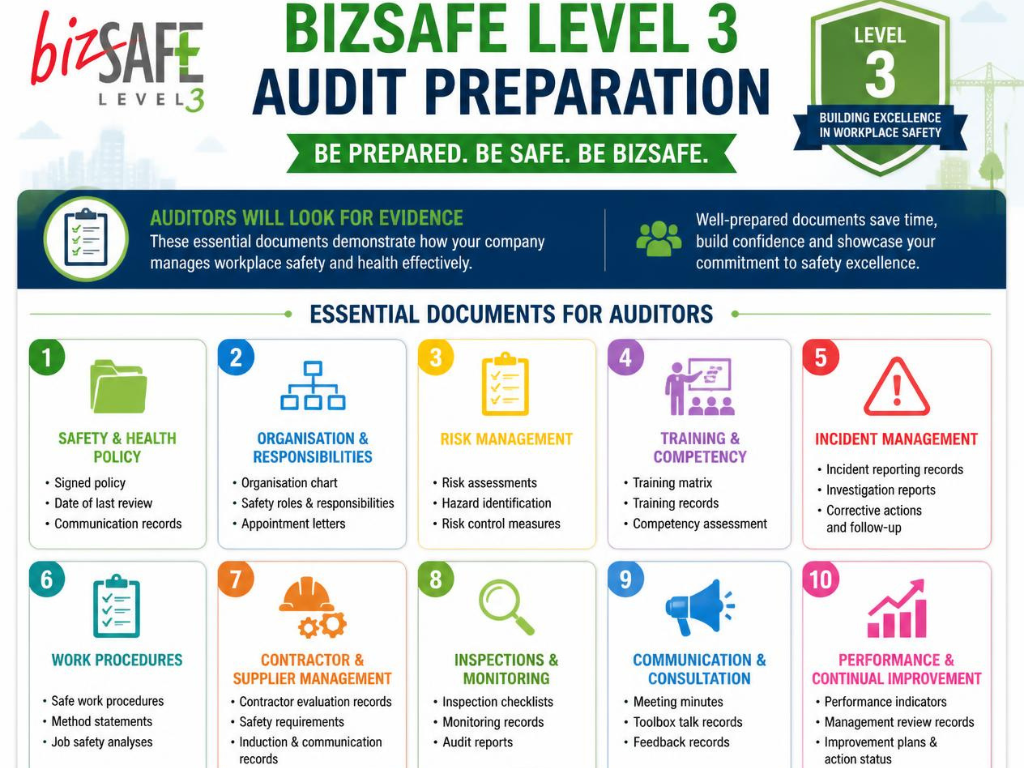
Admin and HR staff without operational visibility will struggle with the hazard identification component. The course expects participants to map hazards to real work activities in their company. Someone who spends the day in a back office cannot meaningfully assess the risks on a loading bay or a production line. They can take the course, but the plan they produce will be generic, and generic plans fail the bizSAFE Level 3 audit that usually follows.
Junior employees lack the authority to implement controls. The plan they build at the end of the course is only useful if someone can actually sign off on buying new equipment, changing a procedure, or reallocating shifts. A trainee or first-year hire cannot do that.
Sending the wrong person is costly in a specific way. The company’s bizSAFE Level 2 certificate is valid for 6 months from approval and is not renewable. If the appointed RM Champion cannot execute the plan within that window, the company loses its starting position for Level 3 and has to retrain someone else.
How to decide: a role-by-role comparison
| Role | Fit for RM Champion | Why | Risk of Nominating |
| Supervisor / foreman | Strong fit | Sees real hazards daily, has direct reports, can assign actions | Low |
| Team leader / ops coordinator | Strong fit | Bridges floor-level visibility with decision authority | Low |
| Business owner (SME) | Good fit if close to operations | Has full sign-off authority and business context | Medium if detached from day-to-day |
| Safety officer / WSH coordinator | Strong fit | Formal safety mandate, already familiar with WSH Act | Low |
| HR or admin staff (no ops exposure) | Poor fit | Cannot meaningfully assess operational hazards | High: produces generic plan, fails Level 3 audit prep |
| Junior employee / trainee | Poor fit | No authority to implement controls or assign owners | High: plan becomes unimplementable |
One more test. Ask the candidate two questions before nominating them. Can you name three current hazards in our operation? Can you assign someone to fix one of them by next week? If either answer is no, find someone else.
What if your company already has a safety officer or WSH coordinator
Then they are usually the right nominee. A WSH coordinator already works within the Workplace Safety and Health Act framework, understands the Code of Practice on WSH Risk Management, and often holds related certifications. Adding bizSAFE Level 2 on top formalizes their authority to lead the RM process for the company.
Prerequisites the nominee must actually meet
The WSQ course has specific entry requirements, not just a suggested audience. The nominee needs at least ES WPLN Level 5 proficiency in English (equivalent to the ability to read, write, speak, and understand English at a professional working level), plus numeracy at the same level. This is enforced because the course material, written assessment, and case study are all in English.
The nominee also needs to be available for 2 full consecutive days. This is not a drop-in workshop. The WSH Council’s approved training providers, including Advanced Safe Consultants, run the course across 2 working days with assessment on Day 2. Someone who can only attend partially will not qualify for the Statement of Attainment.
For details on how the total cost compares across providers and what additional expenses the company should budget beyond the course seat, this breakdown of bizSAFE Level 2 certification cost in Singapore covers what SMEs typically miss.
What happens when the RM Champion leaves the company
This is the most common bizSAFE compliance gap among Singapore SMEs, and most companies do not realize it until the certificate is already in jeopardy.
The RM Champion role is tied to the individual, not the company. When they resign, are reassigned, or go on extended leave, the company must appoint a new RM Champion and enrol that person in bizSAFE Level 2 as soon as possible. Waiting until the certificate expires creates a visible compliance gap during any audit or renewal cycle.
Turnover planning is part of why choosing the right nominee matters from the start. A supervisor with 3 years of tenure is a safer RM Champion than a fresh hire, not because the fresh hire cannot do the work, but because the company avoids retraining within the 6-month validity window.
How Advanced Safe Consultants delivers bizSAFE Level 2 training
Advanced Safe Consultants Pte Ltd is a Singapore-based WSH consultancy and training provider. The bizSAFE Level 2 course runs across 2 full days at the Woodlands training centre, with assessment on Day 2. The course fee is $320 before GST ($348.80 with 9% GST). SkillsFuture Credits are eligible for Singaporeans and PRs, and SME absentee payroll support is claimable up to $4.50 per hour.
Beyond training, Advanced Safe also provides WSH consultancy services that can support companies after the course, including risk management plan review and Level 3 audit readiness. This matters for SMEs that send their RM Champion to the course but still need help turning the training into an implementable plan within the 6-month validity window.
Conclusion
Send the person who can actually run the plan, not just the person with a free calendar.
The bizSAFE Level 2 course works when the nominee has operational visibility, enough authority to assign controls, and the language proficiency to pass the assessment. Supervisors, team leaders, WSH coordinators, and hands-on owner-managers all fit. Back-office staff and junior employees do not. Sending the wrong person wastes the 6-month certificate window and forces a retraining cycle.
If your company is ready to nominate an RM Champion for bizSAFE Level 2, Advanced Safe Consultants can schedule training and advise on whether the nominee is the right fit before the seat is booked.
FAQs About BizSAFE Level 2 Course For Supervisors Singapore
Can a supervisor attend the bizSAFE Level 2 course in Singapore?
Yes. Supervisors are one of the strongest fits for the Risk Management Champion role because they see real workplace hazards daily and can assign action owners. The Workplace Safety and Health Council recognizes supervisors, managers, team leaders, and safety professionals as the intended audience for the course.
Can a business owner attend bizSAFE Level 2 instead of sending a supervisor?
Yes, and for SMEs this is often the right call. Owner-managers with sign-off authority over operations, equipment purchases, and staffing can serve as RM Champion. The fit weakens when the owner is detached from day-to-day operations, in which case a supervisor with floor-level visibility is the better nominee.
What happens if the RM Champion leaves the company after completing bizSAFE Level 2?
The company must appoint a new RM Champion and enrol them in bizSAFE Level 2 as soon as possible to maintain bizSAFE status. The Statement of Attainment belongs to the individual, not the company. Waiting creates a compliance gap during the 6-month certificate validity window.
What are the prerequisites for bizSAFE Level 2 course attendance?
Participants need at least ES WPLN Level 5 proficiency in English (reading, writing, speaking, numeracy). They must attend both full days and pass the written plus case study assessment at 100% competency. Medical conditions affecting physical participation should be declared before enrolment.
Does bizSAFE Level 2 give the company automatic certification?
No. Attending the course gives the RM Champion a Statement of Attainment. The company still needs to submit the bizSAFE Level 2 application with supporting documents to the Workplace Safety and Health Council. The certificate, once approved, is valid for 6 months and is not renewable.