- 20 Jun 2026
The LTA Code of Practice for traffic control governs how every Singapore worksite manages public traffic before a single cone goes down. LTA moved to a new April 2026 edition this year, and many contractors are still working off the 2019 version. This blog walks you through the permits, plans, signage, and personnel your roadworks need, whether your crew handles utilities, maintenance, or managing work zone traffic control.
What is the LTA Code of Practice for Traffic Control at Work Zones?
The LTA Code of Practice for Traffic Control at Work Zone is the Land Transport Authority’s official guide to planning and running temporary traffic control whenever work happens on or beside a public street. It sets the rules for signs, lane closures, and zone layout so road users stay safe while works proceed.
The Code does not stand alone. It sits on the Street Works Act 1995 and the Street Works (Works on Public Streets) Regulations, and it runs alongside the Code of Practice for Works on Public Streets, currently on its June 2025 edition. Together they decide who may dig, who may close a lane, and how. The Code binds LTA, utility agencies, contractors, and service providers, in LTA’s own words everyone “involved in work on public roads.” If your works touch a public road, this document applies to you, not as guidance but as the standard an enforcement officer measures your site against.

Which edition applies in 2026, and what changed?
Use the April 2026 edition. It superseded the July 2019 edition and is the only version LTA assesses against today.
The April 2026 edition made three changes that matter on site. It added lane status signs to traffic control plans so motorists get clearer information on which lanes stay open. It removed “Caution” signs from advance warning arrangements, tightening what crews place ahead of the work zone. It introduced an “Urgent Works in Progress” sign for emergency works, giving contractors a sanctioned way to flag unplanned repairs. The edition also strengthened advance notice to residents and road users. Worth noting: a Traffic Control Plan built on the 2019 layout now carries outdated signage logic. The cleaner approach is to rebuild any reused plan against the April 2026 edition before submission, rather than patch an old one and hope it clears review.
Do you need a permit before starting roadworks?
Yes. No person may occupy or excavate a public street without a valid permit under the Street Works (Works on Public Streets) Regulations. Starting works without one is an offence, not an oversight.
Permits run through LTA.PROMPT, the Permit for Road Occupation Management Portal. The system tracks every excavation, lane closure, and diversion, and it blocks clashes where two contractors try to occupy the same road space. Submit the notification at least 7 days before any lane or road closure. The portal also expects a public liability policy with a minimum sum assured of $1 million, naming LTA as a principal where applicable. A single application can cover up to 9 connecting roads, and major utility proposals need in-principle pre-consultation with LTA at least 6 months ahead. Registered applicants are typically licensed contractors or utility agencies, and the technical substance still needs a Professional Engineer behind it.
What is a Traffic Control Plan, and who has to sign off on it?
A Traffic Control Plan, or TCP, is the document that shows exactly how your work zone manages traffic: sign positions, taper lengths, lane closures, and buffer zones. Where works involve road lane occupation, the TCP is mandatory, and a Professional Engineer must endorse it.
Here is a precision point most providers get loose with. The industry says “traffic management plan.” LTA’s formal, submittable artifact is the Traffic Control Plan. If a vendor hands you a “TMP” and calls the job done, check that it meets the TCP requirements LTA actually reviews. The PE endorsement is not a rubber stamp. The engineer, registered under the Professional Engineers Act, certifies that the design complies with the Code of Practice and the LTA Code of Practice on Civil Design Criteria, whose geometric tables take precedence over the work zone Code where the two differ. Where this breaks down is sites that treat the TCP as paperwork. The plan is the safety design. If the people on the ground cannot read it and build the zone from it, it is not compliant in any way that protects anyone.
What signage and zone layout does an LTA work zone require?
A compliant work zone is built in sequence: an advance warning area, a transition area with a taper, a buffer, the activity zone where work happens, and a termination area returning traffic to normal. Each segment has set spacing and signage under the Code.
The taper guides traffic out of the closed lane, and its length scales with road type and speed. The buffer keeps a gap between live traffic and workers. Get these wrong and you create the exact conflict the Code exists to prevent, traffic meeting works with no margin. Geometric values defer to the LTA Civil Design Criteria, so a designer cannot freelance the numbers. Most sites that fail an inspection fail on the basics: a taper that is too short, a sign placed too late, a missing buffer. A quick review of common traffic control mistakes before mobilising saves a rejected plan and a halted job. Layout is not decoration. It is the difference between a controlled diversion and a hazard on a live carriageway.
Who is allowed to do manual STOP/GO traffic regulation on a public road?
Only trained, authorised personnel may manually regulate traffic on a public road. There is no informal version of this. A worker waving cars through without the right qualification is a liability, not a control.
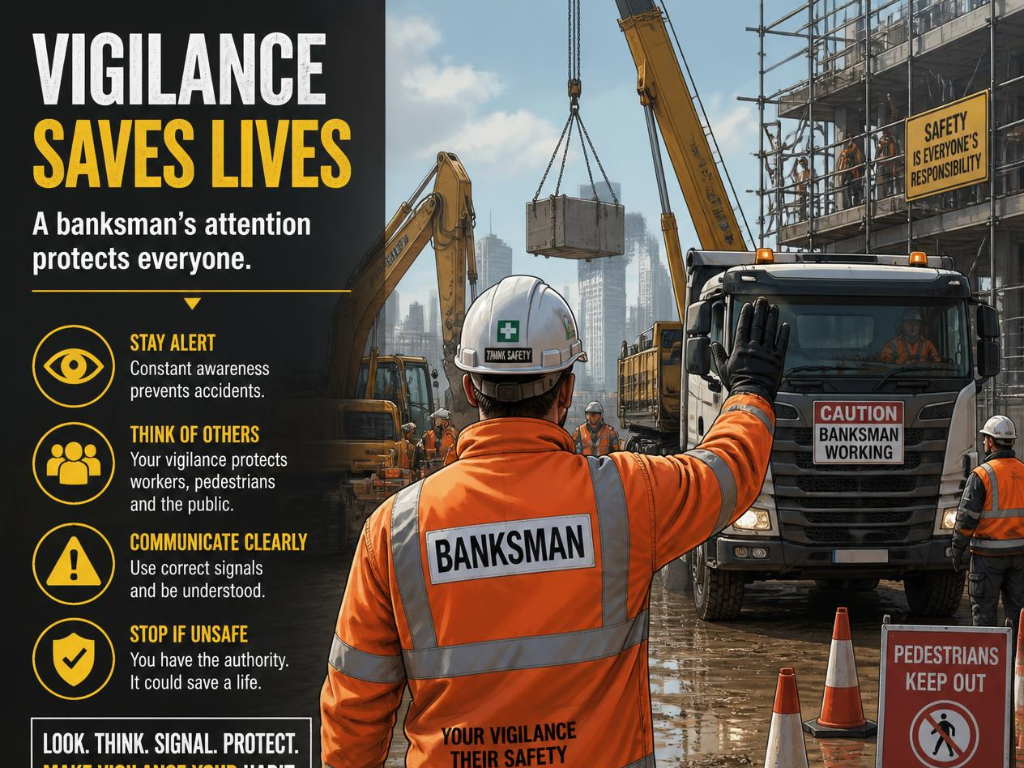
Two routes qualify someone. The first is a trained traffic controller who has completed LTA-compliant traffic control training and works to the Code. The second applies to security personnel: a security officer may perform traffic regulation duties only after completing the “Conduct Crowd and Traffic Control” course under the Security Workforce Skills Qualifications framework, and only once their security agency has applied for and received LTA authorisation. Do not confuse this with a banksman safety course. A banksman directs vehicles and machinery inside a private worksite under the WSH Act and MOM. Manual regulation of public traffic on a road sits under LTA. Same hand signals in spirit, different jurisdiction, different authorisation, and the wrong one on file is a finding waiting to happen.
What happens if your work zone doesn’t comply?
LTA can revoke your permit and stop your works. The Code is enforced under the Street Works Act 1995, and compliance with the Code does not, by itself, shield a contractor from other legal liabilities. Non-compliance is a commercial and safety risk, not a paperwork footnote.
Enforcement officers validate actual site conditions against the approved plan, which is why notification of commencement and completion through LTA.PROMPT is a legal obligation, not a courtesy. If an incident occurs, an interim report must reach LTA’s Road Works Regulation and Licensing division within 12 hours, with the detailed report following within 7 working days. The stakes are real. MOM’s WSH Report 2025 recorded vehicular incidents as the leading cause of workplace deaths, 15 of 36 fatalities, or 42 per cent. A non-compliant road work zone puts your crew inside that statistic. Frontline crews should hold the basic traffic control course, and the appointed person running the zone needs traffic control supervisor training or the manager-level certification. If you are unsure where your gaps are, book a work zone compliance review before your next mobilisation.
Treat the Code as a system, not a form to file
Compliance is not one document. It is a permit through LTA.PROMPT, a Traffic Control Plan endorsed by a Professional Engineer, a work zone built to the April 2026 signage and taper rules, and authorised people running it. Miss any one piece and the others do not save you. The contractors who clear review the first time treat all four as a single chain, built on the current edition.
Map your next roadworks against that chain before you submit. Confirm the edition, the permit, the endorsed plan, and the certification of every person regulating traffic, then send it in once instead of twice.
FAQs About LTA Code of Practice Traffic Control
How many days before roadworks must you notify LTA?
At least 7 days before any lane or road closure, submitted through LTA.PROMPT, the Permit for Road Occupation Management Portal. Major utility proposals need earlier action, with in-principle pre-consultation from LTA required at least 6 months before the permit application.
Is a Traffic Control Plan the same as a Traffic Management Plan?
In LTA’s framework, the formal submittable document is the Traffic Control Plan, or TCP. “Traffic management plan” is the colloquial industry term. Where works involve road lane occupation, the TCP is mandatory and must be endorsed by a Professional Engineer registered under the Professional Engineers Act.
Does the LTA Code apply to short utility or maintenance jobs?
Yes. The Street Works (Works on Public Streets) Regulations cover the laying and maintaining of utility apparatus, lane closures, and engineering works on public streets, regardless of how brief the job is. A two-hour repair on a live road still needs a permit and a compliant work zone.
What training do traffic controllers need to comply with the LTA Code?
LTA-compliant traffic control training, matched to the role. Frontline workers take Advanced Safe Consultants’ Basic Traffic Control for Workers course; supervisors take the Traffic Control Supervisor Course; the appointed manager takes the Traffic Control Manager Course. Security officers regulating traffic need the WSQ “Conduct Crowd and Traffic Control” qualification plus LTA authorisation.