- 27 Jun 2026
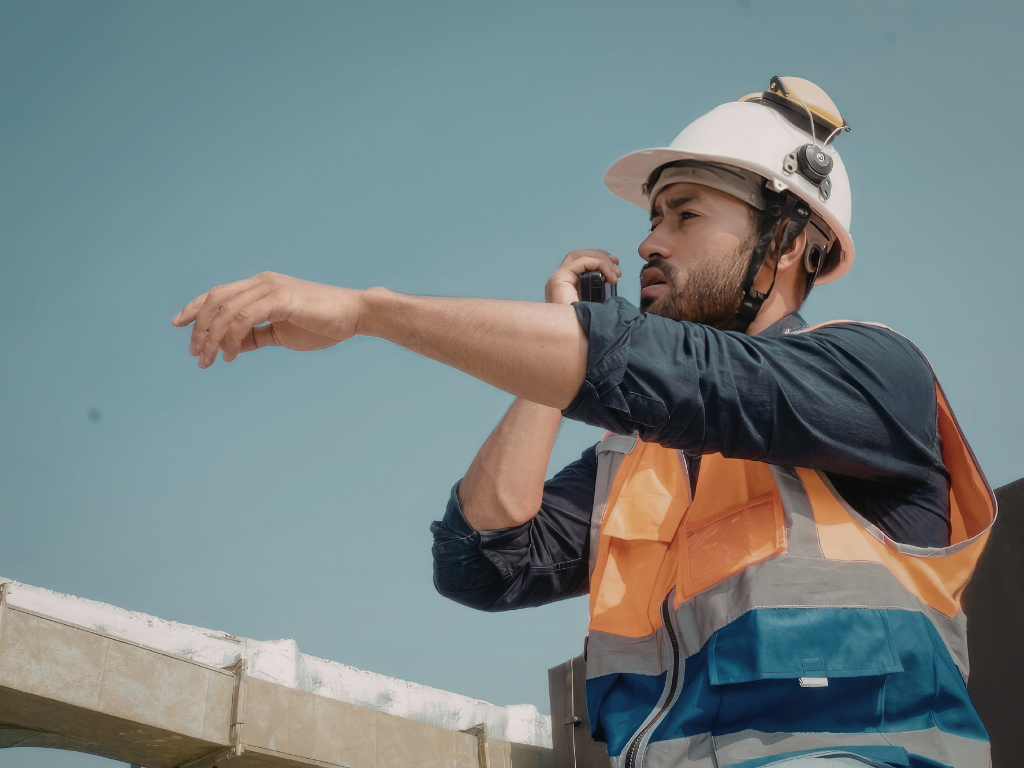
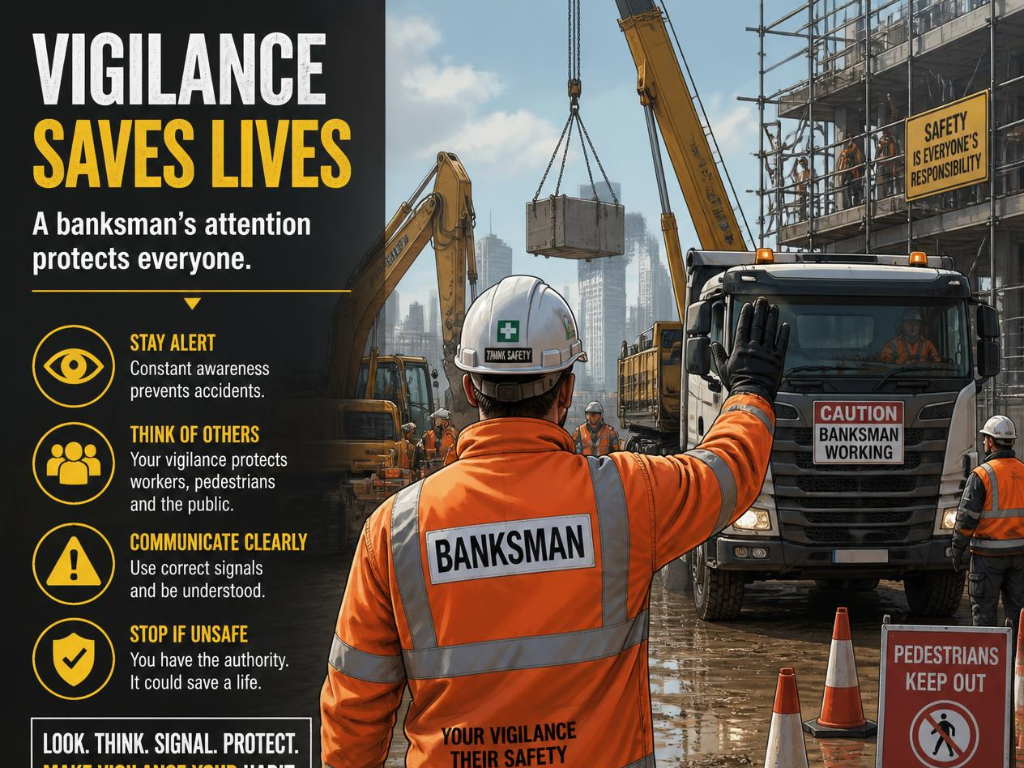
Banksman hand signals in Singapore are the standard gestures a trained signaller uses to guide reversing vehicles, cranes, and heavy machinery when the operator cannot see clearly. They exist because vehicular incidents were the leading cause of workplace deaths in 2025, 15 of 36 reported by MOM. This blog walks you through the standard signals, the rules behind them, and where the vehicle and machinery banksman course fits.
What are banksman hand signals, and why do they matter?
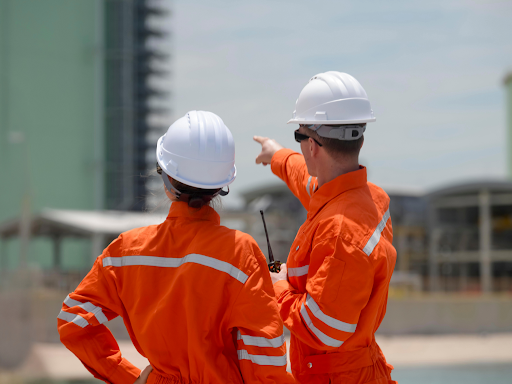
Banksman hand signals are a fixed set of gestures that let a ground-based signaller direct a vehicle or machine the operator cannot fully see. They replace shouting and guesswork with a shared visual language, which is what keeps a reversing manoeuvre controlled instead of chaotic.
The need is acute on Singapore worksites. Engine noise drowns out voices, blind spots hide workers behind large plant, and a reversing vehicle gives little warning. A banksman stands where the operator can see him and converts the surrounding situation into clear instructions: advance, reverse, slow, stop. Standardisation is the point. A gesture only works if both people read it the same way, every time, which is why improvised hand-waving is treated as a hazard rather than a help. The signals are taught, assessed, and standardised precisely so a worker on a Jurong logistics yard and one on a Tuas construction deck use the same vocabulary.
What are the standard banksman signals for directing vehicles?
The vehicle-manoeuvring set follows the recognised model defined in the UK Health and Safety (Safety Signs and Signals) Regulations 1996, the same standardised gestures Singapore banksman training teaches. Each signal maps to one unambiguous instruction, and both banksman and driver agree on them before any movement begins.
|
Signal |
How it’s given |
Meaning |
|
Start / attention |
Both arms extended horizontally, palms forward |
Prepare to move; eyes on me |
|
Move toward me |
Both arms bent, palms inward, beckoning toward the chest |
Advance slowly in my direction |
|
Move away from me |
Both arms bent, palms outward, pushing away |
Reverse slowly away from me |
|
Turn left / right |
One arm extended, pointing the direction |
Steer that way |
|
Slow down |
Hand low, palm down, moving slowly up and down |
Reduce speed |
|
Stop |
One arm raised, palm facing the driver |
Stop now |
|
Emergency stop |
Both arms raised and held |
Stop immediately, hazard present |
The signaller keeps movements slow and deliberate, because a rushed gesture is a misread gesture. Worth noting: the banksman also shows closing distance, narrowing the gap between both hands as the vehicle nears an obstacle, so the driver judges clearance without seeing it.
What hand signals are used for cranes and lifting operations?
Crane and lifting work uses a different, more detailed signal set, governed by the ASME B30.5 standard reflected in references like OSHA’s standard crane hand signals. A banksman directing a reversing lorry and a signalman directing a crane lift are doing related but distinct jobs, and conflating their signals is a real error.
|
Signal |
How it’s given |
Meaning |
|
Hoist |
Forearm vertical, forefinger up, small horizontal circle |
Raise the load |
|
Lower |
Arm extended down, forefinger down, small circle |
Lower the load |
|
Raise boom |
Arm extended, thumb pointing up |
Boom up |
|
Lower boom |
Arm extended, thumb pointing down |
Boom down |
|
Swing |
Arm extended, finger pointing in the swing direction |
Rotate the load that way |
|
Stop |
Arm extended, palm down, swung back and forth |
Stop |
|
Emergency stop |
Both arms extended, palms down, swung back and forth |
Stop immediately |
In Singapore, crane lifts require an appointed, trained signalman under the WSH (Operation of Cranes) Regulations, separate from the vehicle banksman role. The lifting signal set carries more commands because a crane moves on more axes than a truck does.
What rules make signalling safe, beyond the gestures themselves?
Three rules turn a set of gestures into a safe system. Only one person signals the operator at a time. Anyone on site can give the stop or emergency stop, and the operator must obey it. If the operator loses sight of the signaller, all movement stops at once.
These come straight from established signalling regulation. OSHA’s crane signalling rule states that “only one person may give signals” to the machine at a time, a principle Singapore lifting practice mirrors, because two people signalling one operator is how contradictory instructions cause incidents. The stop-override rule matters just as much: the signalling requirements make clear that anyone aware of a hazard can call the stop, and the operator is bound to act on it. The single-signaller and stop-override rules are not bureaucracy. They are the two controls that decide whether a manoeuvre stays safe when something unexpected enters the zone.

How does a banksman position for blind spots and reversing?
The banksman stands where the operator can see him in the mirror and where he can see the whole danger zone, never directly behind a reversing vehicle. Constant eye contact with the operator is the rule. The moment that contact breaks, the vehicle stops.
Reversing is the highest-risk manoeuvre because it removes the driver’s clearest sightline exactly when people are most likely to be behind the vehicle. The banksman manages that gap by positioning to the side, keeping clear of the path of travel, and watching for anyone entering the blind zone. The WSH Council’s workplace traffic safety guidance directs sites to use a trained signaller or banksman precisely when the rear view is compromised and rear-view aids are unavailable. A banksman who stands in the blind spot to direct a reversing vehicle has become the hazard the role exists to prevent.
Are banksman hand signals standardised in Singapore, and is training required?
Yes on both counts. The signals follow recognised international standards, and the people using them are expected to be trained and competent under Singapore’s WSH framework. A worker in a hi-vis vest waving vaguely is not a banksman; competence is the qualification.
Advanced Safe Consultants delivers the standardised set through a half-day course, and the resulting Certificate in Vehicle & Machinery Banksmen Safety is valid for 4 years. Road-traffic work is a separate track: the manual STOP and GO operation a traffic controller performs on a public road sits under the LTA framework, which the traffic control supervisor course covers for the appointed person running the zone. Match the training to the setting. To get a site team signalling to one standard rather than several improvised ones, train your site team on the certified set before the next high-risk manoeuvre.
What goes wrong when signalling fails, and how do you prevent it?
Signalling fails in predictable ways: two people signalling one operator, an untrained worker improvising gestures, the banksman drifting into the blind zone, or eye contact breaking mid-manoeuvre. Each one removes the control the system depends on, and each is preventable.
The fixes are equally specific. Assign one signaller per operator and make it visible who that is. Train everyone to the same standard set so a gesture means the same thing to all parties. Brief the stop-override before work starts, so anyone can halt a manoeuvre that turns unsafe. Keep the banksman positioned for sightlines, not convenience. Most signalling incidents trace back to one of these basics, which is why a refresher on common worksite traffic mistakes is worth running before a complex lift or a tight reversing job. The signal system works when the discipline around it holds.
The signals only work when everyone reads them the same way
Banksman hand signals are a shared standard, not personal style. Vehicle manoeuvring follows one recognised set, crane lifting follows another, and both depend on the same rules: one signaller, a stop that anyone can call and the operator must obey, and constant eye contact that ends the moment it breaks. Trained and competent people are what make the gestures mean anything.
Standardise your site on the certified signal set and the protocol around it, then assign one trained banksman to every manoeuvre where an operator cannot see the whole zone.
FAQs About Banksman Hand Signals Singapore
What is the stop signal for a banksman?
The standard stop signal is one arm raised with the palm facing the driver. The emergency stop uses both arms raised and held, signalling an immediate halt. Under the signalling rules Singapore practice follows, anyone who sees a hazard can give the stop, and the operator must obey it.
Is a banksman the same as a crane signalman?
No. A banksman directs vehicle and machinery movement using the manoeuvring signal set, while a crane signalman directs lifts using the ASME B30.5 signal set. In Singapore, crane lifts require an appointed signalman under the WSH (Operation of Cranes) Regulations, a separate competency from the vehicle banksman role.
Do banksmen need certification in Singapore?
Yes. Under the WSH framework, a banksman must be trained and competent. Advanced Safe Consultants’ Vehicle & Machinery Banksman Safety Course is a half-day programme, and the certificate is valid for 4 years. The WSH Council guidance also calls for a trained signaller or banksman during compromised-visibility reversing.
Can banksman hand signals be replaced by radios?
No. Radios supplement hand signals but do not replace them, because radio can fail, be misheard, or be delayed at the exact moment a manoeuvre needs stopping. Hand signals stay the primary method, with the rule that if the operator loses sight of the signaller, all movement stops immediately.