- 29 Jun 2026

A worksite traffic risk assessment in Singapore is the process of identifying vehicle and machinery hazards, rating the risk, and setting controls before site work begins. It is required under the WSH (Risk Management) Regulations. Vehicular incidents were the leading cause of workplace deaths in 2025, 15 of 36 reported by MOM. This blog walks you through how to run one, with traffic control training sitting inside the controls.
What is a worksite traffic risk assessment, and is it required by law?
A worksite traffic risk assessment is a structured review of how vehicles, mobile plant, and people move around a site, done before work starts, to find the hazards and decide the controls. It is not optional. The WSH (Risk Management) Regulations require employers to assess the risks of the work they undertake and act to eliminate or reduce them.
The legal duty sits with the employer, the self-employed, and the principal, who are responsible for identifying hazards and then assessing, controlling, monitoring, and communicating the risks. Traffic is one slice of that duty, and on most active sites it is the highest-consequence slice. A traffic risk assessment applies the HIRADC method, Hazard Identification, Risk Assessment and Determining Control, to one specific question: what can a moving vehicle or machine do to a person here, and how do we stop it. Records of the assessment must be kept; companies do not submit them to MOM, but inspectors can ask to see them during an inspection or investigation.

What vehicle and machinery hazards should the assessment identify?
The assessment has to name the specific ways vehicles and plant put people at risk on your site, not list generic categories. Reversing is the one that recurs. Blind spots, pedestrian-vehicle contact points, loading and unloading, and uncontrolled plant movement near workers are the hazards that fill real incident logs.
Break it down by how the site actually runs. Heavy vehicles entering and leaving through a shared gate. Mobile cranes and excavators slewing within reach of workers on foot. Delivery lorries reversing into bays with no spotter. Forklifts crossing pedestrian routes in a logistics yard. Each is a distinct hazard with its own likelihood and severity, and each needs rating on that basis. The risk is not theoretical. The Transportation and Storage sector recorded a workplace fatal and major injury rate of 23.8 per 100,000 in 2025, up from 18.4 the year before. Teams that rate these hazards on what could happen, not what usually happens, catch the compounding failures that cause the worst outcomes, a pattern we see repeated in the costly worksite traffic mistakes that show up at audit.
How do you run the assessment before work begins?
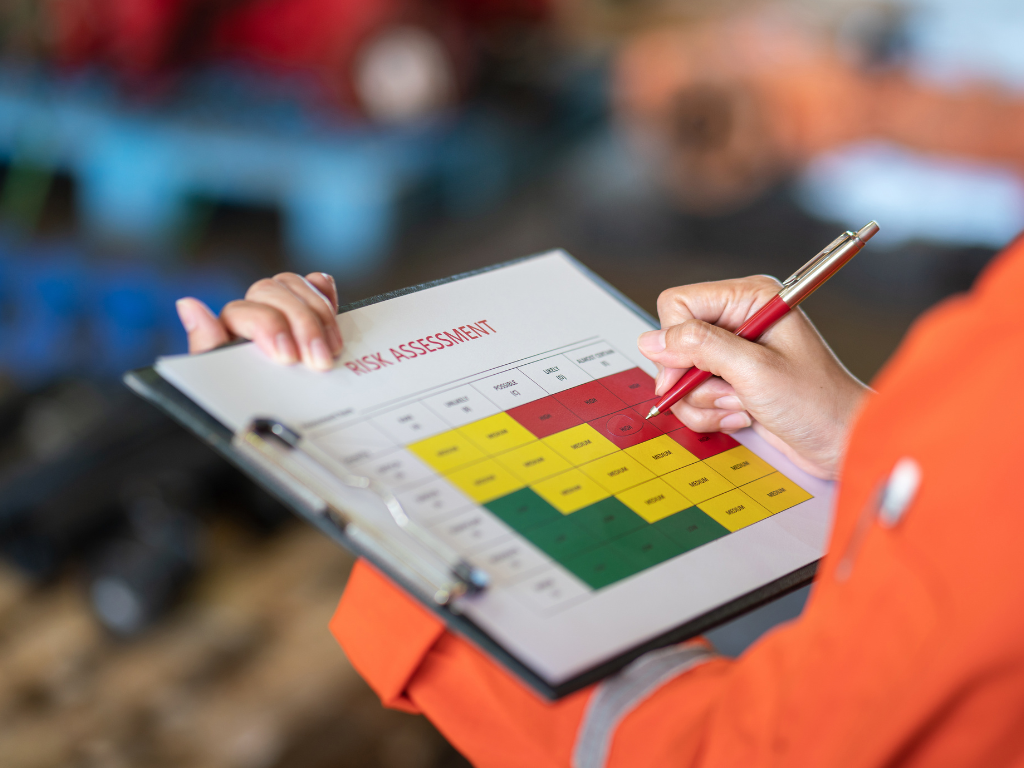
Run it in the same order the work will happen, walking the route a vehicle takes from gate to task and back. Start with the entry point, follow the travel path, map every point where a vehicle or machine comes near a person, and rate each interaction for likelihood and severity.
The sequence that holds up: identify the hazard, assess the risk, determine the control, then record who owns each control and by when. Do it before mobilisation, not after the first near-miss. A site that assesses traffic risk only once a vehicle has already clipped a barrier has inverted the entire point of the exercise. Most teams that struggle here are strong on the form and weak on the walk; they fill the HIRADC table from a desk instead of from the ground. Building that assessment discipline is exactly what a risk management plan course is designed to teach, so the register reflects the site rather than a template. The output is a rated list of traffic hazards, each tied to a control and an owner, ready to feed the plan.
How do you map blind spots and separate people from vehicles?
Blind-spot mapping means standing at the operator’s seat for each vehicle type and marking the zones the driver cannot see, then keeping people out of those zones by design. Pedestrian-vehicle separation means physically dividing where people walk from where vehicles drive, not just painting a line and hoping.
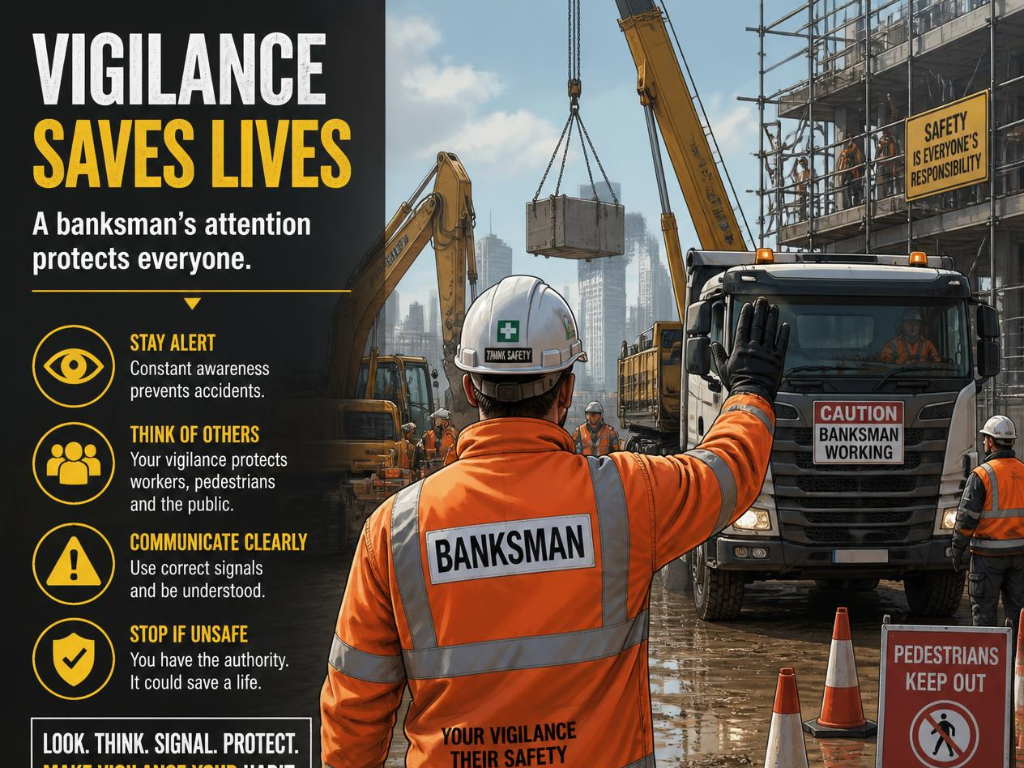
Physical separation beats reliance on hi-vis vests and signage every time, because separation removes the interaction while PPE only mitigates the result of one. The WSH Council’s workplace traffic safety guidance sets the direction: segregate pedestrians from vehicles, control reversing, and use a trained signaller when the rear view is compromised. Where separation is impossible, a competent banksman becomes the control, and banksman safety training produces a certificate valid for 4 years on a half-day course at $120. A vest makes a worker visible. A barrier and a one-way route make the worker unreachable, and unreachable is the safer state.
What controls work, and in what order?
Controls follow the hierarchy, top to bottom: elimination, substitution, engineering, administrative, then PPE. For traffic, that order matters more than usual, because the temptation is to jump straight to vests and toolbox talks.
Eliminate by removing vehicle-pedestrian overlap entirely, scheduling deliveries when workers are off the path. Engineer with one-way systems, physical barriers, designated crossing points, and exclusion zones around slewing plant. Administrative controls such as permits, speed limits, and banksman deployment come next, and PPE sits last as the backstop, never the primary measure. Singapore practice leans hard on engineering controls precisely because they do not depend on a tired worker remembering the rule at 4pm. Select controls until the residual risk is ALARP, as low as reasonably practicable, and record why a higher control was rejected if it was. The assessment is only as good as the control order it produces, and an order that starts with PPE is an order built upside down.
How does a traffic management plan connect to the assessment?
A traffic management plan is the documented output of the risk assessment, the set of routes, rules, and roles that put the chosen controls into practice. The assessment finds and rates the hazards. The plan operationalises the controls. One produces the other, in that direction.
This is where road-facing work and internal site traffic meet the same logic. For work that touches a public road, the plan must also satisfy the LTA Code of Practice for Traffic Control at Work Zones, now in its April 2026 edition, and the appointed person running that zone is trained through a traffic control manager course. A plan that exists without an assessment behind it is a layout drawing with no reasoning, and it falls apart the moment site conditions change. The plan should name the one-way routes, the separation barriers, the reversing controls, the banksman positions, and the person accountable for each, traceable back to a rated hazard in the assessment.
When should the worksite traffic risk assessment be reviewed?
Review it whenever the work, the equipment, or the site layout changes, and at least once every three years as a baseline under the Risk Management Regulations. A new piece of plant, a relocated gate, or a change in delivery schedule each invalidate parts of the original assessment.
Treat the three-year mark as the floor, not the trigger. Live sites change weekly, and the assessment that matched the site in January describes a different site by June. Outdated risk assessments are a frequent audit finding, and an auditor reads the assessment against current site conditions, not the version filed on day one. Keep the record current, version-controlled, and signed, because a HIRADC that lists a control no longer in place is worse than useless at an investigation. If your site lacks the in-house capacity to keep traffic risk assessments current as conditions shift, bring in a risk assessment partner before the next phase mobilises.
Assess the movement before you move the vehicles
Worksite traffic risk assessment in Singapore is the step that decides whether the rest of your traffic safety holds. Identify the vehicle and machinery hazards by walking the route, rate them on what could happen, then apply controls in hierarchy order with separation and engineering ahead of vests and briefings. The traffic management plan is the output, and trained banksmen are a named control inside it, not an afterthought.
Walk your site’s vehicle routes before the next phase begins, rate every point where plant meets people, and lock the controls into a plan with an owner against each one.
FAQs About Worksite Traffic Risk Assessment Singapore
Is a traffic management plan the same as a risk assessment?
No. The risk assessment identifies and rates vehicle and machinery hazards using the HIRADC method. The traffic management plan is its output, the routes, barriers, and roles that put the controls into practice. Under the WSH (Risk Management) Regulations, the assessment comes first and the plan follows from it.
Who is responsible for the worksite traffic risk assessment?
The employer, the self-employed person, and the principal carry the legal duty. MOM holds them responsible for identifying hazards and then assessing, controlling, monitoring, and communicating the risks. On multi-contractor sites the main contractor remains accountable for coordination even when subcontractors run their own vehicles and plant.
What is the penalty for not doing a risk assessment in Singapore?
Breaching the WSH (Risk Management) Regulations carries a fine of up to $10,000 for a first offence, with heavier penalties for repeat offences. Beyond the fine, a missing or outdated risk assessment weakens the company’s position during any MOM investigation following a vehicular incident.
Does HIRADC cover vehicle and machinery hazards?
Yes. HIRADC, Hazard Identification, Risk Assessment and Determining Control, applies to every workplace hazard category, including vehicle movement, reversing, blind spots, and mobile plant. A worksite traffic risk assessment is simply HIRADC focused on how vehicles and machinery put people at risk before site work begins.