- 22 Jul 2026

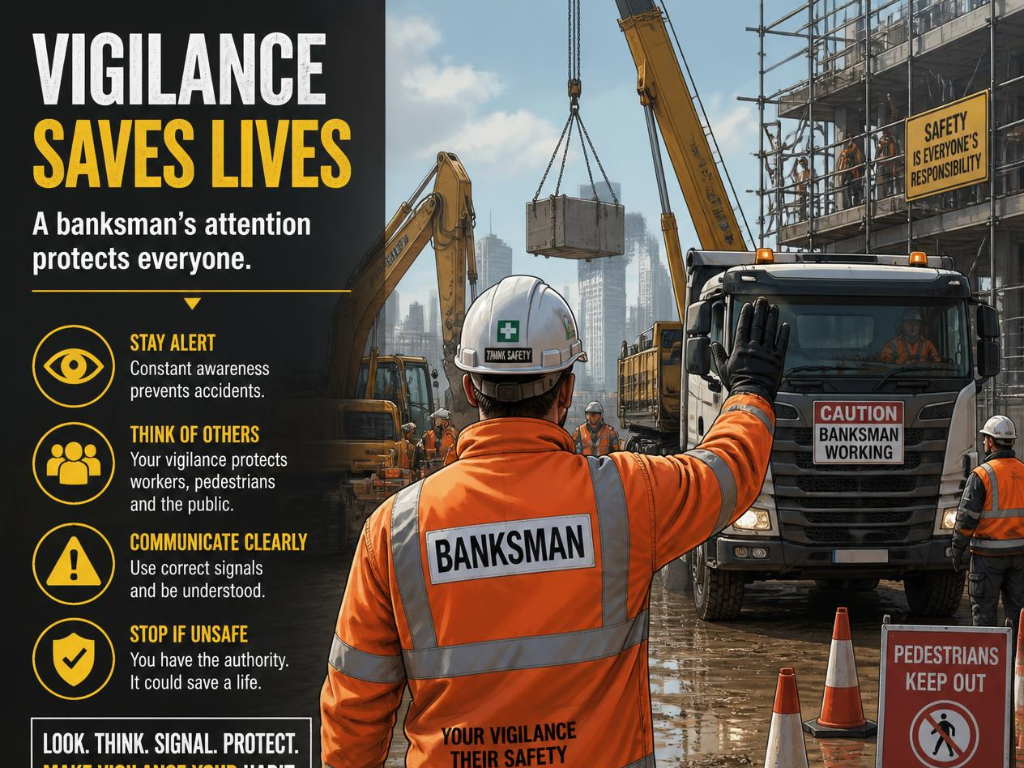
A vehicular safety awareness workshop is a short briefing that keeps drivers, banksmen, and traffic controllers sharp on blind spots, reversing hazards, and signalling between formal certifications. WSH Council’s 12 June 2026 advisory names situational awareness as one of seven controls. This blog walks you through what a briefing should cover and what it cannot replace, starting with banksman certification.
What is a vehicular safety awareness workshop?
It is a short, site-specific briefing on vehicle and machinery hazards, usually delivered as a toolbox session at the start of a shift. It covers blind spots, reversing risk, signalling, and the day’s danger zones. It is not a certification, and it does not issue one.
The distinction matters more than the format. A certified banksman has passed a written and practical assessment at 100% competency and holds a certificate valid for 4 years. A briefing attendee has been reminded of something. Both have value; they are not interchangeable, and treating a briefing as a substitute for certification is how sites end up with an untrained worker in a hi-vis vest waving a truck backwards. The briefing’s job is narrower and more useful than the marketing around awareness training usually admits. It keeps the controls you already have alive on the day. 
Does WSH Council actually back toolbox briefings on vehicular safety?
Yes, explicitly. Increased situational awareness is control 5 of the seven in WSH Council’s advisory on protecting banksmen and traffic controllers, published 12 June 2026. The Council tells sites to highlight onsite hazards during daily toolbox meetings.
The advisory does not leave the content vague, which is unusual and useful. It directs employers to remind drivers and operators to keep a lookout for workers before moving their vehicle or equipment, including during reversing. It tells sites to “Remind workers to stay alert to vehicle/equipment movements and changing site conditions.” It states that banksmen and traffic controllers should not be entering a demarcated danger zone. That is a briefing agenda written by the regulator. Any site running vehicular safety briefings can lift the structure straight from the WSH Council advisory rather than inventing one.

Why brief the crew if your banksman is already certified?
Because certification proves competence on the day it was issued, and the banksman certificate runs for 4 years. In that window the crew turns over, new drivers arrive, the site layout changes, and the LTA Code moved to its April 2026 edition. The certificate does not update itself.
This is the gap the briefing exists to close, and it is the argument most awareness training skips. A banksman certified in 2022 is still technically current today. The reversing bay he trained around has moved twice, the excavator is new, and half the drivers he signals to have never met him. None of that shows up on the certificate. Vehicular incidents were the leading cause of workplace deaths in 2025, 15 of 36 reported by MOM, and the pattern behind why vehicles top the fatality list is proximity on a specific day, in a specific spot, not a lapsed qualification. Certification builds the competency. The briefing keeps it pointed at today’s site.
What should a vehicular safety briefing actually cover?
Two layers: today’s site, and the standing rules. The site layer is the reversing points active this shift, the plant operating today, the blind zones those machines create, and where the banksman stands for each. The standing layer is the signal set, the no-go zones, and the stop authority.
Neither layer should be invented in the room. The site-specific content comes straight out of your site’s traffic risk assessment and the traffic management plan, which already name the hazards and positions. The standing content is the standard signal set, including the rule that anyone can call the stop and the operator must obey it. WSH Council also hands you the case material: four fatalities involving banksmen and traffic controllers between 2022 and 2025, plus a May 2026 incident where a worker on banksman duties was struck after entering a work zone with an operating excavator. Read one of those out. A real incident lands harder than a slide about vigilance.
Who needs to be in the room?
Drivers and operators, not just the banksmen. WSH Council’s control 4 requires training on hand signalling and light stick use for banksmen, traffic controllers, drivers, and operators alike. Briefing only the signaller solves half a communication problem.
This is the most common design flaw I see in awareness sessions. The banksman gets briefed, the excavator operator does not, and the two of them meet at a blind corner with different assumptions about what a raised palm means. A signal only works if the person receiving it reads it the same way. The room should hold everyone who moves a vehicle, everyone who directs one, and the supervisor accountable for the zone, which means the briefing audience maps to the same role structure you use when you match training to each role. Where visual contact is impossible, the Council points to radio equipment, and the briefing is where you agree who talks and who listens.
How do you run a briefing that changes behaviour?
Keep it short, keep it specific to today, and run it where the hazard is. A ten-minute briefing standing at the reversing bay beats forty minutes in a container office with a slide deck. Then record it.
The failure mode is the signature sheet. A briefing that exists to produce an attendance record produces exactly that and nothing else. Name the actual reversing points for this shift. Walk to the demarcated zone and point at the line. Ask the driver to say back what he does before reversing, rather than telling him. WSH Council’s workplace traffic safety guidance requires that the traffic plan be implemented and communicated to all employees, and that companies keep records of traffic incidents and take timely interventions, so the briefing is also the mechanism that closes the loop after a near-miss. Brief the near-miss the morning after it happens, while the crew still remembers it.
What can a briefing not do?
It cannot certify anyone, it cannot replace demarcation, and it cannot make an untrained worker into a banksman. Awareness sits at the bottom of the hierarchy of controls, below elimination, engineering, and administrative measures, and a site that leans on briefings as its main defence has chosen its weakest control as its primary one.
I will be blunt about this, because the training market is not. A briefing depends on a tired worker remembering something at 4pm. A barrier does not. A demarcated exclusion zone does not. A certified banksman with assessed competency does not. The honest sequence: build the traffic management plan and demarcate the zones, certify the people who direct vehicles, then brief daily to keep both alive as the site changes. Certification is the foundation, and the banksman safety course delivers it in a half-day at $120 with a certificate valid for 4 years, with private training available for groups above 8 pax. To pair certification with regular on-site reinforcement for your crew, arrange in-house briefings alongside it.
Briefings keep the controls alive. They do not create them.
A vehicular safety awareness workshop earns its place in the last mile, between the certification your banksman took years ago and the site he is standing on this morning. WSH Council put situational awareness in its seven controls for that reason, and gave sites the agenda to run it. Use it as reinforcement, built on top of demarcated zones, a real traffic management plan, and certified people.
Book the certifications your vehicle and machinery roles actually require, then run a short briefing at the start of every shift against today’s reversing points.
FAQs About Vehicular Safety Awareness Workshop Singapore
Is a toolbox meeting on vehicular safety legally required in Singapore?
WSH Council’s June 2026 advisory names situational awareness through daily toolbox meetings as one of seven recommended controls. The binding duty is the risk assessment under the WSH (Risk Management) Regulations, and WSH Council requires the traffic plan be communicated to all employees. Briefings are how most sites discharge that communication duty.
How often should vehicular safety briefings run?
Daily, at the start of the shift, which is the cadence WSH Council specifies when it directs sites to highlight onsite hazards during daily toolbox meetings. Run an additional briefing whenever the site layout changes, new plant arrives, new drivers join the crew, or a near-miss occurs.
Can a briefing replace banksman certification?
No. Advanced Safe Consultants’ Vehicle & Machinery Banksman Safety Course requires 100% competency in written and practical assessment and issues a certificate valid for 4 years. A briefing issues nothing and assesses nothing. Under the WSH framework the person directing vehicles must be trained and competent, which a toolbox session does not establish.
Can we run vehicular safety briefings in-house for our own crew?
Yes, and site-specific briefings work best delivered on the ground where the hazards are. Advanced Safe Consultants offers private training options for groups above 8 pax, so certification and on-site reinforcement can be arranged for a single crew rather than sending workers out individually.