- 08 Sep 2026
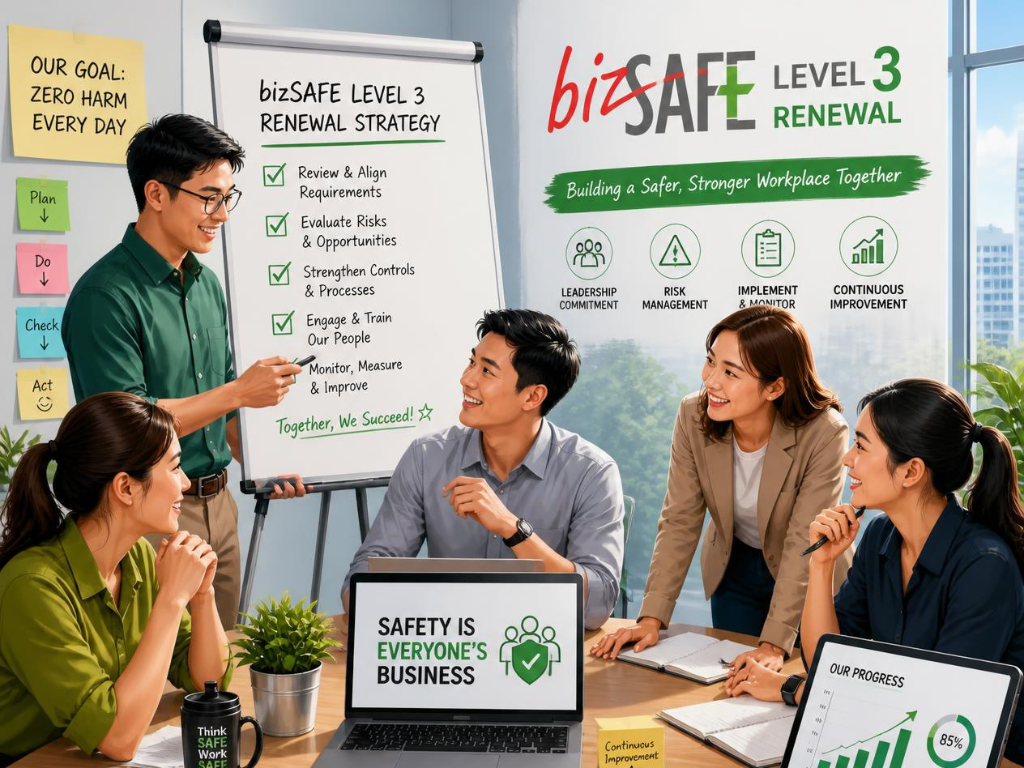
bizSAFE Level 3 renewal in Singapore runs on a 3-year certificate, and the WSH Council asks for the renewal application two months before expiry. Working backwards from that deadline through findings closure and audit scheduling puts the real start line at six months. This blog walks you through the countdown, starting with the Level 2 risk management course whose certificate you still need at renewal.
When does your bizSAFE Level 3 certificate actually expire?
Three years from the date of approval, not the date of your audit and not the date you applied. The WSH Council publishes the validity of every bizSAFE level, and Level 3, Level 4 and STAR all run on 3 years while Levels 1 and 2 sit at 6 months and cannot be renewed.
Two clocks run at once and companies mix them up. The audit report cover page states that the report is valid for 3 years from the date of audit. Your certificate runs 3 years from the date the Council approved the application. Those dates sit weeks or months apart, because the audit happens first, findings get closed, the report is issued, you apply, and processing takes 10 working days.
Check the expiry date on the e-certificate itself rather than counting from memory. The Council also runs a bizSAFE Self-Help service where you can confirm your level, status and expiry date, and the listing refreshes every two weeks.
The date that governs your renewal deadline is the certificate expiry date. Everything in this article counts backwards from it.
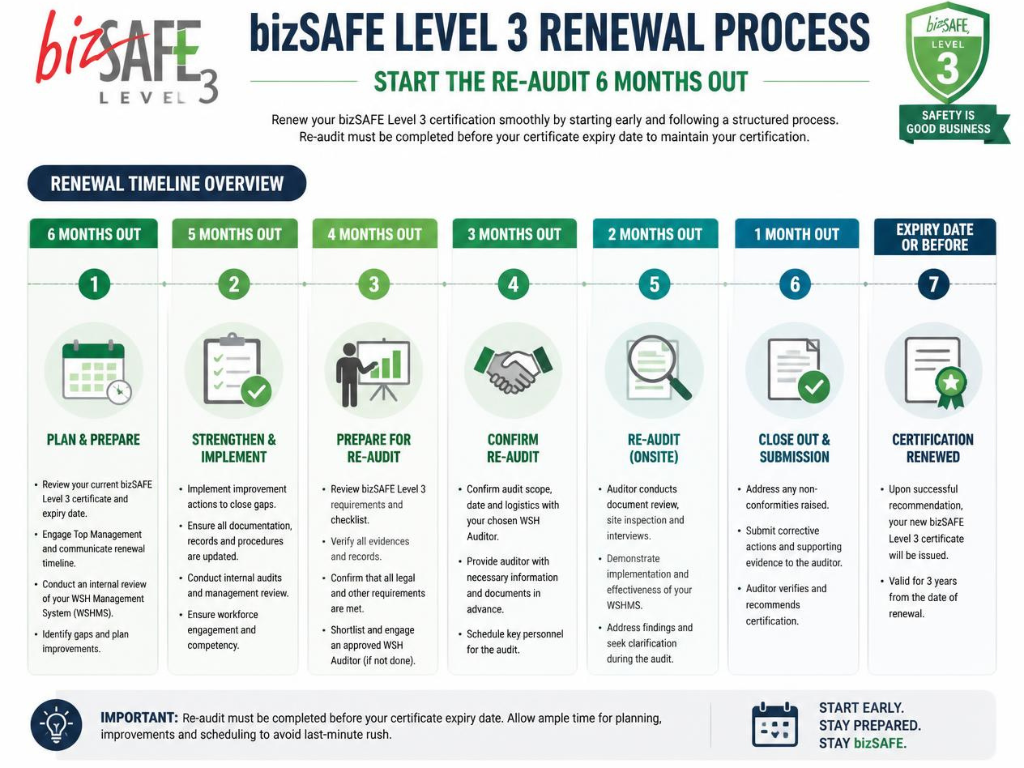
When should you start the renewal, counting backwards?
Six months before the certificate expiry date. The two-month figure the WSH Council publishes is the application deadline, not the project start, and treating it as a start date is the single most common renewal failure.
Count the chain backwards. The Council wants the renewal application submitted two months before expiry, then takes 10 working days to process. Before you can submit, every audit finding must be closed. The bizSAFE Level 3 Risk Management audit report template carries an instruction on its cover page in capital letters: “Do NOT submit the bizSAFE application until all findings are closed.” Closing findings that involve physical controls takes weeks, not days.
Before findings closure comes the audit itself, and before that comes booking an Auditing Organisation from a pool of 39 accredited firms. Before that comes refreshing the documentation the renewal-specific audit questions will test.
A workable reverse timeline looks like this. Month 30 of 36: refresh the risk register and pull together the review records. Month 32: book the Auditing Organisation. Month 33: audit. Month 33 to 34: close findings. Month 34: submit. Month 36: certificate would have expired, and you are already renewed.
In practice, companies that start at month 34 renew late and companies that start at month 30 renew comfortably. There is no prize for finishing at the wire, and a lapsed certificate is not a paperwork problem.
What documents does a bizSAFE Level 3 renewal actually need?
Three, and only one of them is the audit report. The WSH Council’s supporting documents list, last updated December 2025, requires a Top Executive WSH Programme completion certificate, a WSQ Statement of Attainment for risk management, and a Risk Management Implementation Audit Report from an accredited Auditing Organisation.
The first is a Certificate of Completion for the Top Executive WSH Programme issued in the attendee’s name, or a Certificate of Attendance for the older Workshop for CEOs and Top Management if it was issued before 31 March 2024. Certificates from the old workshop remain acceptable, which matters if your CEO attended years ago.
The second is a WSQ Statement of Attainment for Develop a Risk Management Implementation Plan or WSH Control Measures, under course code MF-COM-402E-1 or WPH-WSH-4075-1.1, issued in the attendee’s name.
The third is the audit report, issued in the company’s name rather than an individual’s.
Worth noting: two of the three are tied to named people and one is tied to your company. That split creates a renewal risk most companies discover at month 34.
What does the renewal audit check that a first-time audit does not?
Five extra questions in Section 5 of the checklist, all about whether your Risk Management system stayed alive between audits. A first-time applicant answers Question 5.1 only, on whether a review procedure exists. Renewals answer 5.2 through 5.6.
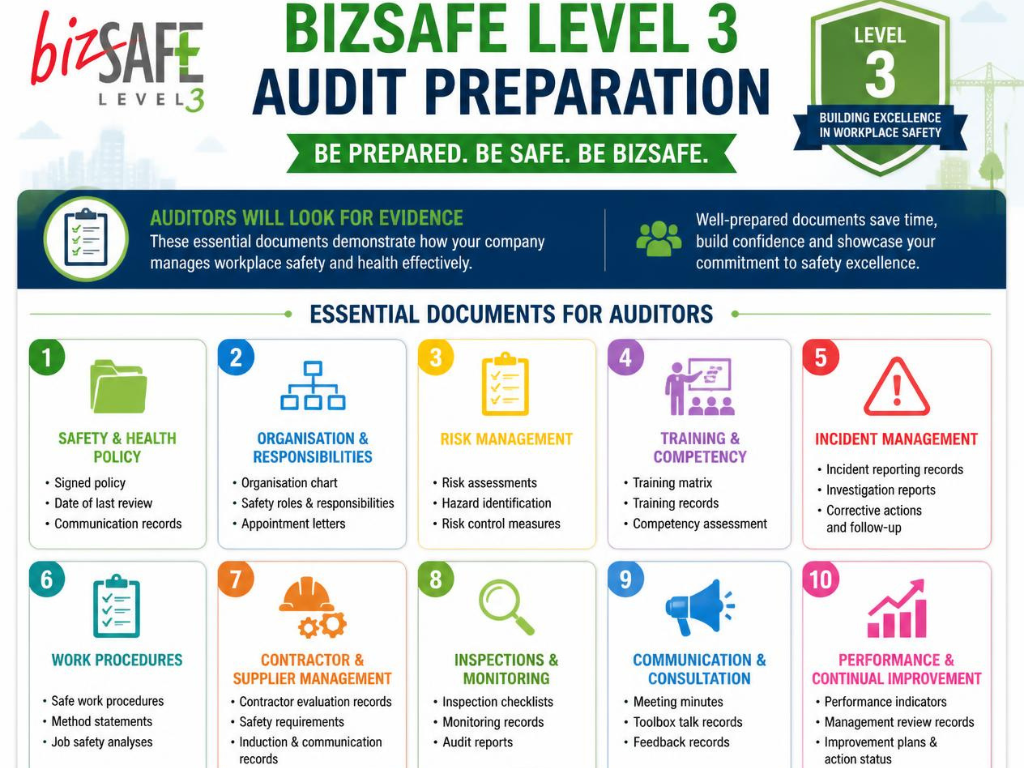
The auditor asks for meeting minutes or correspondence showing risk assessments were reviewed and approved within the last three years. Evidence that risk assessments were revised after any bodily injury caused by exposure to a workplace hazard, checked against your accident, incident, near miss and dangerous occurrence records. A record of at least one significant change in work practices or procedures with the corresponding risk assessment revision. Evidence of where you source new WSH information and its effect on at least one risk assessment. Communication and consultation records showing changes reached different groups across the organisation.
None of these can be produced retrospectively in a convincing way. Meeting minutes dated last month covering three years of reviews read exactly like what they are. Understanding the audit document expectations that carry across both new and renewal audits helps, but Section 5 is the part that separates a maintained system from a revived one.
The current checklist is Revision V3.3, in force from 1 July 2026, carrying 28 main audit questions and 5 Audit Highlights.
What happens if your risk assessments no longer match the work?
The auditor finds it on the walkthrough, and it becomes a finding that blocks your submission. Three years is long enough for equipment, chemicals, subcontractors and site locations to change while the risk register stays frozen at the last audit date.
This is the most common renewal failure and it has a predictable shape. A company replaces a forklift with a different model, adds a new client site, switches to a different cleaning chemical, or takes on a work activity that was not in the inventory three years ago. The documentation never caught up. Question 2.2 has the auditor walk the worksite and validate the inventory of work activities against what is actually happening, and knowing how HIRADC gets reviewed in normal operations is what keeps the two in step.
Question 5.4 then asks directly for a record of at least one significant change in work practices with the corresponding revision. A company that genuinely changed nothing in three years is unusual, and an auditor reading that answer will look harder, not less hard.
The fix is a scheduled review rather than a pre-audit scramble. Refreshing the RM plan annually keeps the register close to the work, and the checklist itself notes that where practicable, risk assessments should be reviewed annually rather than at the three-year limit.
What if your Risk Management Champion has left the company?
You need a current employee holding a valid WSQ Statement of Attainment for risk management before you can renew. The Statement of Attainment is issued in the attendee’s name, so it walks out of the building when they do.
Three years covers a lot of staff turnover. The supervisor or team leader who attended the two-day course in 2023 has a reasonable chance of having moved on by 2026, and the certificate sitting in your bizSAFE folder belongs to them. The same applies to the Top Executive WSH Programme certificate if your CEO or board director changed.
The audit compounds it. Question 2.1 asks whether the appointed Risk Management team leaders are competent to carry out risk assessment, and competency is proven by that Statement of Attainment. Question 3.11 requires completed risk assessments to be approved by the manager of the work activity. An RM team that exists only on a three-year-old appointment letter fails both.
The cleaner approach is to train two people rather than one, and to check the roster at month 30 rather than month 34. Replacing your RM Champion at short notice means finding a course seat, completing 16 hours of classroom training, and passing both written and case study components at 100% competency, which is not a two-week job.
What happens if your bizSAFE Level 3 lapses?
The certificate stops being valid and your company drops off the bizSAFE listing. There is no grace period and no retroactive renewal. You reapply, and the application is treated on its merits with a current audit report.
The commercial consequences arrive faster than the regulatory ones. Main contractors check bizSAFE status through the Council’s Self-Help service before awarding subcontracts. Public sector procurement uses Level 3 as a prequalification filter. A lapse discovered during a tender window costs you the tender, and the tender does not wait 10 working days for your processing to finish.
The bizSAFE logo is a registered trademark and only enterprises holding current status may use it on collateral. A lapsed company still carrying the logo on quotations and name cards has a second problem on top of the first.
Around 43,000 companies hold bizSAFE recognition. Falling out of that list is visible, because the Council updates its listing every two weeks.
Does a lapse affect your NEA cleaning licence or licensed operations?
Directly, for licensed cleaning businesses. NEA’s requirements for renewal of a Cleaning Business Licence include being certified with at least a valid bizSAFE Level 3 for both Class 1 and Class 2 licences.
The thresholds sit alongside it. A Class 2 Cleaning Business Licence requires paid-up capital of at least $25,000 plus valid bizSAFE Level 3. A Class 1 licence requires paid-up capital of at least $250,000 plus valid bizSAFE Level 3, plus no court conviction in the last two years under the Environmental Public Health Act 1987, the Employment Act 1968, the Employment of Foreign Manpower Act 1990, the Workplace Safety and Health Act 2006 or the Central Provident Fund Act 1953.
The route out has narrowed. Only licences issued before 1 January 2024 can renew into a Class 3 licence, which carries no bizSAFE requirement. Any cleaning business holding a licence issued from 1 January 2024 onwards must renew into Class 1 or Class 2, and both need Level 3.
For a licensed cleaning business, the bizSAFE clock and the licence clock are the same clock. Align them deliberately, because a bizSAFE lapse in that sector is a licensing condition problem rather than a marketing one.
Why do some Level 3 certificates expire earlier than three years?
Because they were granted through an alternative entry route, and those certificates track the external certification instead of a fixed 3-year term. The WSH Council’s supporting documents list sets the validity for these as aligned to the external certificate expiry date.
Three alternative routes give direct entry to bizSAFE Level 3. A Singapore List of Trade Sub-Contractors membership certificate together with a Safety and Green Management Assessment Scheme audit certificate. A Joint Commission International certificate, for healthcare institutions. A Responsible Care Award Winner Letter from the Singapore Chemical Industry Council.
A company that entered Level 3 through SLOTS and SgMA has a bizSAFE expiry pinned to its SgMA certificate. If that certificate has 14 months left, so does the bizSAFE status, regardless of when the bizSAFE approval was issued. The Council’s validity table carries this as a footnote reading three years or upon expiry of the relevant external certification, whichever is earlier.
Check which route your company used before you plan a 36-month countdown. Companies in construction subcontracting and the chemical sector are the ones most likely to be on the shorter clock without knowing it.
Can your bizSAFE status be suspended before it expires?
Yes. Placement on MOM’s Business Under Surveillance programme suspends your bizSAFE status immediately, removes your company from the bizSAFE Marketplace listing, and bars use of the bizSAFE logo on any collateral.
Reinstatement is not automatic once you exit the programme. The WSH Council requires two documents: the Exit Notification letter issued by MOM, and a current Risk Management audit report from an Auditing Organisation registered with MOM to provide WSH auditing services. That means a fresh audit and a fresh audit fee, on a timetable you do not control.
Suspension is worth naming here because it changes how you should think about the three-year gap. A company that treats bizSAFE as a document produced every 36 months is exactly the company whose WSH performance drifts far enough to attract surveillance. Speaking at the National WSH Campaign launch on 15 May 2026, WSH Council Chairman Abu Bakar Mohd Nor said companies must “go beyond systems and processes.” Renewal is the test of whether yours did.
Singapore recorded 36 workplace fatalities in 2025 at a rate of 0.96 per 100,000 workers, the lowest on record, and MOM has been explicit that sustaining that depends on continued vigilance rather than periodic paperwork.
How long does the WSH Council take to process a renewal?
10 working days from the date of submission. The e-certificate and logo are emailed to your company’s senior management representative, and the bizSAFE Self-Help listing updates every two weeks after that.
Two things extend it. Auxiliary Enforcement Officers conduct random onsite verification inspections of Risk Management audits as part of the application process, checking whether the Auditing Organisation followed the checklist and audited stringently. An unsatisfactory verification means re-conducting the audit, and the Council states plainly that processing then exceeds 10 working days.
The second is your own submission quality. Applications are tagged to your UEN, and the Council advises companies to submit the application themselves rather than delegating it to a consultant. Handing that step to a third party during a renewal window removes your visibility at exactly the point where a delay costs you a tender.
Build the 10 working days into the countdown as a fixed cost, then add contingency for verification. That is why the application deadline sits two months before expiry rather than two weeks. Engaging risk management support services early in the cycle rather than during the final month is what makes the timeline hold.
Treat the renewal as a three-year habit
The renewal audit does not test whether you can assemble a folder. It tests whether risk assessments were reviewed, revised after incidents, updated when work changed, and communicated to the people doing the work, across three years you have already spent. Section 5 exists to catch systems that were revived rather than maintained. Start at month 30, keep two trained people on the roster, review the register annually, and the audit becomes confirmation rather than discovery.
Book a renewal readiness check with Advanced Safe Consultants to have your risk register, review records and RM team competency tested against the current checklist before you approach an Auditing Organisation.
FAQs About BizSAFE Level 3 Renewal Singapore
Can I renew my bizSAFE Level 3 after it has already expired?
No. bizSAFE Level 3 has no grace period and no retroactive renewal. Once the certificate lapses you submit a fresh bizSAFE Enterprise application supported by a current Risk Management audit report, and your company stays off the WSH Council listing until the new application is approved.
Do I need to retake the bizSAFE Level 2 course to renew Level 3?
Only if no current employee holds a valid WSQ Statement of Attainment for Develop a Risk Management Implementation Plan or WSH Control Measures. The Statement of Attainment is issued in the attendee’s name under course code MF-COM-402E-1 or WPH-WSH-4075-1.1, so staff turnover, not time, is what forces a retake.
Can I renew my bizSAFE Level 3 earlier than two months before expiry?
Yes, and there is no penalty for doing so. The WSH Council states that renewal applications should be submitted two months before expiry, which is a minimum lead time rather than a window. Submitting at month 33 or 34 leaves room for verification inspections without risking a lapse.
Does the July 2026 audit checklist apply to my renewal?
Yes, if your audit takes place from 1 July 2026. Revision V3.3 of the bizSAFE Level 3 Risk Management Audit Checklist took effect that date, carrying 28 main audit questions and 5 Audit Highlights including speed limiter verification for vehicle fleets. Ask your Auditing Organisation which revision it is auditing against.
What happens to my bizSAFE renewal if my company changes its UEN?
Renewal is not available. bizSAFE applications are tagged to the Unique Entity Number and the WSH Council cannot transfer records to a new UEN, so a restructure or re-incorporation means submitting a new bizSAFE Enterprise application with a fresh Risk Management audit report rather than a renewal.