- 26 Aug 2026
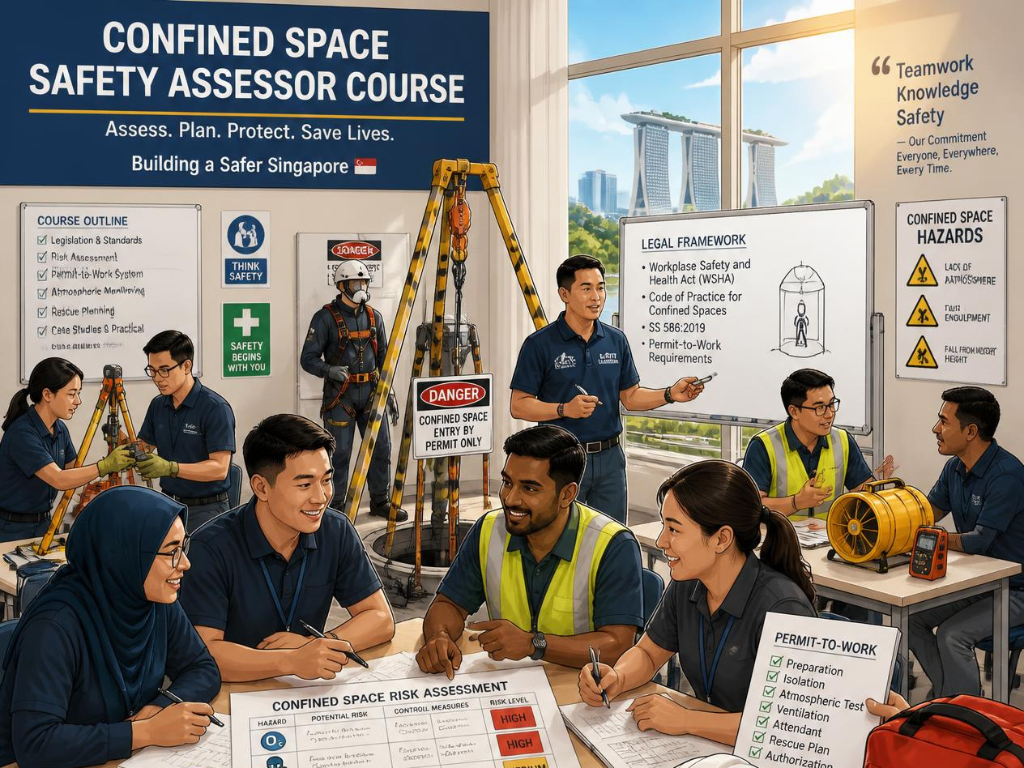
Search interest in the confined space safety assessor course Singapore employers rely on stays high, but the appointment itself carries the legal weight. MOM logged 36 workplace fatalities in 2025, a record-low 0.96 per 100,000 workers. Confined spaces still kill rescuers alongside entrants. This blog walks you through the role, the law behind it, and where appointments break down, drawn from WSH consultancy and training work on Singapore worksites.
What is a confined space safety assessor under Singapore law?
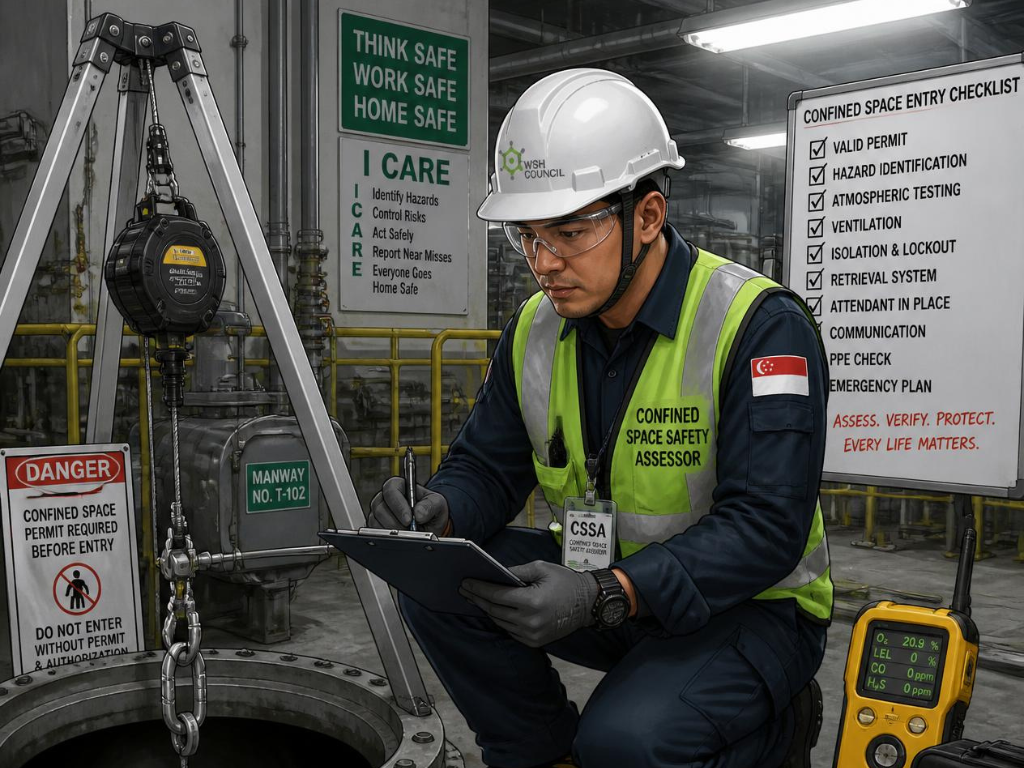
A confined space safety assessor is a competent person appointed under Regulation 9(b) of Singapore’s Workplace Safety and Health (Confined Spaces) Regulations 2009. The assessor tests the atmosphere before entry, records the readings on the entry permit, and endorses or refuses the application. The employer or principal directing the work makes the appointment.
The Regulations came into operation on 1 November 2009 and define a confined space as any chamber, tank, manhole, vat, silo, pit, pipe or flue where dangerous gases may accumulate, air supply is inadequate, or engulfment by material is possible. Regulation 2 sets the atmospheric thresholds the assessor works to: oxygen between 19.5% and 23.5% by volume, flammable gas below 10% of its lower explosive limit, and toxic substances at or under the permissible exposure levels listed in the First Schedule to the WSH (General Provisions) Regulations.
Worth noting: the same regulation defines a competent person simply as someone with “sufficient experience and training to perform the work required.” That phrasing does more work than most employers realise, and section seven of this article returns to it.
The assessor is one of four named roles in the permit chain. The other three are the responsible person, the authorised manager, and the confined space attendant.
Who needs the CSSA course, and who actually needs the appointment?
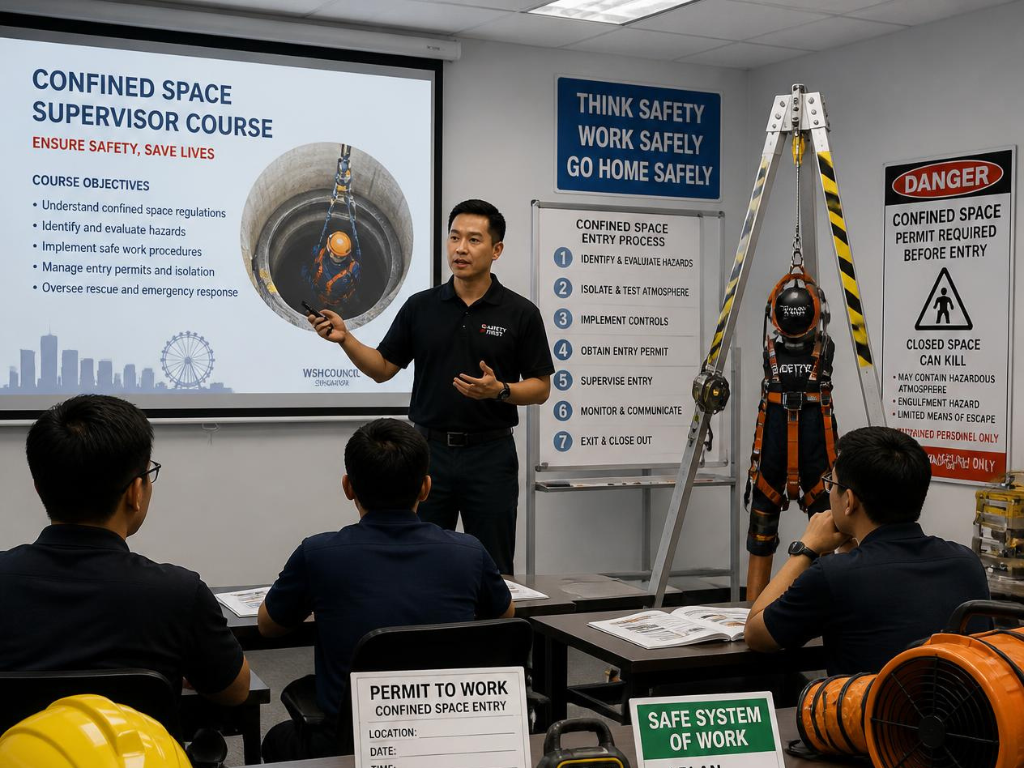
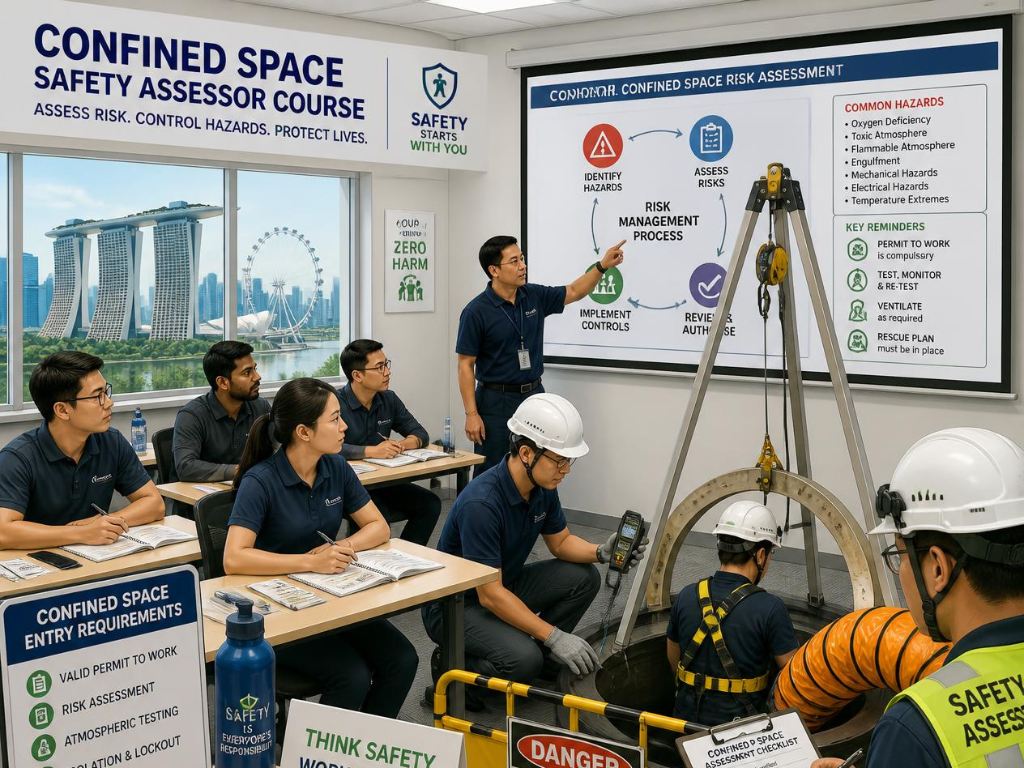
Two different groups. The people who take the WSQ “Assess Confined Space for Safe Entry and Work” course are usually WSH coordinators, WSH officers, occupational hygiene technicians, and safety auditors. The people who need the appointment are whoever your site puts in front of a manhole at 7am with a gas detector.
Any workplace that opens tanks, sewers, silos, boilers, pipelines, ship compartments or underground vaults needs an appointed assessor before entry. Marine, chemical, water treatment, construction and facilities management carry the heaviest exposure in Singapore. A shipyard running twelve tank entries a shift needs assessor coverage across every one of them, not a single certificate holder in the head office.
In practice, the mismatch shows up in small contractors. A firm sends one supervisor on the CSSA course, then treats that certificate as blanket compliance for a crew working three sites at once. Regulation 9 requires an appointed assessor for the confined space, not for the company. One trained person cannot be physically present to test four spaces on four sites, and an untested space with a signed permit is a paper trail, not a control.
Training providers accredited by SkillsFuture Singapore deliver the course under competency code OH-CB-506E-1, catalogued as Confined Space Management (TSC code WPH-WSH-5059-1.1).
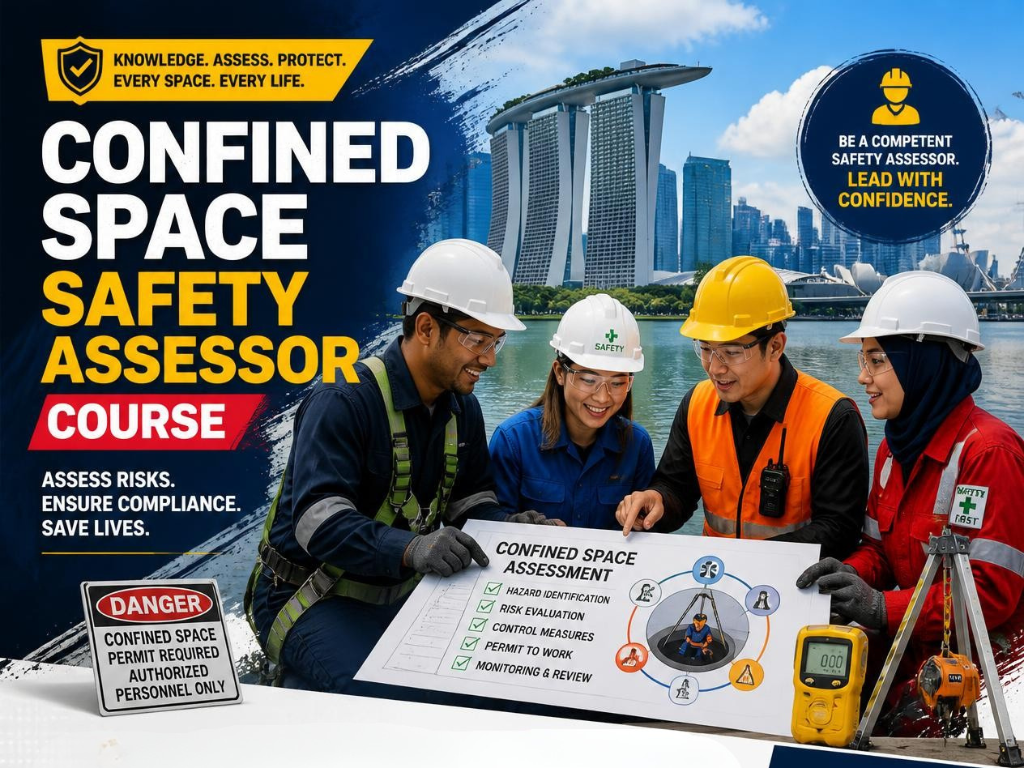
What does the confined space safety assessor do before anyone goes in?
The assessor receives the permit application and tests the atmosphere. Regulation 11 requires the supervisor of the entering worker to make the application, address it to the authorised manager, and submit it to the confined space safety assessor. Nothing happens until that test is done.
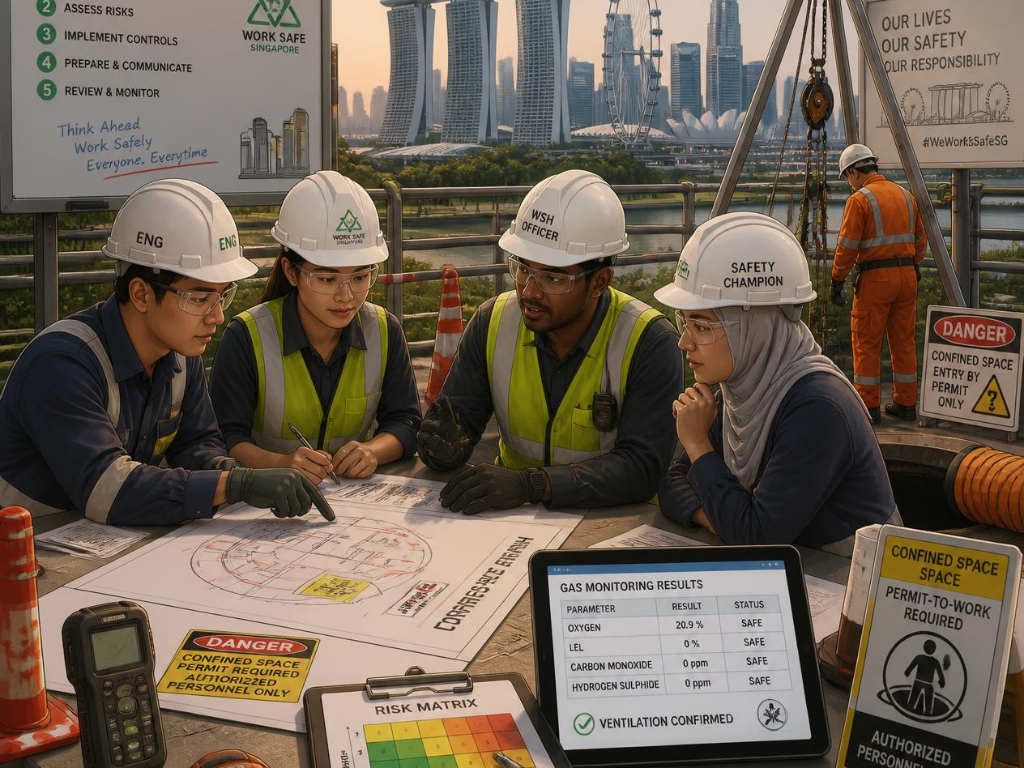
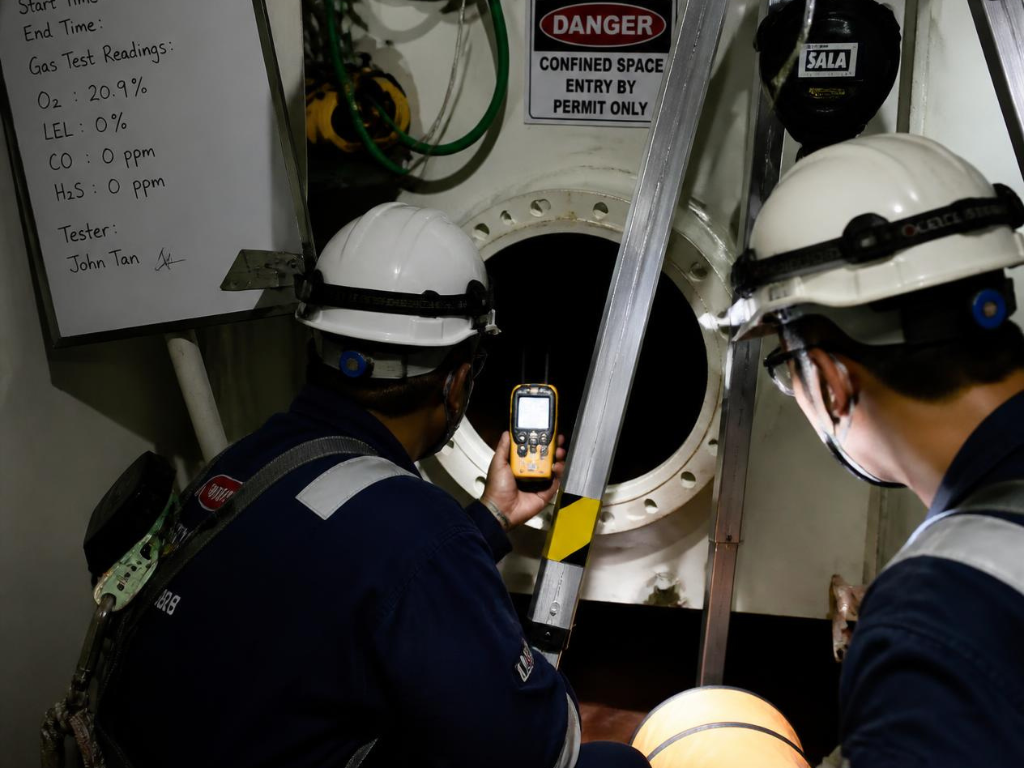
Regulation 12(1) is unambiguous: on receipt of the application, the assessor tests the atmosphere prior to entry by any person. The assessor must use a suitable and properly calibrated instrument, conduct the test without endangering himself or others, and record the results in the entry permit itself.
This sits downstream of work your safety team should already have done. Regulation 5 of the Confined Spaces Regulations ties entry to a risk assessment conducted under the WSH (Risk Management) Regulations, which means the space should already appear in your hazard identification and risk assessment records with its hazards and controls documented. Companies working through risk management plan training at bizSAFE Level 2 usually catch confined spaces at the register stage.
The ventilation check matters here too. Regulation 8 requires adequate and effective ventilation drawn from a contaminant-free source and directed to where the worker will be. An assessor testing a space that has not been purged is measuring a number that will change the moment work starts.
Why the assessor endorses the permit but never issues it
This is the single most misreported point in Singapore confined space content, and several ranking pages state it backwards. The assessor endorses. The authorised manager issues.
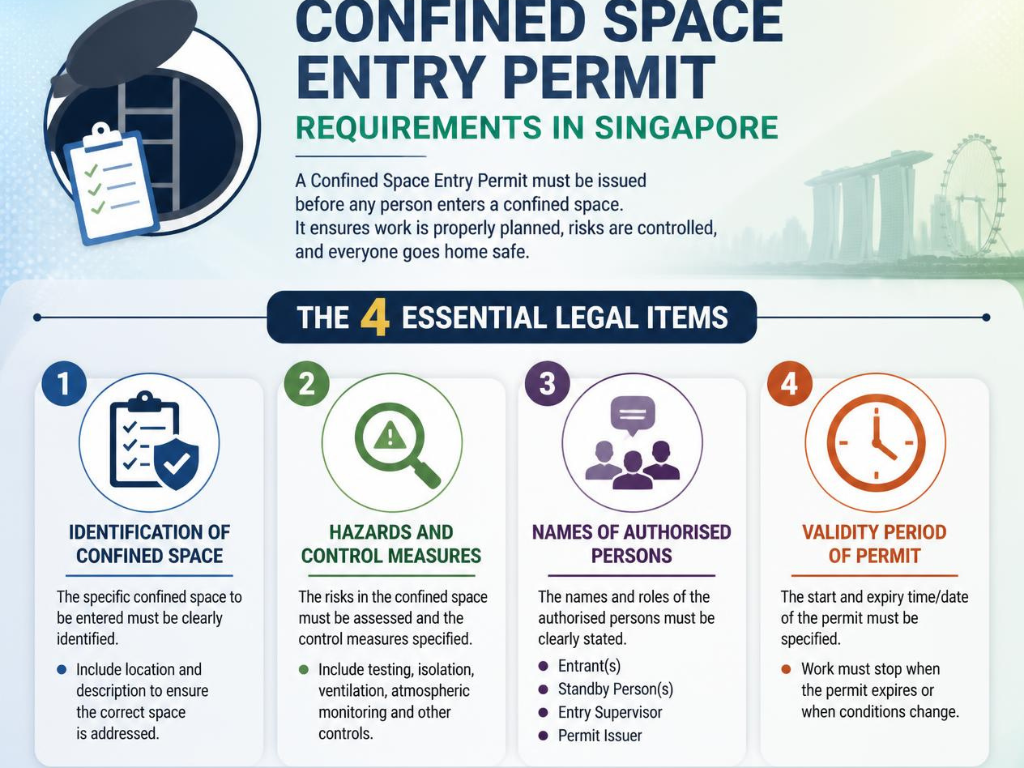
Regulation 12(3) sets it out: if the assessor is satisfied that entry can be carried out with due regard to safety and health, he endorses the application and forwards it to the authorised manager. Regulation 13(1) then gives the authorised manager the power to issue the permit, but only after satisfying himself on six separate conditions, including oxygen within range, flammable gas below 10% LEL, toxic substances under PEL, adequate ventilation, effective steps against ingress of dangerous substances, and all reasonably practicable safety measures.
Both roles carry an independent due diligence duty. Regulation 12(4) requires the assessor to “exercise all due diligence” on testing, evaluation and endorsement. Regulation 13(3) imposes the same on the authorised manager for issuance.
The Workplace Safety and Health Council’s guidance on working safely in confined spaces confirms the design: a compliant entry permit carries the names and signatures of the supervisor, the confined space safety assessor, and the authorised manager. Three people. Three sign-offs.
Where this breaks down is on sites that let one person wear two hats. The two-signature structure exists as a check. Collapse it and the check is gone, whatever the paperwork says.
What gas tests does the assessor run, and why is the order fixed?
Three tests, in a legally specified sequence. Regulation 12(2)(b) requires the assessor to test for oxygen content first, flammable gas or vapour second, and concentration of toxic gas or vapour third where applicable.
The order is not administrative preference. Catalytic bead sensors, still the most common technology for combustible gas detection, oxidise the sample gas across a heated element and need sufficient oxygen to produce a reading. Test for flammable gas in an oxygen-deficient tank and the instrument can under-report, or read clean in an atmosphere that is anything but. Oxygen goes first because every reading after it depends on knowing that number.
Calibration is the other half of the duty. Regulation 12(2)(a) requires a suitable and properly calibrated instrument, and an assessor who endorses a permit on the strength of a detector that last saw a bump test three months ago has not exercised due diligence in any meaningful sense.
MOM’s written answer to Parliament on 2 July 2024, responding to a question on the Choa Chu Kang Waterworks incident, described the required control as “gas tests conducted by a competent assessor,” pointing employers to Approved Code of Practice SS 568 and the WSH Council’s Technical Advisory for detailed guidance.
How long does the assessor’s duty run after workers go in?
It does not end at the hatch. Regulation 16(1)(a) places a continuing duty on the responsible person to ensure the atmosphere is tested by the confined space safety assessor at such intervals as are necessary to evaluate the safety and health of the person working inside.
Two more requirements sit alongside it. Where two or more people are in the space, Regulation 16(1)(b) requires at least one of them to continuously monitor the atmosphere with a suitable gas detector. And if a hazardous atmosphere is detected by either the periodic tests or the continuous monitoring, Regulation 16(1)(c) triggers three mandatory steps: everyone vacates immediately, an evaluation determines how the hazardous atmosphere developed, and nobody re-enters until the authorised manager issues a new permit. The original permit is dead at that point.
Records follow. Regulation 16(2) makes the assessor responsible for recording every test result, and Regulation 16(3) requires the responsible person to keep those records for not less than two years.
Permits also expire on their own terms. Regulation 13(4) requires a fresh application under Regulation 11 if the work is not completed within the permit’s validity period, and Regulation 18(1) obliges the authorised manager to review the need for entry daily and revoke where he thinks fit. Confined space entry sits at the sharp end of Singapore’s high-risk workplace hazards precisely because conditions change while people are inside.
What are the entry requirements for the CSSA course in Singapore?
Accredited providers set a two-part bar. Learners typically need a WSH qualification at Certificate level, satisfied by completing one of SCW, SMW, SWCSO, SWSHPP, SSSC, BCSS or BISH, plus two to three years of relevant working experience in safety operations and coordination. Literacy and numeracy prerequisites usually sit at WSQ Workplace Literacy and Numeracy Level 6, or a C6 grade at GCE ‘O’ Level in English, Mathematics and Science. Assessment commonly demands 70% in theory and 100% in the practical component. Exact thresholds vary by provider, so confirm against the specific training organisation before enrolling anyone.
Now the point most course pages leave out. Regulation 9(b) does not require a certificate. It requires the responsible person to appoint someone “whom the responsible person reasonably believes is competent to carry out the duties of a confined space safety assessor.” Read with the Regulation 2 definition of competent person, the legal test is sufficient experience and training. Not training alone.
The practical consequence lands on the employer. Appointing a fresh certificate holder with no tank experience to assess a hydrocarbon vessel is a defensible-looking decision that would struggle under investigation, because the belief in competence has to be reasonable against the actual space. The course is strong evidence of competence. It is not a substitute for it, and treating it as one transfers risk to nobody.
What happens when an employer appoints an assessor who isn’t competent?
Regulation 24 sets four penalty tiers, and most published summaries flatten them into one number. General contraventions expose an individual to a fine not exceeding $20,000, imprisonment not exceeding two years, or both, and any other person to a fine not exceeding $20,000.
Contravention of Regulation 9 or Regulation 10(1), meaning a failure to appoint the required roles or allowing entry without evaluation and a permit, carries a fine not exceeding $20,000. Breaches of Regulation 20 or 22(2), covering identification badges and attendant duties, attract up to $1,000, rising to $5,000 on a second or subsequent conviction. Failures under Regulation 23(2) by the competent person examining rescue equipment draw up to $2,000, and $5,000 on repeat.
Rescue provisions carry their own weight. Regulation 23(1) requires a written rescue plan, appointed rescuers trained in first aid and PPE use, and breathing apparatus, harnesses, ropes and reviving apparatus kept available, properly maintained, and thoroughly examined by a competent person at least once every month.
Fines are the visible cost. The operational cost is a Stop-Work Order and an MOM investigation that reaches every entry your appointed assessor endorsed. Firms with a practical risk register and dated appointment letters survive that scrutiny. Firms relying on a certificate photocopy in a drawer do not.
Should you train an in-house assessor or bring one in?
Train in-house when confined space entry is routine and predictable. Bring in an appointed assessor when entry is periodic, high-consequence, or outside your team’s real experience.
The maths is straightforward. A facility opening the same three sumps weekly builds better competence internally than any external provider can deliver, because familiarity with the specific space is the thing Regulation 9(b) is actually asking about. A property manager who opens a water tank twice a year gets no such benefit, and the certificate quietly goes stale between entries while the legal duty stays live.
Mixed coverage is common and defensible. Keep a trained internal assessor for routine entries, and appoint an external assessor for shutdowns, first entries into unfamiliar vessels, and any space with a hydrocarbon or biological history. The cleaner approach for multi-site contractors is to map every confined space in the estate first, count actual entry frequency, then decide coverage against that number rather than against headcount.
Employers who want the appointment structure audited before the next shutdown can bring in WSH manpower and inspection support to review appointment letters, permit records, detector calibration logs and rescue plans against Regulations 9 through 23.
The appointment is the compliance, not the certificate
Singapore’s confined space framework hangs on one judgement: whether the person you appointed is genuinely competent for the space in front of them. Regulation 9(b) puts that judgement on the employer, and no training certificate moves it. The endorse-and-issue split, the fixed gas testing sequence, the two-year record retention and the monthly rescue equipment examination all exist to make that judgement auditable after the fact.
Book a WSH consultancy review of your confined space appointment records, permit chain and detector calibration logs before your next shutdown. Advanced Safe Consultants can audit the structure against Regulations 9 to 23 and tell you where it would fail an MOM inspection.
FAQs About Confined Space Safety Assessor Course Singapore
What’s the difference between a confined space safety assessor and a confined space attendant?
The assessor tests the atmosphere and endorses the entry permit under Regulation 12. The attendant is appointed under Regulation 22 and stays outside the space to monitor entrants, maintain regular contact, assist evacuation, and alert rescuers. Different appointments, different duties, and both are mandatory before entry.
Can one person be both the confined space safety assessor and the authorised manager?
Regulation 12(3) requires the assessor to forward the endorsed application to the authorised manager, and the WSH Council’s permit template calls for three separate signatures. The two roles are structured as independent checks. Combining them removes the verification the 2009 Regulations were built to create.
Does confined space assessor certification expire in Singapore?
The WSH (Confined Spaces) Regulations 2009 impose no expiry date on the qualification. The legal test under Regulation 9(b) is ongoing competence, which the employer must reasonably believe at the time of each appointment. Individual training providers and safety card schemes may apply their own renewal cycles.
What must happen if gas readings fail while workers are inside?
Regulation 16(1)(c) requires three actions. Everyone vacates the confined space immediately, an evaluation determines how the hazardous atmosphere developed, and no one re-enters until the authorised manager issues a new entry permit. The original permit cannot be reinstated after a hazardous atmosphere is detected.
How long must confined space gas test records be kept?
Two years minimum. Regulation 16(2) makes the confined space safety assessor responsible for recording every atmospheric test result, and Regulation 16(3) requires the responsible person to retain each record for not less than two years from the date it was made.