- 25 Jul 2026
Danger zone demarcation on Singapore construction sites means physically marking the area around operating plant and vehicles so unauthorised persons stay out. WSH Council made it control 2 of seven in its 12 June 2026 advisory, after a worker on banksman duties was struck in May 2026 while inside an excavator’s work zone. This blog walks you through how to set the zones, with traffic control training covering the people who work beside them.
What is danger zone demarcation on a construction site?
Danger zone demarcation is the marking of an exclusion area around operating equipment or a moving vehicle, bounded by everywhere that machine can reach. Inside the line, a person can be struck, crushed, or run over. Outside it, they cannot. The line exists to make that distinction physical rather than theoretical.
The concept is simple and the execution is where sites fail. A zone is not a warning. It is a space with nobody in it. WSH Council’s instruction in its June 2026 advisory is to clearly demarcate danger and exclusion zones around operating construction equipment so that unauthorised persons are kept out, with barriers used to physically separate work zones. Note the verb. Kept out, not warned. A demarcation that relies on a worker choosing to respect it has already conceded the point, and the fatalities behind the advisory all involved someone standing inside a zone that either did not exist or did not hold.
Does WSH Council require exclusion zones on Singapore sites?
Demarcation is control 2 of the seven WSH Council named in its advisory on protecting banksmen and traffic controllers, published 12 June 2026. The binding legal duty sits upstream, in the WSH (Risk Management) Regulations, which require employers to assess and control the risk. Demarcation is how you control this one.
The Council also treats separation as foundational elsewhere, directing sites to properly demarcate pedestrian walkways from vehicular roads as a standing employer duty. What the advisory adds is the machine-specific layer: zones around operating plant, not just walkways. The reason is in the incident record. Vehicular incidents were the leading cause of workplace deaths in 2025, 15 of 36 reported by MOM, and four banksmen and traffic controllers died between 2022 and 2025. Your traffic risk assessment is where each zone gets identified, because the assessment already names every point where a person and a machine can occupy the same ground.

How do you set an exclusion zone around an excavator?
Draw the zone around the machine’s full slew arc, not just the bucket end. An excavator’s counterweight swings through a circle as the cab rotates, and the rear of the machine is as lethal as the front. The zone is the whole circle the machine sweeps, plus the reach of whatever it is carrying.
The May 2026 incident is the case to brief your crew on. A construction worker carrying out banksman duties entered a work zone where an excavator was operating and was struck by a falling concrete slab. The hazard was not the tracks or the bucket. It was the load in the air and the fact that a person was underneath the machine’s working envelope at all. Two rules follow. The zone extends to everything the machine can drop, swing, or reach, which for a slewing excavator handling material is considerably larger than the machine’s footprint. And nobody enters it while the machine is live, including the person directing it. WSH Council’s line on this leaves no room: banksmen and traffic controllers should not be entering a demarcated danger zone.
How do you demarcate a crane or lifting zone?
For lifting operations, the zone is the load radius, and Singapore practice puts it in writing. WSH Council’s guidelines on lifting plan development include demarcation as a required element and call for a sketch of the zone of operation and layout plan as part of the plan itself.
That documentation requirement is the useful part, and it is the model the rest of the site should copy. A lifting plan does not just say “keep clear.” It draws the zone. Everything under a suspended load sits inside it, which means the zone travels as the load travels, and the ground crew’s position has to be planned around the arc rather than discovered during the lift. Where an excavator zone is a circle around a machine, a crane zone is a moving envelope beneath a load, and the demarcation has to account for the swing radius and the path the load takes between pick and set. The lift is planned, so the exclusion should be planned with it, on the same drawing.
How do you mark the zone around reversing vehicles?
The zone behind a reversing vehicle is the dead space the driver cannot see, and it should be barriered or coned off wherever the manoeuvre is repeated in the same place, such as a loading bay or a delivery point. Where the manoeuvre is one-off, the zone is enforced by a banksman positioned outside it.
Reversing is the pattern that keeps recurring, which is why why vehicles top the fatality list reads like a list of people standing behind trucks. Fixed reversing points deserve fixed demarcation, because a bay that a lorry backs into forty times a week is a permanent hazard dressed as a temporary one. The banksman controls the zone from the side, never from within it, maintaining visual contact with the driver and using the standard signal set to stop the vehicle the instant anyone crosses the line. The zone and the signaller work as a pair. One defines the danger space, the other keeps it empty.
What should you demarcate with: barriers, paint, or signage?
Physical barriers, wherever the site allows it. Paint and signage indicate a zone; barriers enforce one. The difference decides whether a distracted worker walks into a slew arc or bumps into something first.
I will state this plainly because the industry hedges on it. A painted line is a request. A hard barrier is a control. WSH Council’s advisory specifies that barriers may be put in place to physically separate different work zones, and its machinery guidance carries a related warning worth pinning to the wall: “Machines with moving parts should be located a safe distance from any fixed structure.” That is the crush hazard, and it is not hypothetical. One of the fatalities behind the advisory involved a worker guiding a bus who was crushed against a pillar when the driver moved forward. Paint would not have saved him. Sequence the layers in this order: barrier first, then floor markings and signage to reinforce what the barrier already enforces, then high-visibility gear as the last line. Signage without a barrier is a zone that exists only in the mind of whoever read the sign, and the WSH machinery guidelines treat physical separation as the real measure.
Why do exclusion zones fail, and who enforces them?
Zones fail for four reasons: the zone was never physically enforced, the banksman stood inside it, the zone did not move when the machine did, or nobody had authority to stop work when it was breached. The employer carries the duty to fix all four.
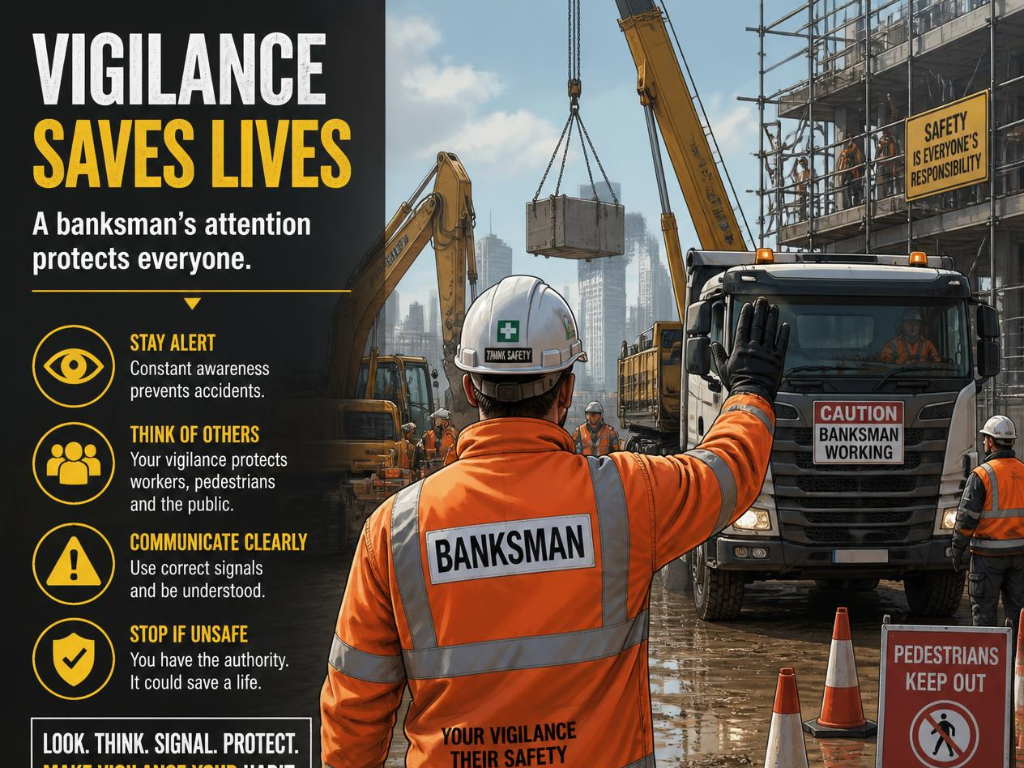
The banksman inside the zone is the failure that keeps killing people, and it deserves naming rather than softening. The person directing the machine is the one most likely to drift into its arc, because his attention is on the operator and the manoeuvre rather than on his own feet. Training him to hold a position clear of the movement zone while maintaining visual contact is the entire point of banksman safety certification, a half-day course at $120 with a certificate valid for 4 years. Mobility is the second failure: a zone chalked around an excavator on Monday means nothing when the machine tracks twenty metres on Tuesday, so the zone moves with the plant or it is not a zone. Give every crew member stop authority, because a barrier nobody will speak up about is only as strong as the person who saw the breach. To get the zones right around your active plant, map your site’s exclusion zones against the machines actually running this phase.
A zone is a space with nobody in it
Danger zone demarcation works when the line is physical, the zone covers everything the machine can reach, and it moves when the machine moves. WSH Council put demarcation second among its seven controls because it removes the person from the danger rather than protecting them inside it. The excavator’s slew arc, the crane’s load path, and the space behind a reversing lorry are all the same hazard wearing different equipment.
Walk your site this week, mark the full operating envelope of every live machine with hard barriers, and confirm that not one of your banksmen has to stand inside a line to do the job.
FAQs About Danger Zone Demarcation Construction Singapore
What buffer distance should a construction exclusion zone use?
There is no single universal figure in Singapore guidance. The zone is set by the machine’s operating envelope, meaning the full slew arc for an excavator or the load radius for a crane, plus whatever your risk assessment and the equipment manufacturer’s manual specify. Treat any blanket metre figure quoted without a source as unreliable.
Can a banksman stand inside a demarcated danger zone?
No. WSH Council’s 12 June 2026 advisory states that banksmen and traffic controllers should not be entering a demarcated danger or exclusion zone. The banksman positions clear of the machine’s movement zone while keeping visual contact with the operator, which is exactly what the Vehicle & Machinery Banksman Safety Course trains.
Is floor paint enough to mark an exclusion zone?
No, not on its own. Paint indicates a boundary; it does not enforce one. WSH Council’s advisory calls for barriers to physically separate work zones, and paint should reinforce a barrier rather than replace it. Use hard barriers around live plant, with markings and signage as the supporting layer.
Who is responsible for setting up exclusion zones on a construction site?
The employer and occupier carry the duty under the WSH (Risk Management) Regulations, which require them to assess and control the risks of the work. On multi-contractor sites the main contractor remains accountable for coordinating zones, even where subcontractors operate the plant creating the hazard.