- 28 Jul 2026
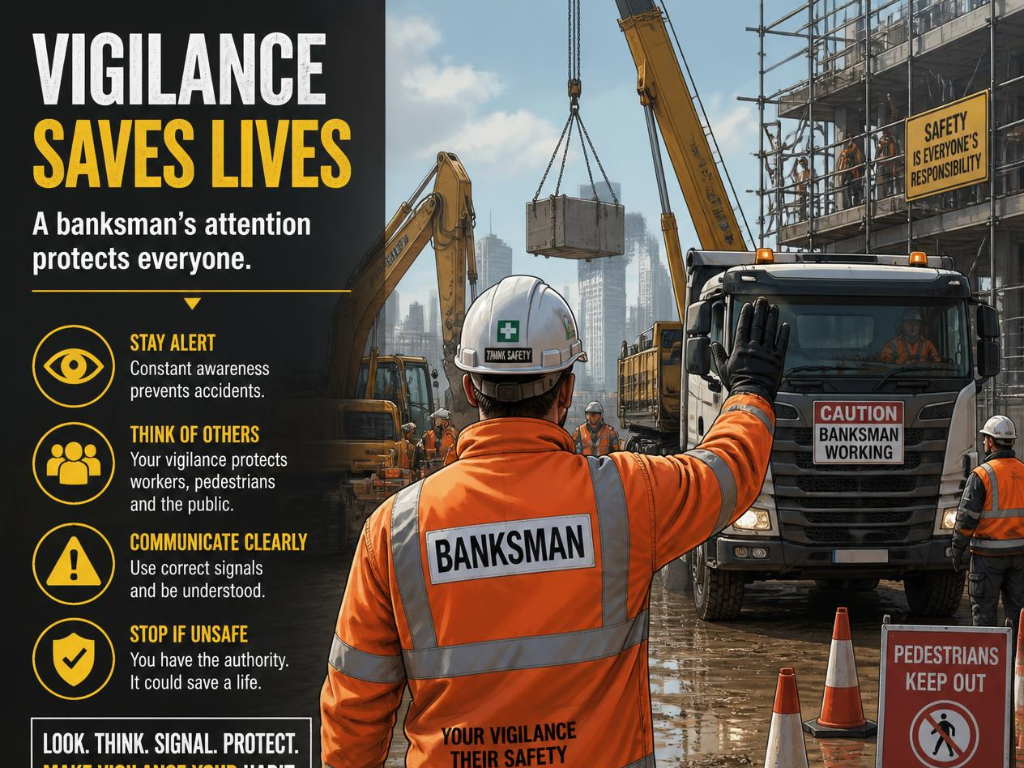
Banksman fatality lessons in Singapore come from a short, specific record: four workers killed between 2022 and 2025, plus a further incident in May 2026. WSH Council published all five in its 12 June 2026 advisory. This blog walks you through each case, the control that was missing, and how to check your own site, with traffic control training sitting behind every lesson.
What happened in the five incidents?
WSH Council’s advisory records four fatalities involving banksmen and traffic controllers between 2022 and 2025, plus a May 2026 incident. Each involved a worker directing or controlling vehicle movement who ended up inside the machine’s reach.
|
Date |
What happened |
Machine |
|
3 Aug 2022 |
A worker guiding a bus to reverse into position, standing beside a pillar, was crushed against it when the driver moved the bus forward to reposition |
Bus |
|
16 Aug 2022 |
A traffic controller at a company’s main gate was struck when he moved in front of a truck that suddenly moved forward |
Truck |
|
15 Sep 2023 |
A worker performing traffic control for expressway road works was struck when a motorcycle crashed into the work zone |
Motorcycle (public traffic) |
|
3 Mar 2025 |
A traffic control worker crossing a newly paved road behind a tire roller was struck when it suddenly reversed |
Tire roller |
|
14 May 2026 |
A construction worker on banksman duties entered a work zone where an excavator was operating and was struck by a falling concrete slab |
Excavator |
These are not obscure edge cases. They are the ordinary manoeuvres of an ordinary site, and they killed the people whose job was to make those manoeuvres safe.
What pattern connects them?
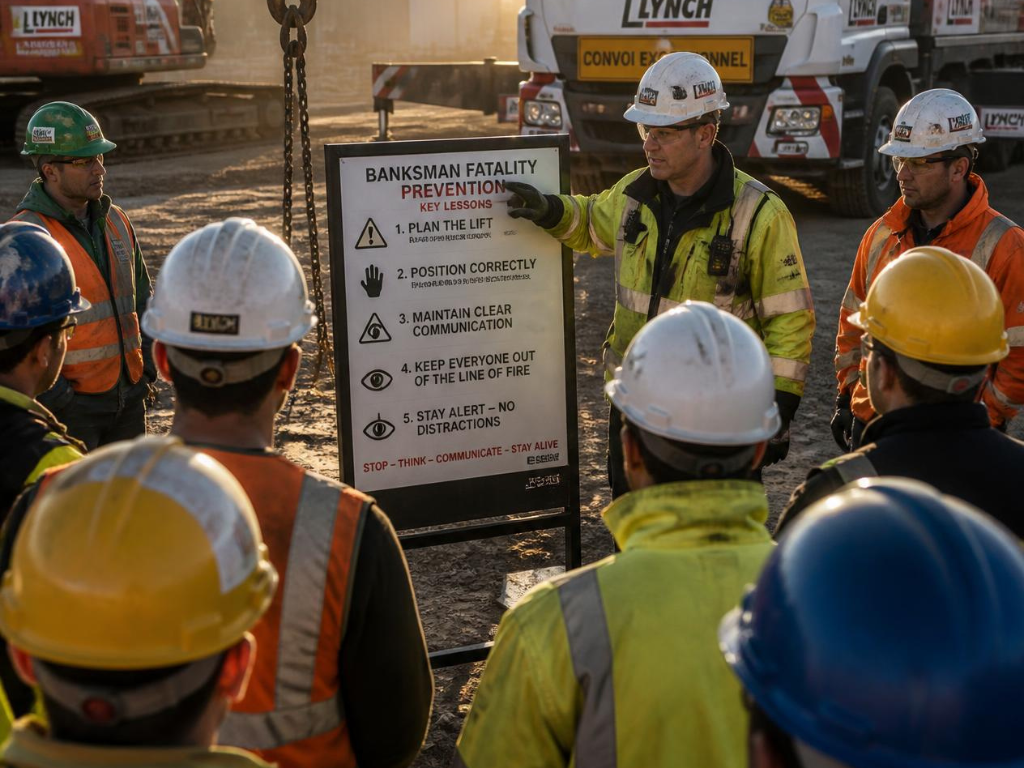
Two patterns, and the second one is the useful one. In four of the five, the worker was inside the space the machine could reach. In three of the five, the vehicle moved in the opposite direction to what the worker expected.
Read the descriptions again with that second pattern in mind. The tire roller suddenly reversed. The truck suddenly moved forward. The bus, having reversed, was moved forward again to reposition. In each case a trained person had formed a mental model of where the machine was going, and the machine went the other way. That is not carelessness. That is a communication failure with two participants, and it points at the operator’s awareness as squarely as the banksman’s position. WSH Council’s own framing is that serious accidents happen when a banksman or traffic controller enters a danger zone, and vehicular incidents were the leading cause of workplace deaths in 2025, 15 of 36 reported by MOM. The deeper reason vehicles top the fatality list is that a machine changing direction unexpectedly gives a person on foot no time at all.
The 3 March 2025 tire roller: what control was missing?
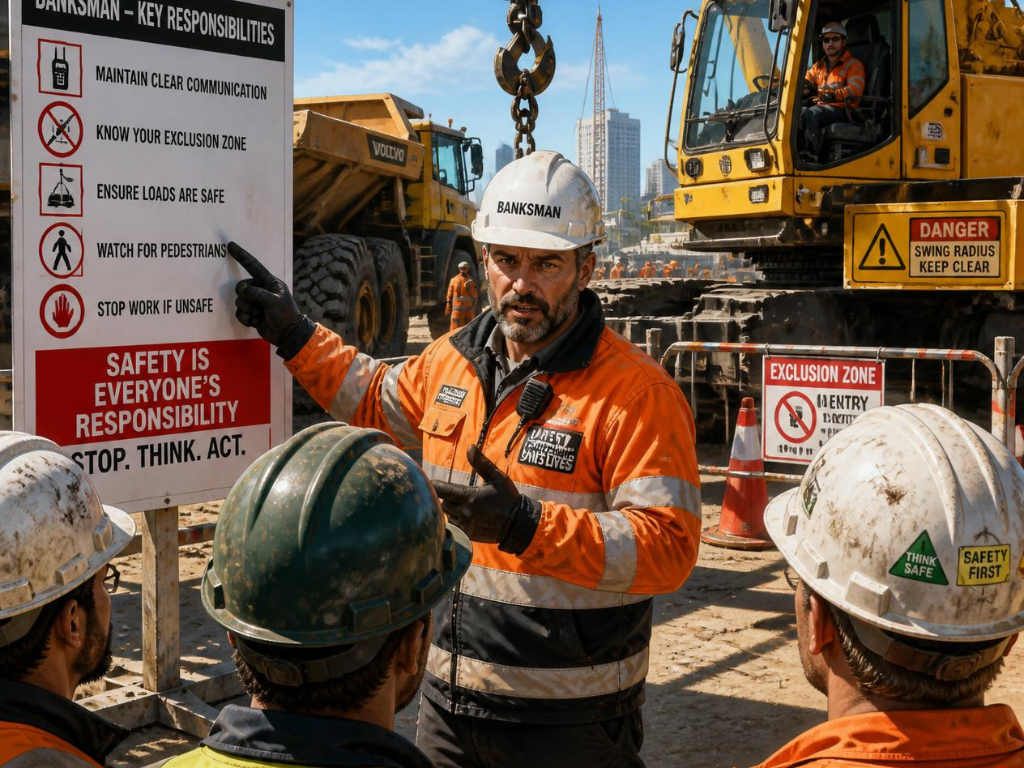
Safe work position. The worker was crossing a newly paved road behind a tire roller when it reversed. Standing behind a machine capable of reversing is the position WSH Council now tells sites to prohibit outright.
The lesson is narrow and hard. A tire roller is slow, and slowness breeds the assumption that you can get out of the way. You cannot, because the machine’s blind area is directly behind it and its mass makes even a crawl fatal. The control that closes this is positional discipline, taught and assessed rather than assumed, backed by demarcation that makes the space behind live plant a place nobody crosses. Reinforce it with the standard signal set, because the rule that anyone can call the stop and the operator must obey exists precisely for the second when someone appears where they should not be.
The 15 September 2023 expressway incident: what makes it different?
This is the outlier, and treating it like the others would produce the wrong fix. The hazard did not come from the site’s own machine. A motorcycle crashed into the work zone from the public road, striking a worker performing traffic control for expressway road works.
No amount of banksman positioning discipline stops an intruding vehicle travelling at expressway speed. The controls here are entirely different: the work zone’s own protection, advance warning, buffer space, lane closure design, and signage that gives approaching traffic enough distance to react. That is LTA territory, governed by the Code of Practice for Traffic Control at Work Zones, now in its April 2026 edition. A traffic controller on a public road is exposed to a hazard the WSH controls were never designed to stop, which is why the LTA work zone requirements govern how the zone is built before anyone steps into it. Lumping this incident in with the reversing cases produces a site briefing that misses the actual failure.
The 2022 truck and bus incidents: where was the worker standing?
In front of the vehicle, and between the vehicle and a pillar. Both positions are now explicitly named by WSH Council as places a banksman must never stand.
The August 2022 traffic controller moved in front of a truck at a main gate, and the truck suddenly moved forward. Two weeks earlier, a worker guiding a bus to reverse stood beside a pillar and was crushed against it when the driver moved forward to reposition. WSH Council’s instruction covers both: never stand “between moving vehicles/equipment and fixed objects, or within blind spots.” The crush hazard has separate backing in the WSH machinery guidelines, which state that machines with moving parts should be located a safe distance from any fixed structure. Any position where a worker can be pinned between something that moves and something that does not is a fatality waiting for a driver’s mistake. The bus driver made an ordinary correction. The position turned it lethal.
The 14 May 2026 excavator incident: why was he in the zone?
He entered a work zone where an excavator was operating and was struck by a falling concrete slab. The missing control is demarcation, control 2 of the seven, paired with the rule that banksmen do not enter demarcated danger zones.
The hazard was overhead, which makes this case worth briefing separately. The worker was not run over by tracks or clipped by a bucket. He was underneath a machine’s working envelope when a load came down. Exclusion zones around operating plant have to account for everything the machine can drop, swing, or reach, not just its footprint on the ground, and they have to move when the machine moves. A zone that stops at the tracks is not a zone. Worth noting: this incident happened in 2026, after every control needed to prevent it was already published. That is the uncomfortable part of the record.
How do you map these lessons onto your own site?
Take each incident, find its equivalent on your site, and name the control that would stop it. Four of the five map to positioning and demarcation. One maps to work zone protection from public traffic.
Walk the ground and ask the specific questions. Where does a machine reverse near a person on foot, and is that space barriered? Where does a worker stand between a vehicle and a wall, a pillar, or a stack of material? Which of your plant operates with loads overhead, and does the exclusion zone cover the whole working envelope? If any of your crew works on a public road, is the zone built to the April 2026 Code? Your traffic risk assessment should already name these points, and the competency to hold a safe position comes from banksman safety certification, a half-day course at $120 certifying for 4 years. If your review turns up positions matching any of these five cases, close the gaps on your site before the next shift.
Five incidents, and not one of them needed a new idea to prevent
The record is small enough to read in a minute and specific enough to act on this week. Four workers died between 2022 and 2025 and another was struck in 2026, and in every case the control that would have saved them already existed. Positioning, demarcation, visual contact, and a properly built work zone are not advanced techniques. They are the basics, applied to the person standing closest to the machine.
Brief your crew on all five cases this week, then walk the site and mark every position where one of them could happen again.
FAQs About Banksman Fatality Lessons Singapore
How many banksmen and traffic controllers have died on Singapore worksites?
WSH Council’s 12 June 2026 advisory records four fatalities involving banksmen and traffic controllers between 2022 and 2025, plus a further incident on 14 May 2026 where a worker on banksman duties was struck by a falling concrete slab. Vehicular incidents were Singapore’s leading cause of workplace deaths in 2025.
What is the most common cause of banksman fatalities in Singapore?
Being inside the machine’s reach when it moves. In four of WSH Council’s five recorded cases the worker was in the danger zone, and in three the vehicle moved in the opposite direction to what he expected, including a tire roller that reversed and a truck that moved forward.
Where should a banksman never stand?
Directly behind a reversing vehicle, between moving equipment and a fixed object, or inside a blind spot. WSH Council names all three positions in its June 2026 advisory. The 3 August 2022 fatality involved a worker crushed against a pillar by a bus, which is exactly the second of those positions.
What did WSH Council recommend after these incidents?
Seven controls, published 12 June 2026: a traffic management plan, danger zone demarcation, enhanced worker visibility, worker training, increased situational awareness, safe work position, and use of technology. The Council advises occupiers and employers to strengthen onsite practices and adopt technology that keeps workers out of high-risk areas.