- 27 Aug 2026
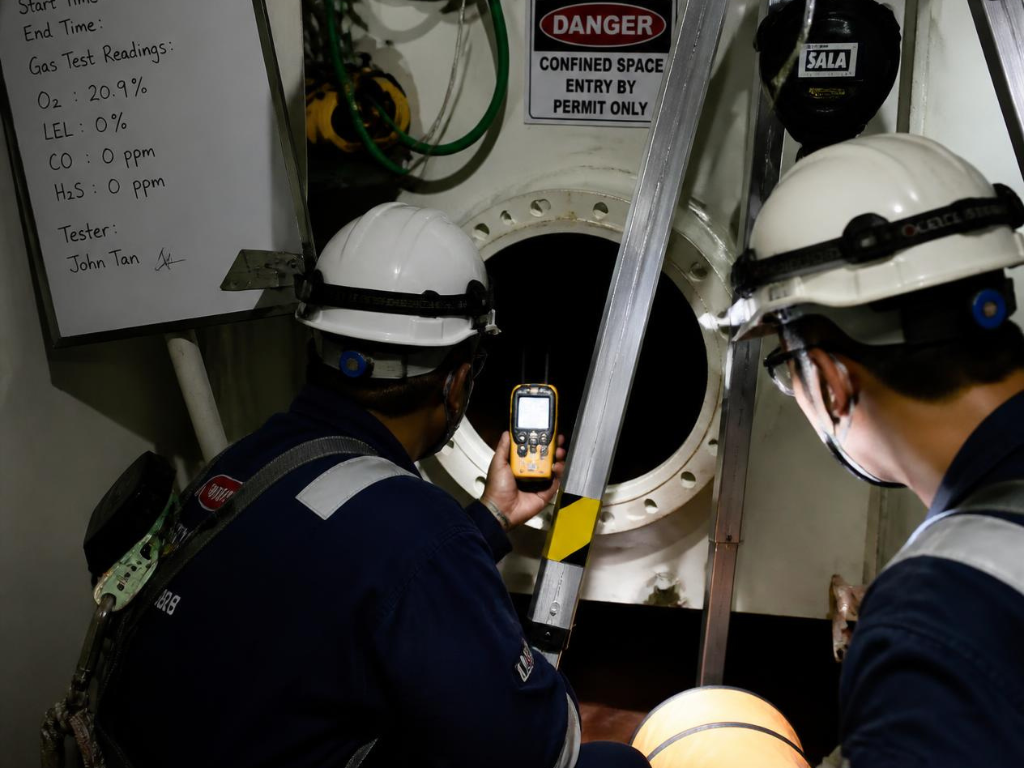
Confined space gas testing in Singapore fails quietly. The detector reads 10% LEL, the permit gets signed, and nobody checks which gas the instrument was calibrated on. MOM recorded 36 workplace fatalities in 2025, a record-low 0.96 per 100,000 workers. This blog walks you through the three tests, the legal thresholds, and the instrument errors that pass as compliance on Singapore worksites, drawn from WSH inspection and consultancy work.
What is confined space gas testing, and who is legally allowed to do it?
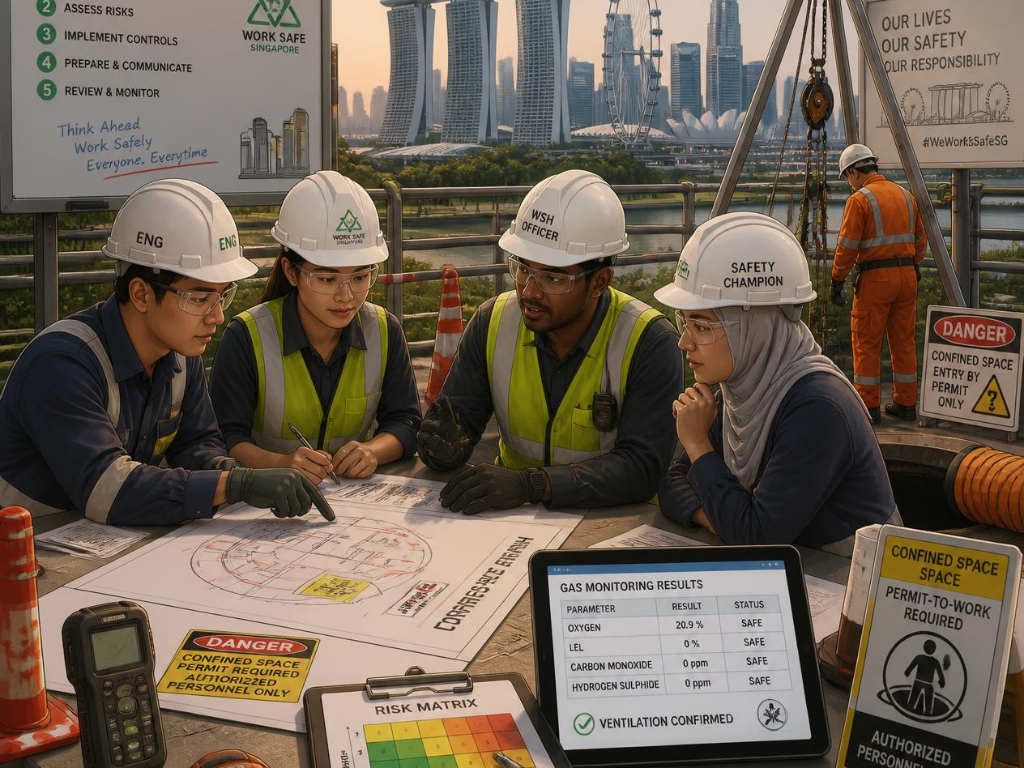
Confined space gas testing is the pre-entry measurement of a confined space atmosphere for oxygen content, flammable gases, and toxic gases, carried out by a confined space safety assessor appointed under Regulation 9(b) of Singapore’s Workplace Safety and Health (Confined Spaces) Regulations 2009. Results go on the entry permit before anyone’s head passes the opening.
Nobody else can do it. The assessor is the only role the Regulations authorise to test and endorse, and Regulation 12(2) tells that person exactly how: use a suitable and properly calibrated instrument, follow a fixed sequence, avoid endangering yourself or others, and record the results in the permit.
The first test happens from outside. The WSH Council’s Technical Advisory on Working Safely in Confined Spaces is direct about this, requiring initial testing to be conducted from outside the space by drawing air out with suitable sampling devices while the atmospheric hazard assessment is under way. A tester who climbs in to get a better reading has already become the casualty. The Technical Advisory documents a Singapore case of exactly this, where a worker was exposed to phosgene gas during gas testing.
Testing sits downstream of paperwork most sites rush. Regulation 5 links entry to a risk assessment under the WSH (Risk Management) Regulations, so the space and its likely contaminants should already appear in your records from identifying hazards before entry. The assessor cannot select the right sensor for a gas nobody predicted.
What oxygen level is safe for confined space entry in Singapore?
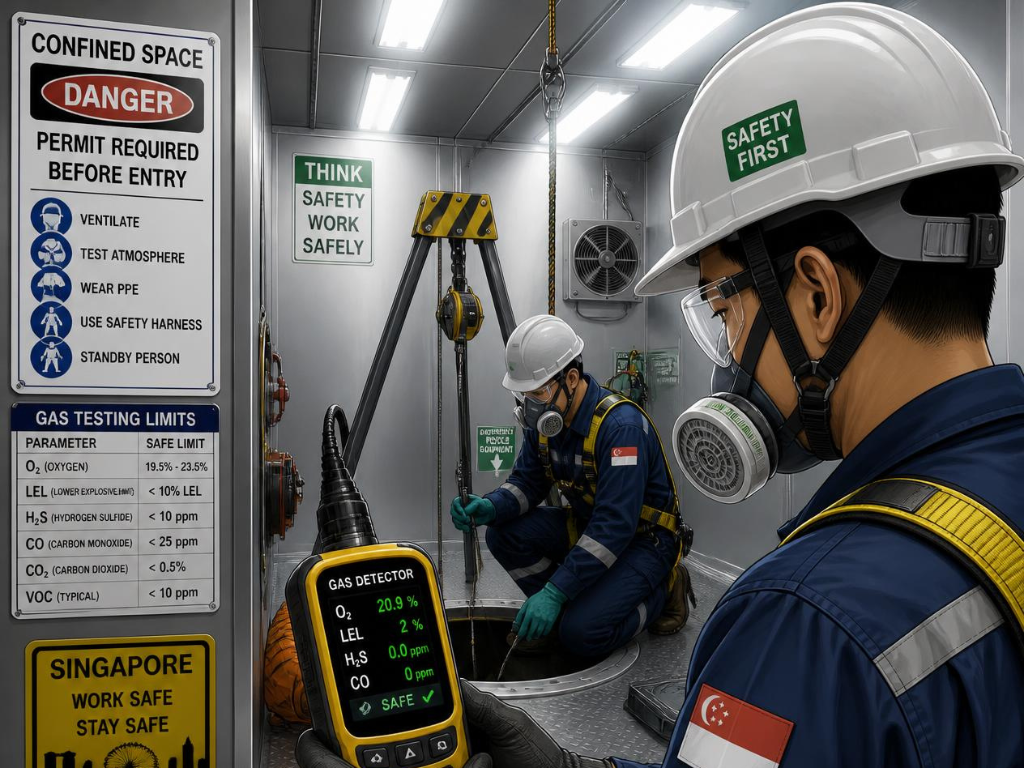
Between 19.5% and 23.5% by volume. Outside that band, Regulation 2 classifies the atmosphere as hazardous and Regulation 13(1)(a) blocks the authorised manager from issuing a permit.
Clean outdoor air sits at 20.9% oxygen, so the legal floor gives you roughly 1.4 percentage points of margin. That margin closes fast. The WSH Council’s data on oxygen deficiency effects reads as a ladder: 16% to 19% brings poor coordination and fatigue, 12% to 16% produces rapid pulse and breathing difficulty, and 10% to 12% turns the lips blue. At 8% to 10%, workers faint. At 6% to 8%, exposure is fatal within eight minutes, and half of those exposed die within six. Below 6%, coma arrives in one minute.
Oxygen goes missing for mundane reasons. Rusting steel consumes it. Bacterial action in sewage consumes it. Welding consumes it. Nitrogen or carbon dioxide used to purge a vessel displaces it entirely, which is why a tank that has just been inerted is more dangerous than one that was never touched.
The ceiling matters as much as the floor. Above 23.5%, oxygen enrichment makes ordinary materials ignite far more readily, and the usual source is a leaking cutting torch left inside overnight.
Why oxygen must be tested first
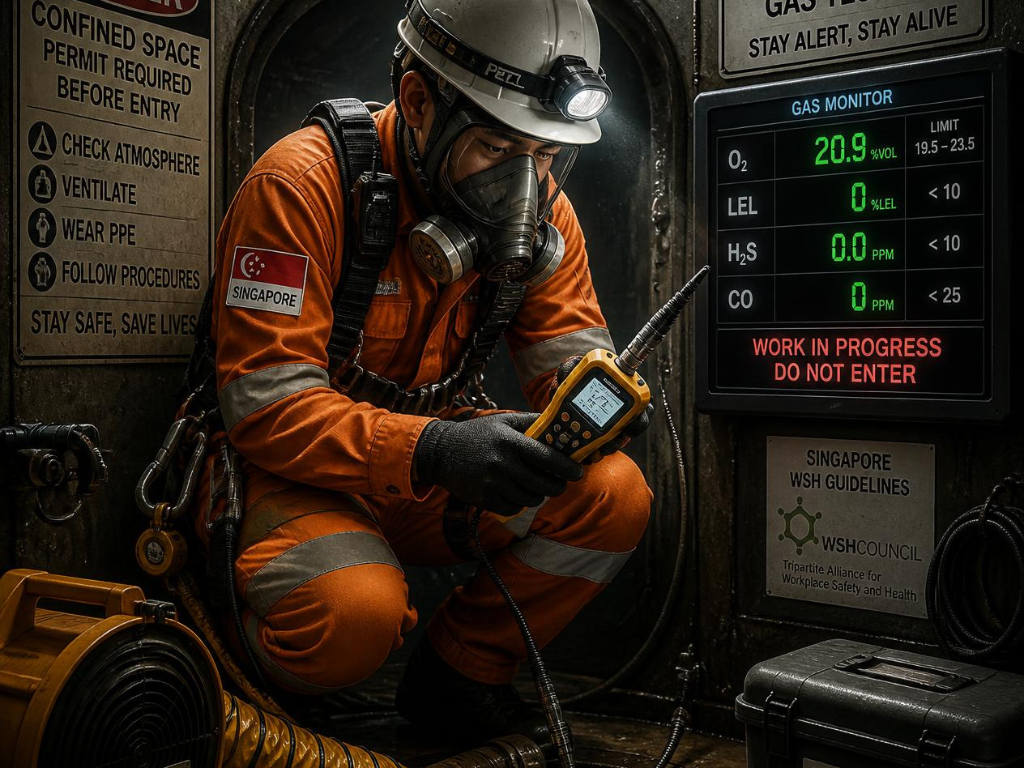
Regulation 12(2)(b) fixes the order: oxygen, then flammable gas or vapour, then toxic gas where applicable. The sequence is not filing convenience. Catalytic bead sensors, the standard technology for combustible gas detection, work by oxidising sample gas across a heated element. Starve that reaction of oxygen and the sensor under-reports. You get a clean LEL reading in an atmosphere that would flash. Oxygen goes first because every reading after it depends on knowing that number.
What LEL reading must you see before anyone enters?
Under 10% of the lower explosive limit. Regulation 2 treats 10% or more of LEL as a hazardous atmosphere, and Regulation 13(1)(b) requires the authorised manager to confirm the space sits below that line before issuing the permit.
Ten percent is a deliberately wide safety margin, because LEL values themselves are low. Hydrogen sulphide has a lower explosive limit of 4.3% by volume and an upper limit of 44%, with an autoignition temperature of 260°C. Carbon monoxide runs from 12.5% to 74% and autoignites at 607°C. Benzene is worse at the bottom end, igniting from 1.2% by volume with a flash point of minus 11.1°C.
Ignition needs three things present at once: fuel between the LEL and UEL, sufficient oxygen, and an ignition source at or above the substance’s ignition temperature. Sites tend to fixate on the third and control it with hot work permits. The atmosphere is the one you measure.
Worth noting: a percentage-LEL instrument tells you nothing useful about health risk. Many flammable substances are also toxic at concentrations far below their explosive range, measured in parts per million rather than percentage points. A tank reading 4% LEL of benzene vapour is nowhere near explosive and comfortably lethal.
Which toxic gases matter most, and what are Singapore’s exposure limits?
Hydrogen sulphide and carbon monoxide account for most confined space poisonings in Singapore, and both have gazetted limits. H₂S carries a permissible exposure level of 10 ppm. CO sits at 25 ppm. Both figures come from the First Schedule to the WSH (General Provisions) Regulations, where MOM specifies PELs for every listed toxic substance.
A PEL is a time-weighted average, defined as the maximum airborne concentration a worker may be exposed to across an eight-hour day and forty-hour week without adverse health effects. Short-term PELs cover a fifteen-minute window. Reading those numbers as instantaneous go/no-go thresholds is technically wrong, and the working fix is the one the WSH Council recommends: pre-set your detector alarms to the limit values for the specific substances you expect, so the instrument enforces the number rather than the assessor interpreting it afterwards.
Substance selection is the real skill. H₂S comes from sewage and decaying organic matter. CO comes from combustion engines and incomplete burning during hot work. Nitrogen dioxide comes from welding. Benzene and vinyl chloride monomer come off cargo tank walls, both carcinogens, with benzene’s PEL set at 5 ppm. Sending a four-gas detector into a chemical vessel and calling it tested is how confined spaces stay on the list of Singapore’s deadliest workplace hazards.
Where Singapore has not gazetted a PEL for a substance, the Technical Advisory directs assessors to internationally established limits, naming ACGIH Threshold Limit Values and NIOSH exposure limits as acceptable references.
Where in the space should you test, and how long should you wait for a stable reading?
Test at three or more elevations, and wait roughly ten seconds for every metre of sampling hose. Gases stratify by density, so a single reading taken at the manhole rim describes one thin layer of the atmosphere.
The stratification pattern is predictable. Methane is lighter than air and collects at the top. Carbon monoxide has roughly the same density as air and distributes through the middle. Hydrogen sulphide is heavier than air and pools at the bottom, which is precisely where a worker’s head arrives last and their body sits longest. WSH Council guidance calls for sampling at the top, mid-point and bottom of the space, and more points again in large vessels with separate compartments.
Wait time is the part sites get wrong. The rule of thumb is ten seconds per metre of hose, but the volumetric calculation is more defensible. Take a 30 metre hose with a 0.6 cm bore drawn by a 0.5 litre per minute pump: internal area works out to 0.283 cm², total hose volume to 849 cm³, and sampling time to 102 seconds. Pull the hose at 40 seconds and you have measured the air that was already sitting in the tube.
Sensor physics adds a second delay. Manufacturers quote response time as t90, the time taken to read 90% of the actual gas concentration. Full concentration takes considerably longer than t90, so the reading you record at the quoted response time is optimistic by design. Build in a margin and wait for the display to stabilise before writing anything on the permit.
Hose material changes the answer too. Hoses that are not solvent resistant absorb hydrocarbon vapours and under-report, so the Technical Advisory specifies PTFE or Viton. For sulphur dioxide, ammonia and hydrocarbon vapours, Viton is capped at five metres. For hydrogen cyanide, chlorine and nitrogen dioxide, no hose is recommended at all, because absorption or condensation on the inner wall corrupts the reading regardless of material.
Why does a detector calibrated on methane under-report other gases?
Because catalytic sensors respond differently to different fuels, and almost every LEL instrument leaves the factory calibrated on methane. Run that instrument in a pentane atmosphere and a displayed 10% LEL corresponds to an actual concentration near 22% LEL.
Work the WSHC example through. An instrument calibrated on methane reads 10% LEL in pentane vapour. The correction factor at the methane-to-pentane intersection is 2.20. Multiply, and the true value is 22.0% LEL. The permit says compliant. The space is at more than double the statutory threshold.
The factors are not small. Against methane calibration, benzene, toluene and cyclohexane all carry factors around 2.50. Xylene isomers run from 3.50 to 4.00. n-Butane sits at 2.00 and propane at 1.90. A handful run the other way: ammonia reads high at 0.60, and hydrogen and carbon monoxide at 1.20. Published multipliers carry an accuracy band of plus or minus 30%, and the specific values vary between instrument models, so the correct move is to pull the chart for your own detector rather than a generic table.
This is the single most common technical failure I would look for in a confined space audit, and it never shows up in the paperwork. The permit records a number. It does not record which gas the sensor was calibrated against, so nobody downstream can tell whether the number means anything.
Two defences work. Calibrate on the target gas where you can get it. Where a space holds several flammable substances, calibrate on the gas the sensor is least sensitive to, which builds the safety factor into the instrument instead of relying on someone remembering a multiplier at 7am.
How often must a confined space gas detector be calibrated or bump tested?
Bump test before every use. Calibrate on the manufacturer’s stated interval, and again whenever the instrument has taken abuse.
The two operations are different, and sites conflate them constantly. Calibration adjusts the sensor’s baseline and sensitivity against a known gas concentration. A function test, commonly called a bump test, simply exposes the sensor to test gas long enough to confirm it responds within its rated time and displays within 10% of the calibration gas concentration, with alarms firing at the preset levels. A bump test takes under a minute and requires no adjustment unless the reading is off.
WSH Council guidance lists six triggers for a function test: before use of the instrument, after over-exposure to the target gas, after exposure to extreme environmental conditions, after a severe jolt or drop, when changing shift, and when in doubt. Extreme conditions are ordinary on Singapore sites, covering 55°C engine rooms, pressurised tunnels, and water ingress in drains and sewers.
There is a physical reason this matters. Catalytic sensors degrade, and worse, they get poisoned. Hydrogen sulphide, silicones and leaded petrol all attack the catalyst so it loses the ability to sustain combustion. A poisoned sensor reads low or reads nothing, and the failure is invisible until the sensor meets test gas. An instrument that has spent a week in a sewer has been marinating in the exact compound that kills it.
Zero the instrument with clean air or nitrogen before applying test gas, use only the calibration kit and gas the manufacturer specifies, never use expired cylinders, and keep a logbook of calibrations and parts replacements. Regulation 12(2)(a) requires a “properly calibrated” instrument, and the logbook is what turns that phrase into evidence.
When must you retest the atmosphere, and when must everyone get out?
Retest at intervals the assessor sets, and evacuate the moment a hazardous atmosphere appears. Regulation 16(1)(a) makes periodic testing by the confined space safety assessor a continuing duty for as long as anyone is inside.
Continuous monitoring runs alongside it. Where two or more people are in the space, Regulation 16(1)(b) requires at least one of them to monitor the atmosphere continuously with a suitable gas detector. WSH Council guidance goes further, expecting at least one person in any working group to carry an instrument covering oxygen, combustibles and the identified toxic contaminants.
Three triggers set the retest clock. Retest when continuous occupation passes six hours. Retest when the space has been vacated for thirty minutes or more without continuous monitoring, because conditions drift while nobody is watching. Retest whenever the work itself could release hazardous material, which covers most cleaning, cutting and sludge removal.
Detection ends the job immediately. Regulation 16(1)(c) requires everyone to vacate at once, an evaluation to establish how the hazardous atmosphere developed, and a new permit before re-entry. The original permit is dead, “No Entry” signage goes up, and the space must be re-certified. Regulation 16(2) puts the recording duty on the assessor and Regulation 16(3) requires the responsible person to keep those records for at least two years. Companies that have been through risk management plan training usually have the record-keeping discipline for this already.
Does purging and ventilation remove the need for gas testing?
No. The WSH Council states plainly that “purging and ventilation do not exclude the need for gas testing.” Regulation 8 requires adequate ventilation from a contaminant-free source, and Regulation 12 still requires the test.
Purging and ventilating are different operations. Purging happens before entry and displaces the existing hazardous atmosphere with air, water, steam or an inert gas. Ventilation runs throughout the permit’s validity to keep contaminants low and oxygen in range as the work itself introduces new hazards.
Ventilating a heavily contaminated space can create the explosion it was meant to prevent. Where the original concentration sits above the Upper Explosive Limit, blowing in fresh air leans the mixture out and walks it down through the explosive range on the way to safe. WSH Council guidance recommends exhaust ventilation or dilution with an inert medium such as nitrogen for these cases instead. Any site that assumes fresh air is always the safe answer has not thought about which side of the UEL it started on.
Match the method to the toxicity. Forced ventilation with a blower suits contaminants with a PEL at or above 500 ppm. Below 500 ppm, local exhaust ventilation applied at the source is the right tool, and because LEV pulls the space slightly negative, it needs replacement supply air. Inerting carries its own trap: after purging with nitrogen, the space must be ventilated with fresh air to restore a breathable atmosphere, and the purge equipment must be bonded to the space to stop static discharge igniting what you just displaced.
MOM’s written answer to Parliament on 2 July 2024 described the required control as “gas tests conducted by a competent assessor,” and pointed employers to Approved Code of Practice SS 568 and the WSH Council’s Technical Advisory. Both documents assume testing happens after ventilation, not instead of it. Sites that treat ventilation as a substitute rarely have the calibration logs or sampling records to show otherwise, which is usually the first gap that surfaces when documenting controls properly or during WSH inspection and audit support.
Three numbers, and the instrument that produces them
Singapore’s confined space regime hangs on three readings: oxygen between 19.5% and 23.5%, flammables under 10% LEL, and toxics below the First Schedule PELs. Every one of those numbers arrives through an instrument that can be poisoned, mis-calibrated, read too early, or pointed at the wrong layer of the tank. The thresholds are the easy part. Proving the reading behind them is real is where confined space compliance actually lives.
Have your confined space gas testing records audited before the next shutdown: detector calibration and bump test logs, sampling depths and hose lengths, alarm setpoints against the substances you actually store, and retest intervals on live permits. Advanced Safe Consultants can review the lot against Regulations 8, 12 and 16 and show you which readings would not survive an MOM inspection.
FAQs About Confined Space Gas Testing Singapore
Can you smell hydrogen sulphide before it becomes dangerous?
No. H₂S deadens the sense of smell at higher concentrations, so the warning disappears as the danger rises. The WSH Council is explicit that senses cannot be trusted to judge confined space air, since oxygen deficiency and most toxic gases are invisible and undetectable by smell. Singapore’s PEL for H₂S is 10 ppm.
How long must confined space gas test records be kept in Singapore?
Two years minimum. Regulation 16(2) of the WSH (Confined Spaces) Regulations 2009 makes the confined space safety assessor responsible for recording every atmospheric test result, and Regulation 16(3) requires the responsible person to retain each record for not less than two years from the date it was made.
Can one gas detector cover oxygen, flammable and toxic gases?
Yes, and the WSH Council recommends it. An Ex-approved multi-gas instrument measuring oxygen, combustibles and toxics simultaneously is the preferred setup for confined space entry testing. Some gases still resist electronic detection, and colorimetric tubes remain the standard fallback for those substances.
What happens if the gas detector alarms while workers are inside?
Everyone leaves immediately. Regulation 16(1)(c) requires the space to be vacated at once, an evaluation to determine how the hazardous atmosphere developed, and a new entry permit issued by the authorised manager before re-entry. The original permit is revoked and “No Entry” signage goes up at the opening.
What oxygen reading means a worker cannot survive unaided?
Below 6% by volume causes coma within one minute, per WSH Council data on oxygen deficiency. Between 6% and 8%, exposure is fatal within eight minutes and kills half of those exposed within six. Singapore’s minimum safe entry level is 19.5% oxygen by volume.