- 29 Aug 2026
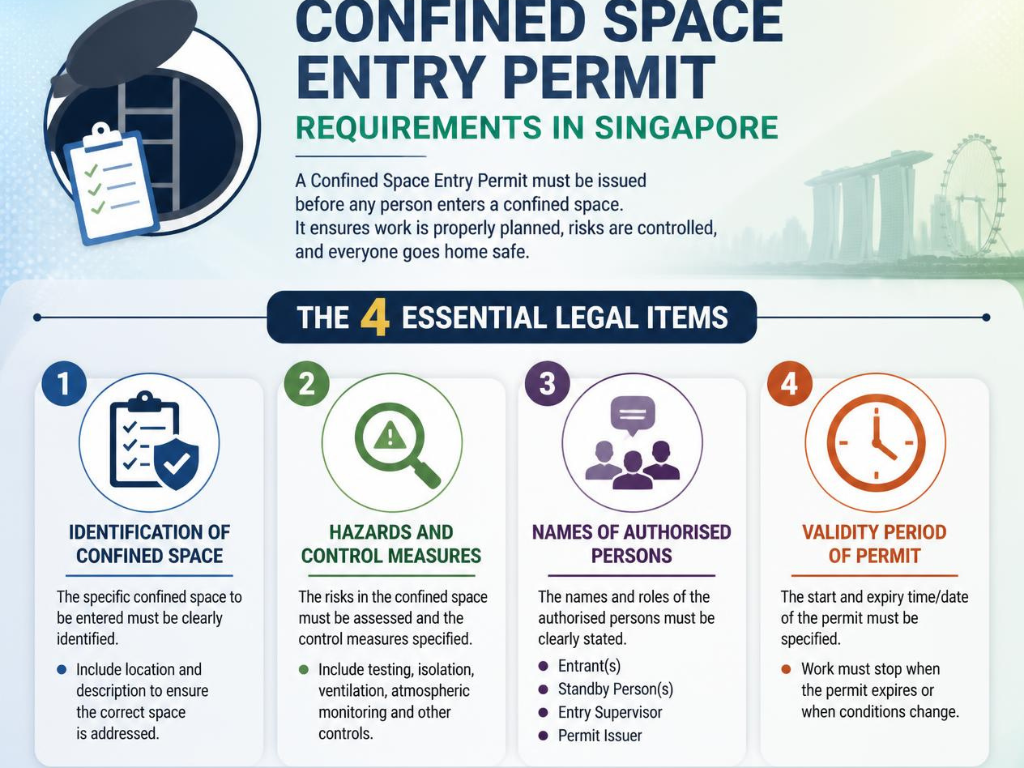
A confined space entry permit in Singapore is treated as a form to fill. Regulation 9(c) requires four items, and most site permits carry fifteen without anyone knowing which four are legally load-bearing. MOM recorded 36 workplace fatalities in 2025, a record-low 0.96 per 100,000 workers. This blog walks you through what the permit must contain, who signs it, and how long it survives, from WSH consultancy and inspection work.
What is a confined space entry permit, and when is it required?
A confined space entry permit is a document issued by the authorised manager under Regulation 13 of Singapore’s Workplace Safety and Health (Confined Spaces) Regulations 2009, certifying that a specific confined space has been tested and controlled well enough for named people to enter. Regulation 10(1) makes entry unlawful without one, subject to a narrow exception.
Two conditions must both be satisfied before anyone goes in. The occupier of the workplace must have evaluated that entry is necessary, and a permit must have been issued for that entry. Necessity comes first for a reason. WSH Council guidance treats entry into a confined space as a last resort, expecting employers to consider alternatives such as vacuum extraction of sludge through an extended hose before putting a person inside a vessel.
The permit is not a record of what happened. It is a forward-looking authorisation, and its legal function is to freeze a set of verified conditions at a point in time. Once those conditions change, the document stops describing reality and stops being valid.
Contravening Regulation 9 or Regulation 10(1) carries a fine not exceeding $20,000 under Regulation 24(2). The general tier in the Regulations goes further, exposing an individual to $20,000, imprisonment up to two years, or both.
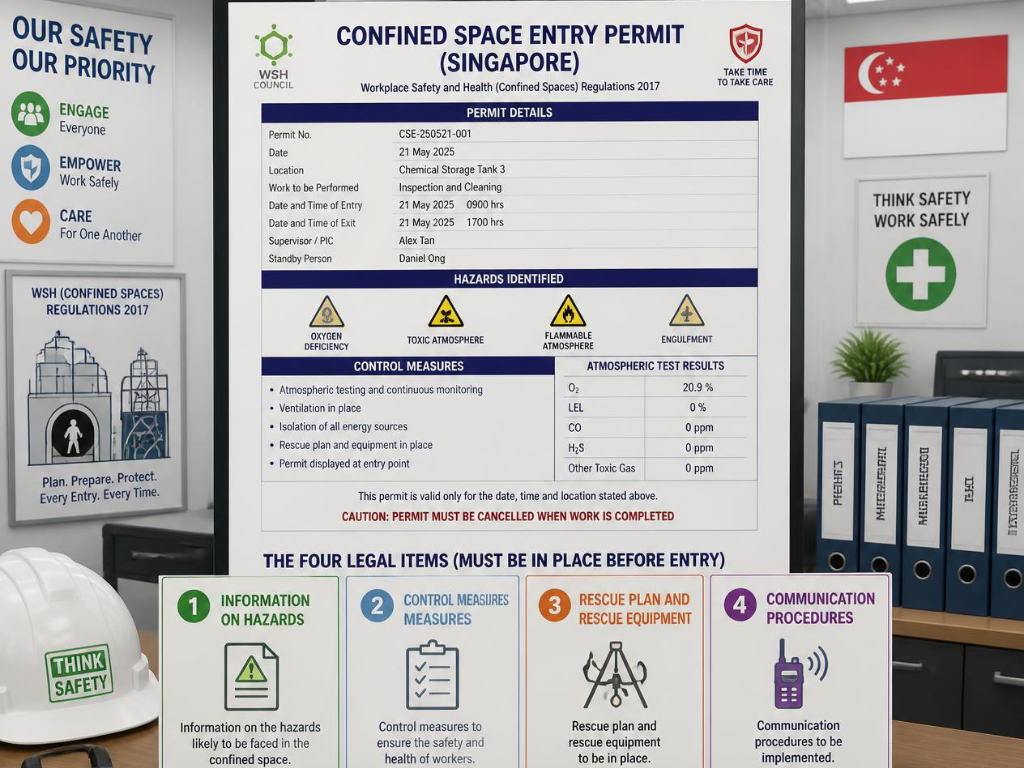
What must legally appear on a confined space entry permit?
Four items. Regulation 9(c) requires the permit to specify the description and location of the confined space, the purpose of entry, the results of the gas testing of the atmosphere, and “its period of validity.”
That is the entire statutory list. Everything else you see on a standard Singapore permit form comes from WSH Council guidance rather than the Regulations, and knowing which is which matters when an inspector reads your paperwork. A permit missing the validity period fails Regulation 9(c) outright. A permit missing the lighting arrangement does not, though it fails as a working document.
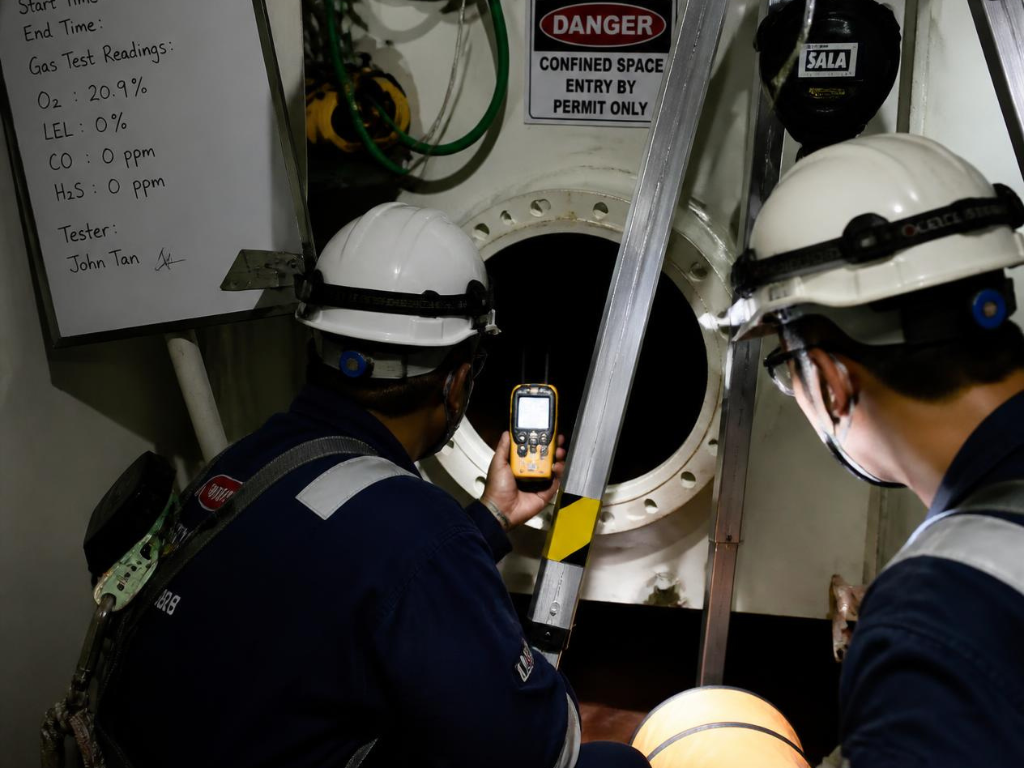
Gas test results carry the most weight of the four, because they are the only field a second person is legally required to produce. Regulation 12(2)(d) puts the recording duty on the confined space safety assessor, who must enter results from tests conducted in sequence: oxygen first, flammable gas second, toxic gas third where applicable, all on a suitable and properly calibrated instrument.
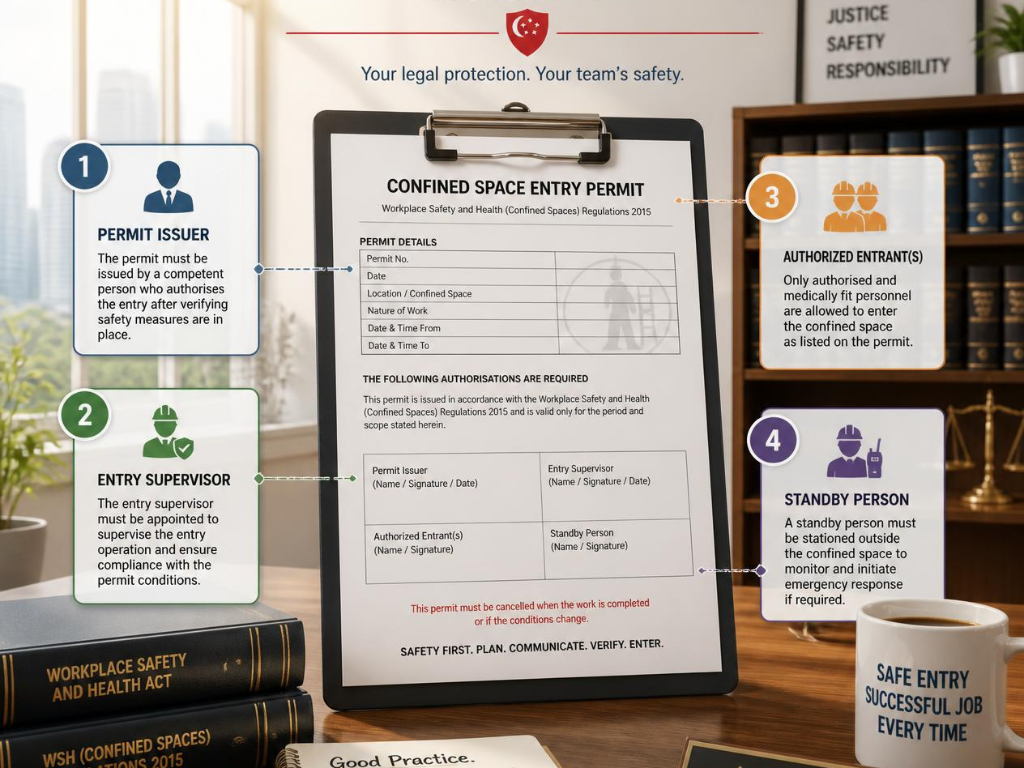
What the WSH Council expects beyond the legal minimum
The recommended permit runs to roughly fifteen fields. Entry date, time and duration. Potential atmospheric and non-atmospheric hazards. Control measures broken into isolation, personal protective equipment, other precautions and emergency response. The name of the confined space attendant. Provision of ventilation. Lighting arrangement, including use of flame-proof lighting. Atmospheric testing results split across oxygen, flammable gases and other toxic gases. Names and signatures of the supervisor, the confined space safety assessor and the authorised manager.
Isolation deserves particular attention because it is where permits go vague. WSH Council guidance breaks it into de-energisation and lockout-tagout, blanking or bleeding or isolating pipes, and removal of mechanical belts and linkages. A permit that records “isolated” as a tick box has recorded nothing. These fields only carry meaning if they trace back to the risk assessment behind it, which the supervisor and authorised manager conduct jointly before the application is made.
Who signs the permit, and who has the power to issue it?
Three people sign. Only one issues. WSH Council guidance requires the names and signatures of the supervisor, the confined space safety assessor and the authorised manager on a compliant permit, and Regulation 13(1) reserves issuance to the authorised manager alone.
The sequence explains the signatures. Regulation 11 makes the supervisor the applicant, requiring the application to state the measures to be taken, be addressed to the authorised manager, and be submitted to the safety assessor. Regulation 12(3) then has the assessor endorse the application and forward it onward if satisfied entry can proceed safely. Regulation 13(1) puts the final decision with the authorised manager, who must be satisfied on six conditions before issuing.
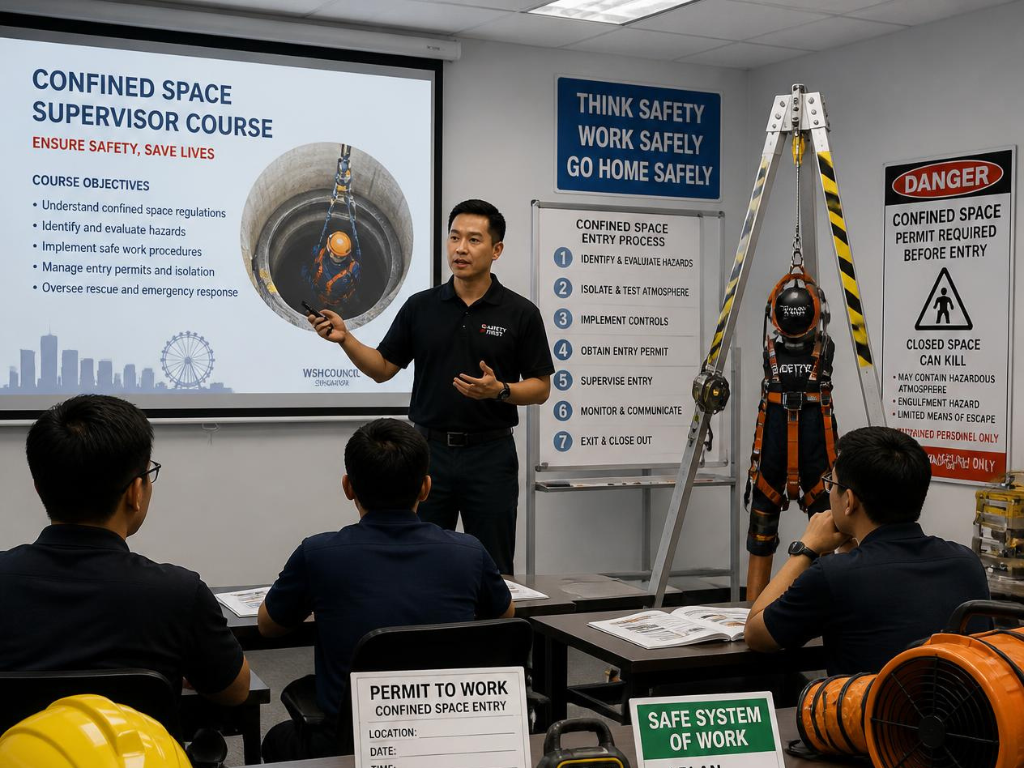
Those six are worth listing because they are the substantive test. Oxygen within 19.5% to 23.5% by volume. Flammable gas or vapour below 10% of its lower explosive limit. Toxic substances at or under the permissible exposure levels in the First Schedule to the WSH (General Provisions) Regulations. Adequate ventilation. Effective steps against ingress of dangerous gases, vapours or other dangerous substances. All reasonably practicable measures taken for the safety and health of entrants.
Two independent due diligence duties sit under those signatures. Regulation 12(4) binds the assessor on testing, evaluation and endorsement. Regulation 13(3) binds the authorised manager on issuance. Neither can hide behind the other, which is the design intent of splitting the roles in the first place. Sites that let one person hold two of the three signatures have removed a check the Regulations built deliberately.
Regulation 13(2) adds a quiet obligation people forget: once issued, the authorised manager must retain a copy of the permit.
How long does a confined space entry permit stay valid in Singapore?
For whatever period the permit itself states. Singapore’s Regulations set no fixed maximum. Regulation 9(c)(iv) requires the permit to specify its period of validity, and the employer sets that figure against the work.
This surprises people, because most confined space material online assumes a shift-length permit. That convention comes from OSHA and UK practice, not from Singapore law. Importing it as a legal requirement is wrong, and importing it as an operational default is usually sensible. The two statements are different and content that blurs them misleads readers about what an inspector can actually cite.
The real control is daily review, not duration. Regulation 18(1) places a duty on the authorised manager who issued a permit to review and assess the need for entry into or work in the confined space on a daily basis, and to revoke the permit if he thinks fit. WSH Council guidance adds that where work continues after that assessment, the authorised manager endorses the permit by signing it or by other equally effective means. A multi-day permit with no daily endorsement is not a long permit. It is an unreviewed one.
Expiry ends the authorisation cleanly. Regulation 13(4) requires a fresh application under Regulation 11 if the entry or work is not completed within the validity period. There is no extension mechanism in the Regulations, so the supervisor restarts the application, the assessor retests, and the authorised manager issues again.
Atmospheric conditions impose their own clock inside the validity period. WSH Council guidance calls for retesting when continuous occupation exceeds six hours, and when a space has been vacated for thirty minutes or more without continuous monitoring.
Can anyone enter a confined space without a permit?
Yes, under one narrow set of conditions, and this is the least-known provision in the Regulations. Regulation 10(2) disapplies the permit requirement where the person entering wears suitable breathing apparatus, has been authorised to enter by the authorised manager for that space, and where reasonably practicable wears a safety harness with a rope securely attached, with a confined space attendant keeping watch outside who has the means to pull them out in an emergency.
All three elements have to hold together. Breathing apparatus alone is not the exception. Authorisation alone is not the exception. The provision exists because there are entries where waiting for atmospheric clearance is not viable, principally rescue and emergency intervention, and the Regulations substitute engineered protection for a tested atmosphere.
Worth noting: the occupier’s evaluation of necessity under Regulation 10(1)(a) is not waived. Only the permit requirement in paragraph (1)(b) falls away. The space still has to warrant entry.
Where this gets abused is routine work dressed as an exception. A crew that cannot get a clean gas reading, straps on a set and goes in with the authorised manager’s verbal nod, has technically satisfied Regulation 10(2) and has practically abandoned every atmospheric control the framework provides. The assessor never tested. Nothing was recorded. If the entrant collapses, there is no document describing what was known before entry. Confined space work stays near the top of the list of why confined spaces stay lethal partly because this exception is used as a shortcut rather than a rescue provision.
Does the confined space entry permit cover hot work inside the space?
No. WSH Council guidance is direct: the entry permit “does not entitle the applicant to carry out hotwork or any other hazardous work.” A separate permit-to-work is required.
This is the most expensive misreading I see on Singapore sites. A crew gets an entry permit for a tank, the scope says cleaning and inspection, and then someone decides a bracket needs re-welding while they are in there. The entry permit does not stretch to cover it, and the atmospheric clearance it records was taken before an ignition source entered a space that may still hold flammable residue.
Regulation 17 handles the adjacent version of the same problem. Anyone aware of work being carried out near a confined space that is incompatible with work inside it must immediately report it to their supervisor, the WSH officer, the WSH coordinator, or the authorised manager. Hot work starting outside an open tank counts.
The cleaner approach is to treat the entry permit as the door and the permit-to-work as the task. One authorises presence, the other authorises the activity, and both have to be live at the same moment. Companies that build this into their control hierarchy during control selection at bizSAFE Level 2 rarely get caught out. Companies running a single permit form for everything get caught out routinely.
Where must the permit be displayed, and for how long?
At the entrance to the confined space, posted by the supervisor, until the earliest of three events. Regulation 14(a) requires a copy clearly posted at the entrance, including where reasonably practicable a sketch of the area within the space where entry or work is to be conducted.
The sketch requirement gets skipped almost universally, and it is the field that helps rescuers most. A responder arriving at a manhole needs to know which compartment the crew went into before deciding how to reach them.
Regulation 14(b) fixes the removal point. The posted copy stays up until the date of expiry of the permit, the revocation of the permit, or the person leaving the space after achieving the purpose of entry or completing the work, whichever comes earliest. A permit still taped to a tank after the crew has knocked off is not evidence of diligence. It tells the next person that an entry is live when it is not.
The permit also discharges a separate obligation. Regulation 19 requires the occupier to post a notice at the entrance warning of the hazards of the confined space, unless a copy of the entry permit is posted there in accordance with Regulation 14(a), or the space has no entrance a person could use. The permit substitutes for the warning sign while it is up, which means removing the permit at knock-off reinstates the need for hazard signage.
When must the permit be withdrawn, revoked, or reissued?
Three different acts, three different triggers, and different people carry them out. WSH Council guidance gives the supervisor or the confined space safety assessor authority to withdraw the permit when a hazardous atmosphere is detected by periodic testing or continuous monitoring. The authorised manager revokes it.
Revocation has several triggers under Regulation 18. The authorised manager may revoke on daily review if he thinks fit, may order everyone out and revoke where the work poses or is likely to pose a risk, and may revoke where the entry has been completed or cannot continue for a significant period. Revocation becomes mandatory in the Regulation 16(1)(c) circumstances, meaning a detected hazardous atmosphere.
Detection sets off a fixed sequence. Everyone vacates immediately. “No Entry” signage goes up at the opening. The supervisor, safety assessor and authorised manager evaluate how the hazardous atmosphere developed. The atmospheric hazard is removed. Then the supervisor raises a new entry permit and the application sequence under Regulation 11 runs from the start. There is no route back to the original document.
WSH Council guidance is blunt about the alarm threshold: the authorised manager is to revoke when the monitoring equipment alarm sounds, indicating oxygen deficiency, 10% of LEL, or a toxic gas PEL exceeded. That removes the judgement call from the person under the most pressure to keep the job moving.
Records survive the permit. Regulation 16(3) requires gas test records to be kept for not less than two years, and WSH Council guidance extends that retention to entry permits themselves. Sites already building a defensible control record tend to have this filed properly.
How do you tell a compliant permit from a decorative one?
Check whether the fields were filled by the people legally required to fill them. A decorative permit is complete, tidy, and signed by one person in three places.
Four tests separate the two in practice. Do the gas test results show a sequence and an instrument, or just three numbers written at the same moment in the same pen? Does the validity period carry a date and a time, or only a date? Is there a daily endorsement signature for every day the work ran past the first? Do the isolation entries name what was locked out, blanked, or disconnected?
The permit is also the only document that ties the whole chain together. It carries the assessor’s readings, the supervisor’s stated measures, the authorised manager’s decision, and the attendant’s name. An inspector reading it should be able to reconstruct who knew what, and when, without asking a single question. That reconstruction is the actual test of a permit system, and most fail it not through negligence but because nobody ever read the form back as a narrative.
Companies unsure where they sit can have the chain checked through permit and documentation review against Regulations 9 to 19.
The permit is a snapshot with an expiry, not a licence
Singapore’s confined space framework asks the entry permit to do one job: record a verified set of conditions and the people who verified them, for a stated period. Four fields make it legal. Three signatures make it valid. Daily review keeps it alive, and a single alarm kills it outright. Permits fail audits not because fields are blank but because the document no longer matches the space it describes.
Have your confined space permit records reviewed before the next shutdown: field completeness against Regulation 9(c), signature separation across the three roles, daily endorsements on multi-day permits, and retention against the two-year rule. Advanced Safe Consultants can tell you which of your live permits would not survive an MOM inspection.
FAQs About Confined Space Entry Permit Singapore
How long must confined space entry permits be kept in Singapore?
Two years minimum. Regulation 16(3) of the WSH (Confined Spaces) Regulations 2009 requires records of atmospheric tests to be kept for not less than two years from the date made, and WSH Council guidance extends the same retention to entry permits. Regulation 13(2) separately requires the authorised manager to retain a copy on issuance.
What happens if the work is not finished when the permit expires?
You start over. Regulation 13(4) requires a fresh application under Regulation 11 where entry or work is not completed within the permit’s validity period. The supervisor reapplies, the confined space safety assessor retests the atmosphere, and the authorised manager issues a new permit. The Regulations contain no extension mechanism.
What is the difference between a confined space entry permit and a permit-to-work?
The entry permit authorises presence in the space under Regulation 13. A permit-to-work authorises a specific hazardous activity such as hot work. WSH Council guidance states the entry permit does not entitle the holder to carry out hot work, so welding inside a tank requires both documents live at the same time.
Does a confined space entry permit replace the hazard warning sign?
Yes, while it is displayed. Regulation 19 requires the occupier to post a notice warning of confined space hazards at the entrance, unless a copy of the entry permit is posted there under Regulation 14(a). Removing the permit at the end of work reinstates the requirement for separate hazard signage.
Who keeps the original confined space entry permit?
The authorised manager. Regulation 13(2) makes retaining a copy a duty of the authorised manager who issues the permit, while Regulation 14(a) requires the supervisor to post a copy at the entrance to the space. Two copies exist by design, held by two different roles.