- 30 Aug 2026
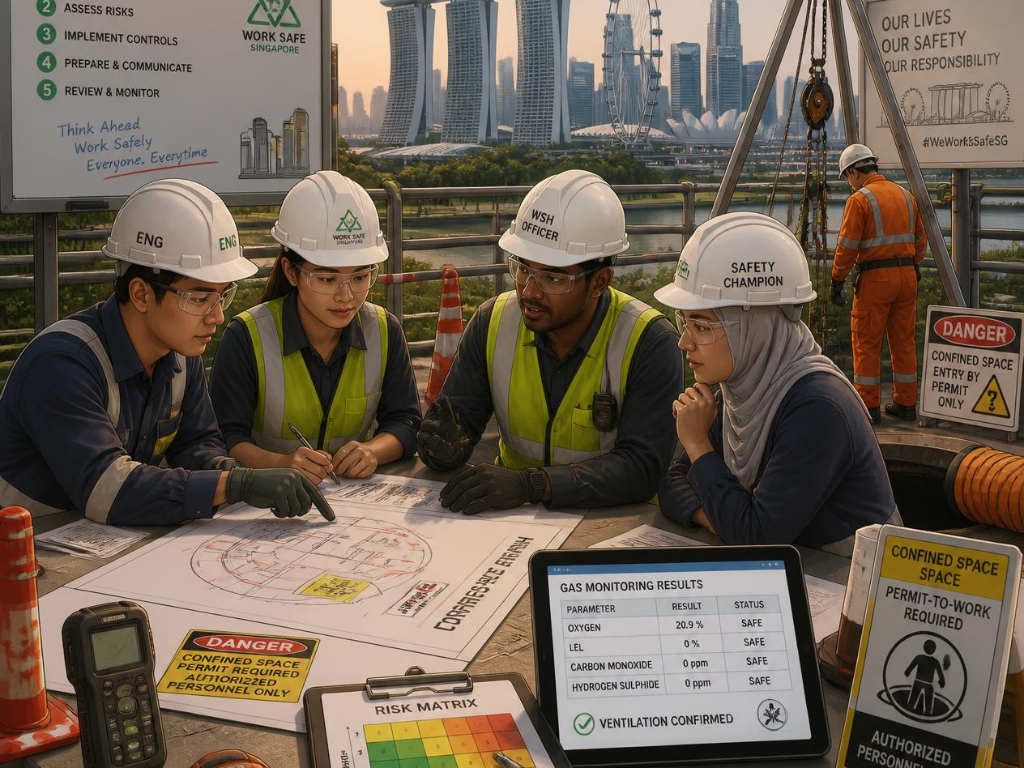
A confined space risk assessment in Singapore is not a section of your HIRADC. Regulation 5 makes it a precondition of entry, and most site registers fail that test quietly. MOM recorded 36 workplace fatalities in 2025, a record-low 0.96 per 100,000 workers. This blog walks you through where the two assessments diverge, who must sign, and what a compliant one contains, drawn from WSH consultancy and inspection work.
What is a confined space risk assessment, and is it legally separate from HIRADC?
A confined space risk assessment is a hazard evaluation required by Regulation 5 of Singapore’s Workplace Safety and Health (Confined Spaces) Regulations 2009, conducted before any entry, identifying the atmospheric, physical and biological hazards of a specific space and the controls that make entry survivable. It uses the HIRADC method but exists as a separate legal requirement.
The wording of Regulation 5 does the work. No person may enter or work in a confined space “unless a risk assessment has been conducted” in accordance with the WSH (Risk Management) Regulations. Two instruments stack: the Risk Management Regulations supply the method, and the Confined Spaces Regulations make that method a gatekeeping condition for a specific act.
The separation matters because the consequences differ. A general HIRADC that misses a hazard produces a weak control. A missing confined space assessment makes the entry itself unlawful, and no permit issued on top of it can be valid, since the permit application under Regulation 11(c) has to state measures that come from somewhere.
If you need the underlying method rather than the confined space overlay, how HIRADC works day to day covers the identification, rating and control sequence. This article covers only what changes when the work happens inside a tank.
How does a confined space risk assessment differ from a standard HIRADC?
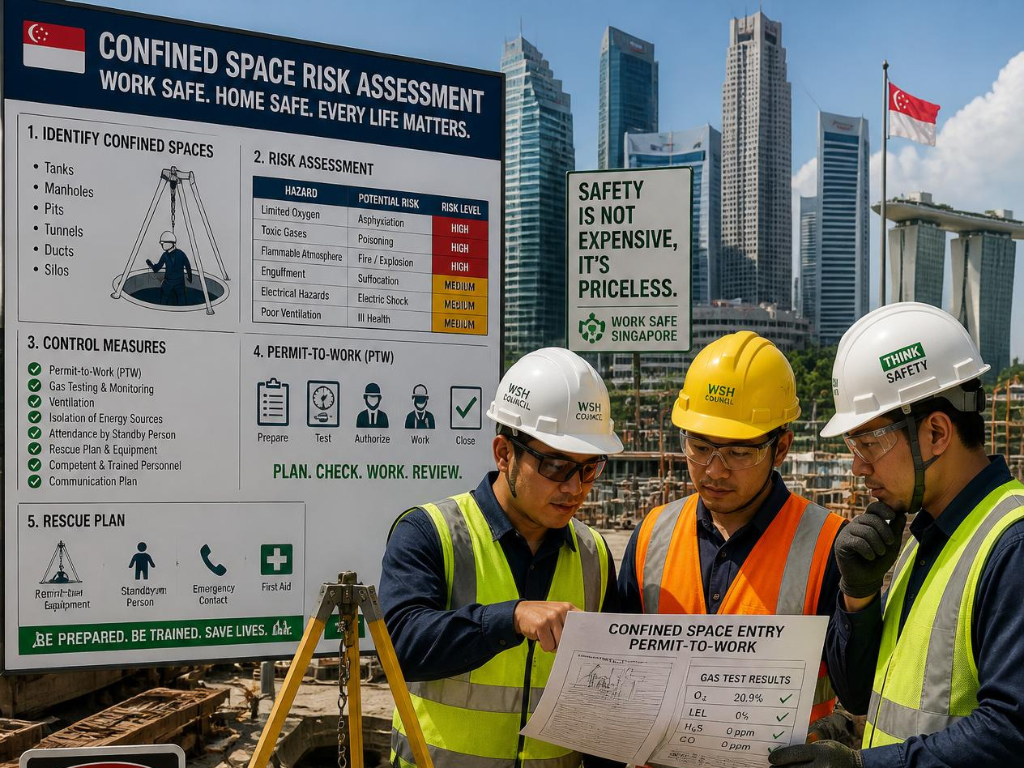
Seven ways, and none of them are cosmetic. The differences run to who writes it, what it attaches to, what it assumes, and what consumes its output.
A standard HIRADC organises by work activity. A confined space assessment attaches to a physical space. Regulation 4 requires a record of confined spaces in the workplace, and WSH Council guidance expects every space to be identified, documented and labelled, with equipment records carrying the type and an identification number. Your register lists Tank 3B, not “cleaning operations.”
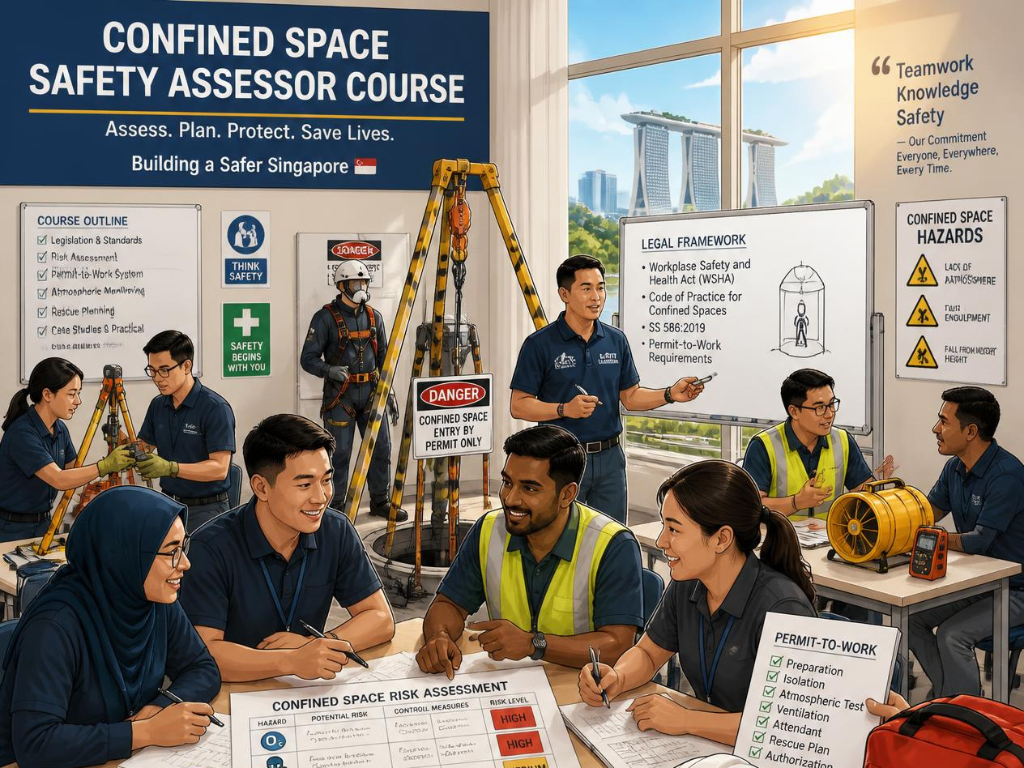
A standard HIRADC is authored by an RA team the employer designates. The confined space assessment names its authors. WSH Council guidance requires it to be jointly conducted by the supervisor and the authorised manager, two statutory appointees, before the permit application is made.
A standard HIRADC starts from observed hazards and rates them upward. The confined space assessment starts from presumed lethality. WSH Council guidance instructs teams to “always consider a confined space as immediately dangerous to life and health” unless proven otherwise. The burden of proof runs the opposite direction.
A standard HIRADC assumes the task happens. The confined space assessment is required to test whether entry is necessary at all before assessing anything else.
A standard HIRADC feeds training and safe work procedures over months. This one feeds an entry permit within days, sometimes hours.
A standard HIRADC runs on a three-year review cycle. This one runs on four clocks.
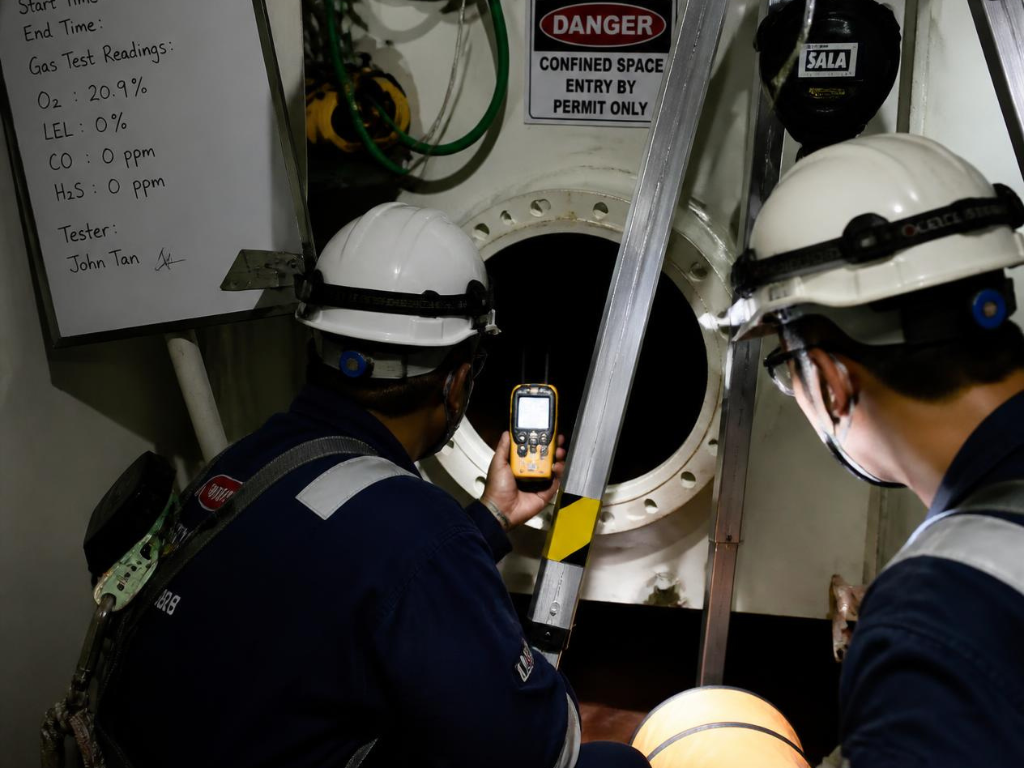
A standard HIRADC treats atmosphere as one hazard among many. Here, atmosphere is the hazard class that kills, and it gets verified independently by a third appointee before every single entry.
The same logic applies whenever HIRADC meets a specialised hazard class. Applying it to worksite traffic produces a similar narrowing, though without the statutory gatekeeping that Regulation 5 imposes here.
Who must conduct the confined space risk assessment?
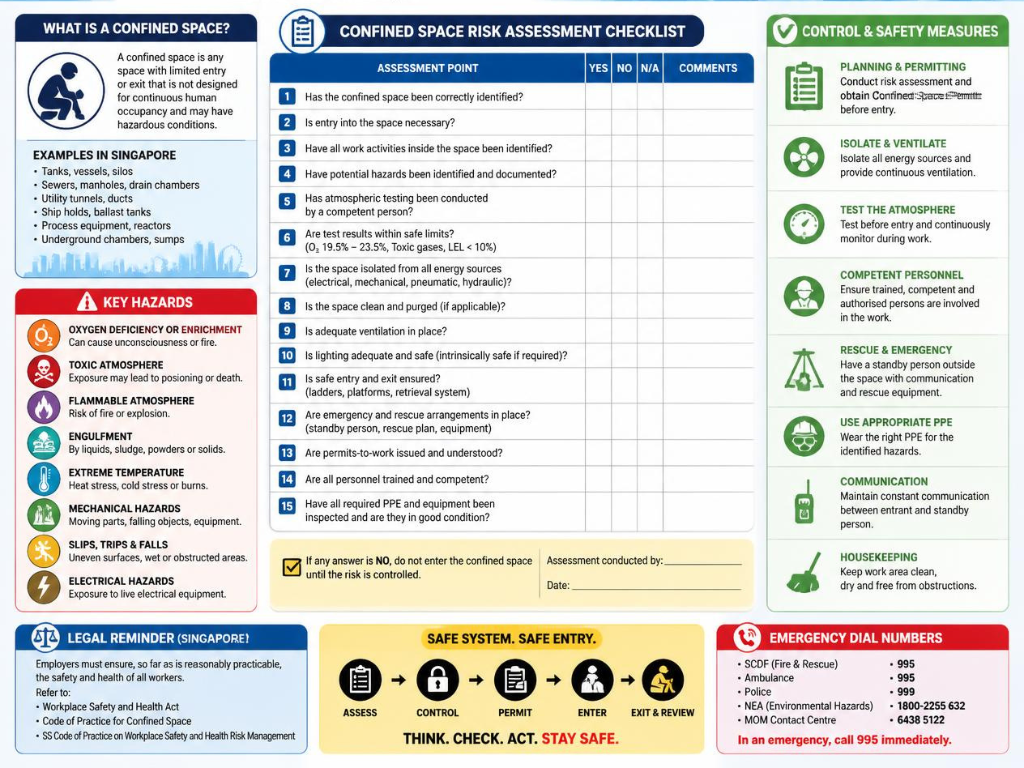
The supervisor and the authorised manager, together. WSH Council guidance requires the risk assessment to be jointly conducted by both before the application for entry is made, which makes it the only risk assessment in Singapore’s WSH framework naming two statutory appointees as co-authors.
The pairing is deliberate. The supervisor knows the task, the crew, the sequence and the equipment going in. The authorised manager holds the issuing power and has to be satisfied on six separate conditions under Regulation 13(1) before signing a permit. Requiring both to build the assessment means the person who authorises entry cannot claim ignorance of what the assessment said.
Where this breaks down is inheritance. A contractor arrives on a site, receives a confined space assessment written by the previous contractor two years ago, and treats it as current. The named supervisor no longer works there. The authorised manager has changed. The document is now a template with two stale signatures, and neither current appointee can describe how any control was chosen.
WSH Council guidance is firm that the assessment must be conducted by knowledgeable and experienced personnel, and the practical test is simple. Ask the authorised manager why forced ventilation was selected over local exhaust for that space. An assessment they co-authored produces an answer. One they inherited produces a search through a folder. Supervisors and managers who have worked through building the assessment properly at bizSAFE Level 2 tend to hold up under that question.
Which hazards does a general HIRADC template usually miss?
Engulfment, entrapment, oxygen enrichment, and the rescuer-multiplication effect. Generic HIRADC templates carry slips, falls, manual handling, electrical and chemical exposure. They rarely carry the four hazard classes that make confined spaces categorically different.
Engulfment is being buried or submerged by material that behaves like a fluid. Collapsing flour, catalyst, grain, sand or gravel, or the inadvertent opening of a feed line into an occupied space. Entrapment is structural: tapering or inwardly sloping smooth walls, as in a cyclone, where a worker slides toward the narrow end and cannot climb out.
Oxygen enrichment gets omitted almost universally because teams think of oxygen only as something that runs out. Above 23.5% by volume, ordinary materials ignite far more readily, and the usual cause is a leaking cutting torch left inside overnight. Ambient air sits at 20.9%, the legal floor is 19.5%, and between 6% and 8% oxygen exposure is fatal within eight minutes, killing half of those exposed within six.
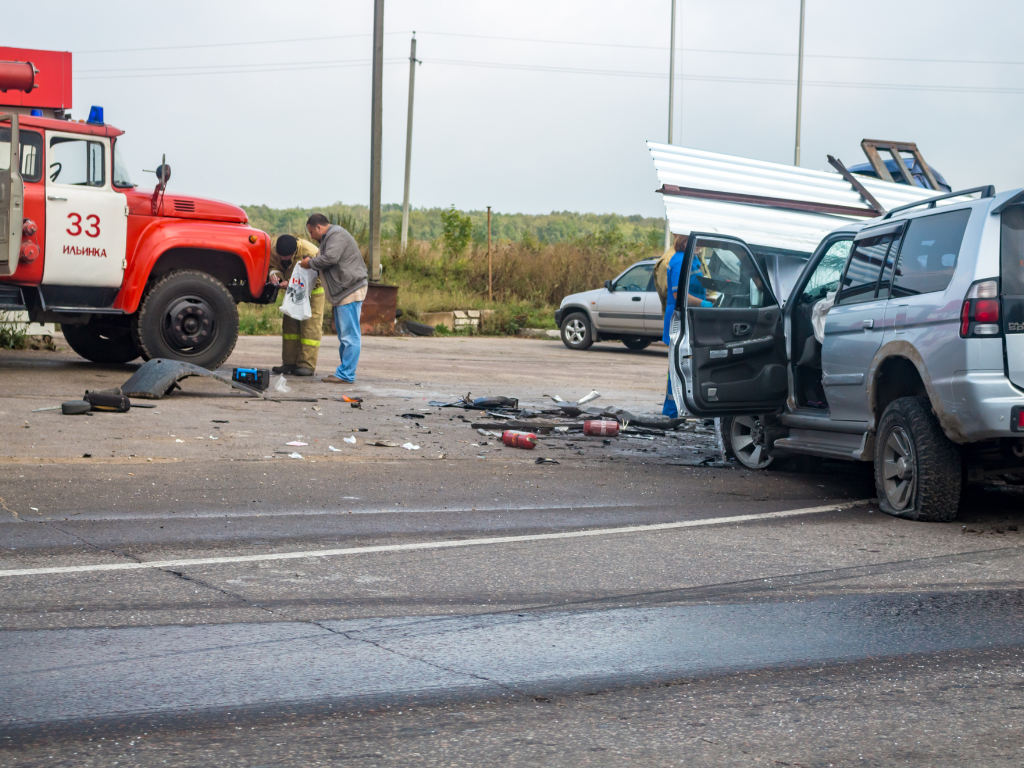
The fourth is the one that turns single fatalities into multiple ones. WSH Council guidance notes that those killed in confined spaces include not only the workers inside but the people who tried to rescue them, and that an unplanned rescue is likely to be the rescuer’s last. A generic HIRADC has no row for “someone will instinctively climb in after a collapsed colleague.” A confined space assessment must, because roughly four minutes without adequate breathing causes permanent brain damage and that timeline is what drives people to act without equipment.
Biological hazards belong here too. Viruses and bacteria in decomposing waste or standing water, plus insects, rodents and snakes, all appear in WSH Council’s confined space hazard list and almost never in a general workplace template.
Why does the assessment start by asking whether anyone should enter at all?
Because WSH Council guidance treats entry into a confined space as a last resort, and requires the assessment to consider alternatives before it considers controls. The first key element of the assessment is assessing the need for entry, not identifying hazards.
This inverts the normal HIRADC sequence, where the task is given and the assessment manages it. Here the task is provisional until someone demonstrates it cannot be done another way.
The alternatives are usually more available than crews assume. WSH Council guidance gives the worked example of a vacuum machine with an extended hose to extract sludge instead of sending a person in to remove it manually. Remote camera inspection replaces visual entry. External cleaning ports replace internal access on some vessel designs. None of these are exotic, and all of them appear in the substitution rung of the hierarchy of controls.
In practice, entry gets treated as a given because it is faster and because the equipment is already on site. That reasoning is exactly what the assessment is designed to interrupt. A confined space assessment that never records the alternatives considered has skipped its first required step, and an MOM investigator reading it after an incident will notice the omission immediately.
Regulation 10(1)(a) reinforces the point from the other direction, requiring the occupier of the workplace to evaluate that entry is necessary before any permit is issued. Two separate provisions ask the same question, which is a reasonable signal of how seriously the framework treats it.
How does the hierarchy of controls change inside a confined space?
The top two rungs stop being theoretical. Elimination and substitution, which most HIRADC exercises skip past on the way to PPE, carry real options here, and WSH Council guidance names them explicitly for confined space work.
Elimination in this context means removing hazards inside the space so entrants can complete the task and exit safely. Disconnecting and applying lockout-tagout to every electrical energy source feeding equipment in the space. Removing sludge remnants and any trapped product or gas through continual cleaning before entry.
Substitution means doing the job without going in. The vacuum-and-hose example sits here.
Engineering controls centre on continuous forced ventilation paired with continuous atmospheric monitoring. Ventilation type follows toxicity: forced ventilation with a blower suits contaminants with a permissible exposure level at or above 500 ppm, while local exhaust ventilation applied at the source is the right tool below 500 ppm.
Administrative controls are the entry procedures and the permit system itself.
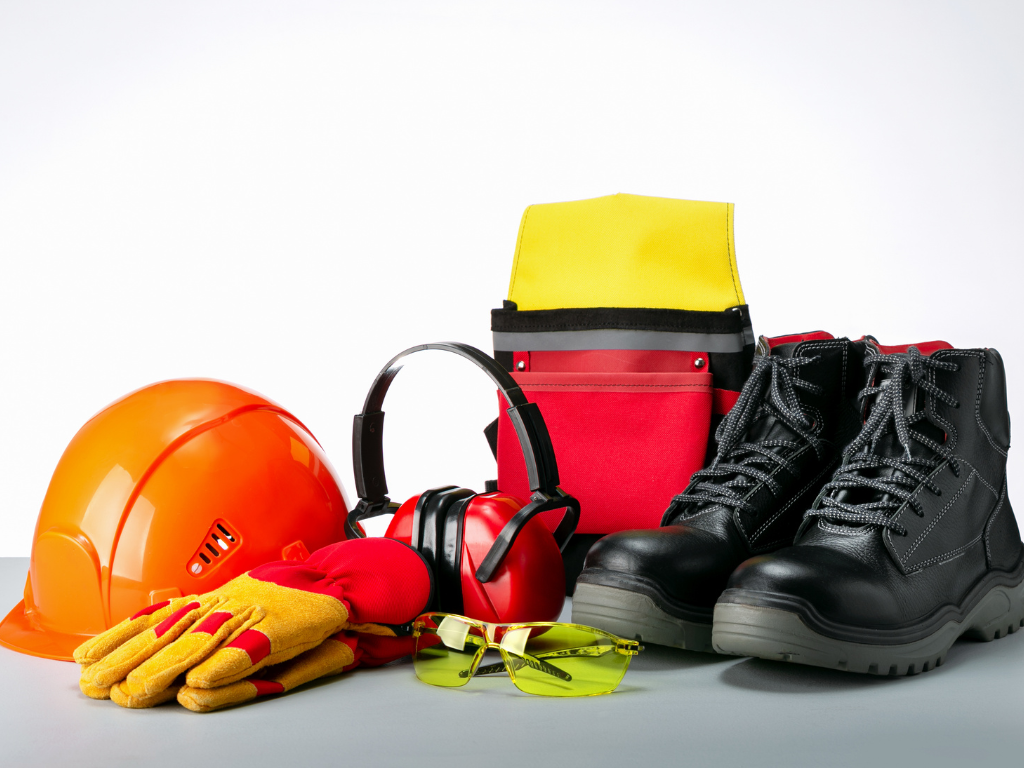
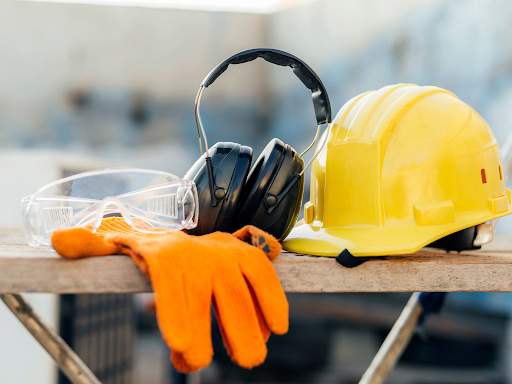
PPE sits last, and confined space work has a specific restriction most templates get wrong. Air-purifying cartridge respirators offer no protection against oxygen deficiency and must not be used in oxygen-deficient atmospheres below 19.5%, in poorly ventilated spaces such as tanks and tunnels, or where contaminant concentrations are unknown or immediately dangerous to life or health. Only supplied-air respirators, meaning SCBA or airline systems, are acceptable where oxygen is lacking. A risk assessment specifying “respirator” without naming the type has specified nothing, which is the same failure pattern that shows up when organisations struggle at turning findings into real controls.
How does the risk assessment feed the confined space entry permit?
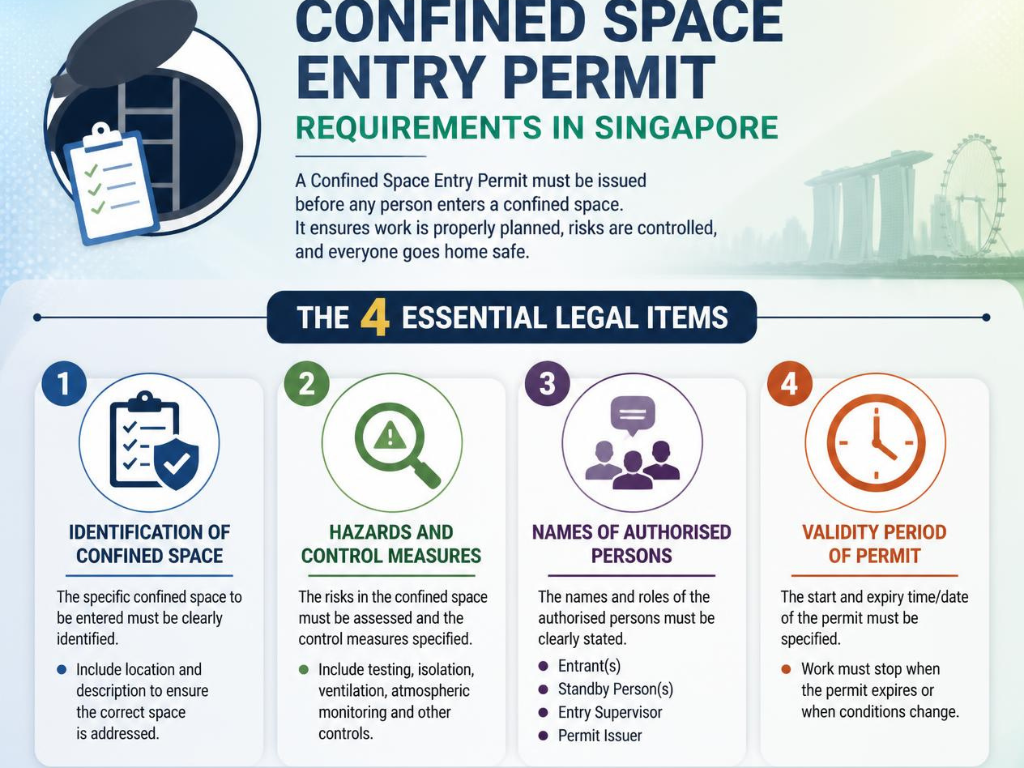
Directly, and in writing. Regulation 11(c) requires the permit application to state the measures which will be taken to ensure the safety and health of persons entering the space, and those measures are the control column of the risk assessment.
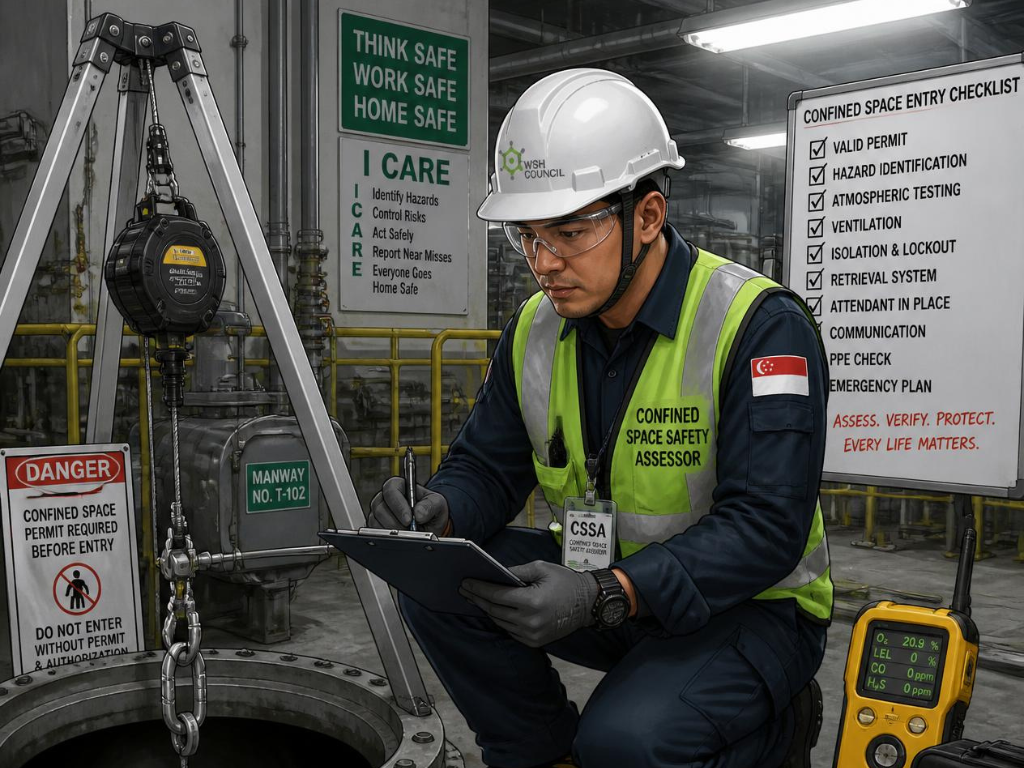
The chain is short and traceable. The supervisor and authorised manager conduct the assessment. The supervisor writes the resulting measures into the permit application under Regulation 11 and submits it to the confined space safety assessor. The assessor tests the atmosphere, which independently verifies the assessment’s atmospheric assumptions, and endorses under Regulation 12(3). The authorised manager issues under Regulation 13(1) after confirming six conditions, several of which are checks against what the assessment predicted.
That third-party verification step has no equivalent in general HIRADC. A standard risk assessment predicts a hazard level and nobody measures it before work starts. Here, an appointed assessor puts an instrument into the space and confirms or refutes the prediction every single time.
The failure mode is an assessment written in generic language. “Ensure adequate ventilation” transfers to the permit as “ensure adequate ventilation,” which tells the authorised manager nothing he can be satisfied about under Regulation 13(1)(d). An assessment specifying forced ventilation via blower with ducting to the base of the vessel, running continuously through the permit validity period, gives him something to verify.
How often must the assessment be reviewed, and how long must records be kept?
Review at least once every three years, and keep records for at least three years. Three further triggers sit on top of the calendar, which is where confined space assessments diverge from the standard cycle.
WSH Council guidance requires review whenever there is a significant change to work practices or procedures, including the implementation of additional risk control measures, and after any incident arising from work in confined spaces. Neither trigger waits for the three-year mark.
Two more clocks run at permit level rather than assessment level. Regulation 18(1) obliges the authorised manager to review the need for entry on a daily basis and revoke the permit if he thinks fit. Regulation 16(1)(c) requires an evaluation of how a hazardous atmosphere developed whenever one is detected, and that evaluation feeds back into the assessment if the cause was a control failure rather than a one-off.
Retention periods differ by document type and people mix them up. Risk assessment records run to at least three years. Atmospheric test records and entry permits run to not less than two years under Regulation 16(3). Keeping everything for three years is the simpler policy and the one I would recommend, since the cost of over-retention is a filing cabinet and the cost of under-retention is an unanswerable question during an investigation.
Documentation content is specified rather than left open. The record must include the findings of the assessment, the risk control measures taken or to be taken within an agreed time frame, and any safe work procedures. Missing review dates and missing signatures are among the most common findings when what auditors actually check is applied to risk assessment files.
What does a compliant confined space risk assessment actually contain?
Six components, and the first two are the ones sites skip. It opens with the evaluation of whether entry is necessary and the alternatives considered, then identifies and evaluates the specific space by name and identification number.
From there it follows the standard structure with confined-space-specific content. Hazard identification covering atmospheric hazards, meaning oxygen deficiency and enrichment, flammable gases and vapours, and toxic gases; physical hazards including engulfment, entrapment, mechanised equipment, extreme temperature, noise and poor illumination; and biological hazards from decomposing waste or standing water.
Risk evaluation rates each hazard and prioritises for control. Control determination applies the hierarchy with named, specific measures rather than categories. Communication records what was told to the workers, including the activities, the nature of the risks, the controls implemented, and their obligations under the permit-to-work system.
The sixth component is the one that separates a working assessment from a filed one: named ownership and dates for every control. WSH Council documentation requirements call for control measures to be taken “within an agreed time frame,” which means a control with no owner and no date is an incomplete entry.
Two checks tell you quickly whether an assessment is real. Does it name the specific space with an identification number, or does it say “confined spaces on site”? Does the control column specify equipment and configuration, or does it say “use PPE”? Companies unsure how their files would read to an inspector can get them checked through risk assessment review support against Regulations 4, 5 and 11.
The assessment decides whether entry happens, not just how
Singapore treats the confined space risk assessment as a gate rather than a record. It runs before the permit, names two statutory appointees as its authors, presumes the space is lethal until measurement proves otherwise, and has to justify why anyone is going in before it addresses how. A general HIRADC does none of those things, which is why a folder full of activity-based assessments leaves a company exposed the moment someone opens a manhole.
Have your confined space assessments reviewed against your actual space register before the next shutdown: space identification and numbering, supervisor and authorised manager co-signatures, alternatives considered, named controls with owners and dates, and review currency. Advanced Safe Consultants can tell you which of your spaces have no valid assessment behind them.
FAQs About Confined Space Risk Assessment Singapore
Do you need a separate risk assessment for every confined space?
Yes. Regulation 4 requires a record of every confined space in the workplace, and WSH Council guidance requires each to be identified, documented and labelled, with equipment records carrying type and identification number. Hazards vary by space, since a sewer manhole and a nitrogen-purged vessel share almost no atmospheric profile.
Can you use a confined space risk assessment template?
Use one as a structure, never as content. WSH Council guidance advises against assuming any confined space is hazard-free, since different chemical and physical hazards enter through different work activities. A template that names your space, its identification number, and its actual contents history is a record. One that does not is a formality.
What happens if you only have a general HIRADC and no confined space assessment?
The entry is unlawful. Regulation 5 prohibits entry unless a risk assessment has been conducted under the WSH (Risk Management) Regulations, and Regulation 24 exposes an individual to a fine up to $20,000, imprisonment up to two years, or both. Any permit issued on that basis rests on nothing.
Who reviews the confined space risk assessment after an incident?
The supervisor and the authorised manager who conducted it. WSH Council guidance requires review after any incident arising from confined space work, separate from the three-year cycle. Where a hazardous atmosphere triggered the incident, Regulation 16(1)(c) also requires an evaluation of how that atmosphere developed before any re-entry.
How long must confined space risk assessment records be kept in Singapore?
At least three years. WSH Council risk management guidance sets three years for risk assessment reports, while Regulation 16(3) sets a separate two-year minimum for atmospheric test records and entry permits. Retaining all confined space documentation for three years avoids the mismatch entirely.