- 08 Sep 2026
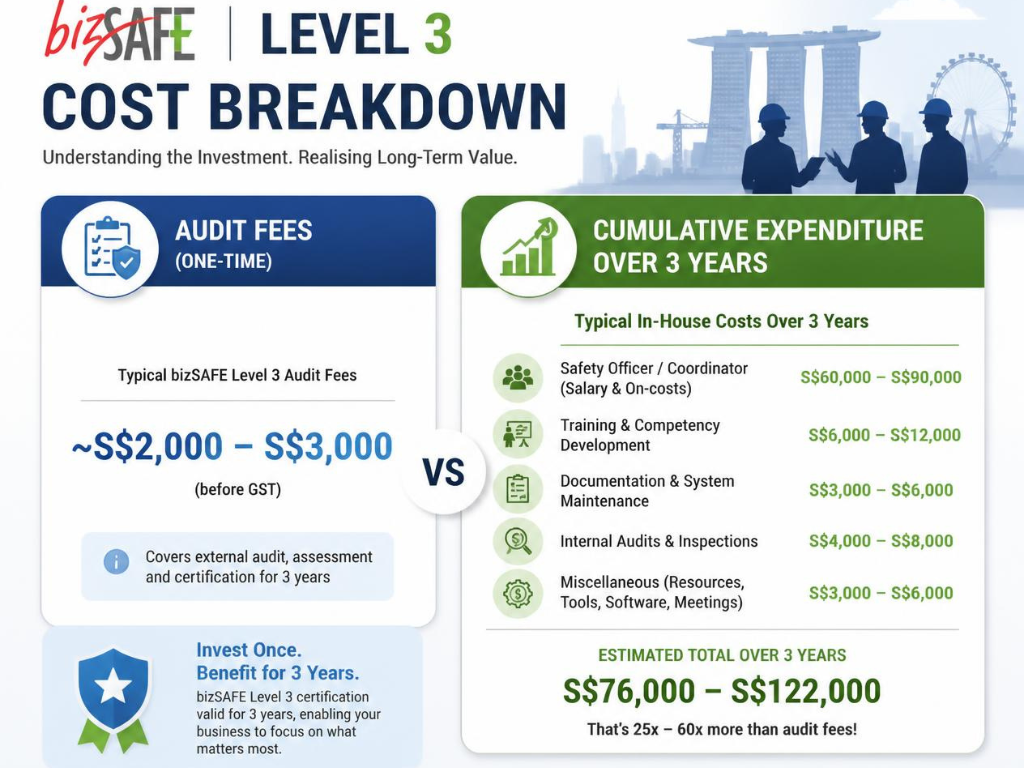
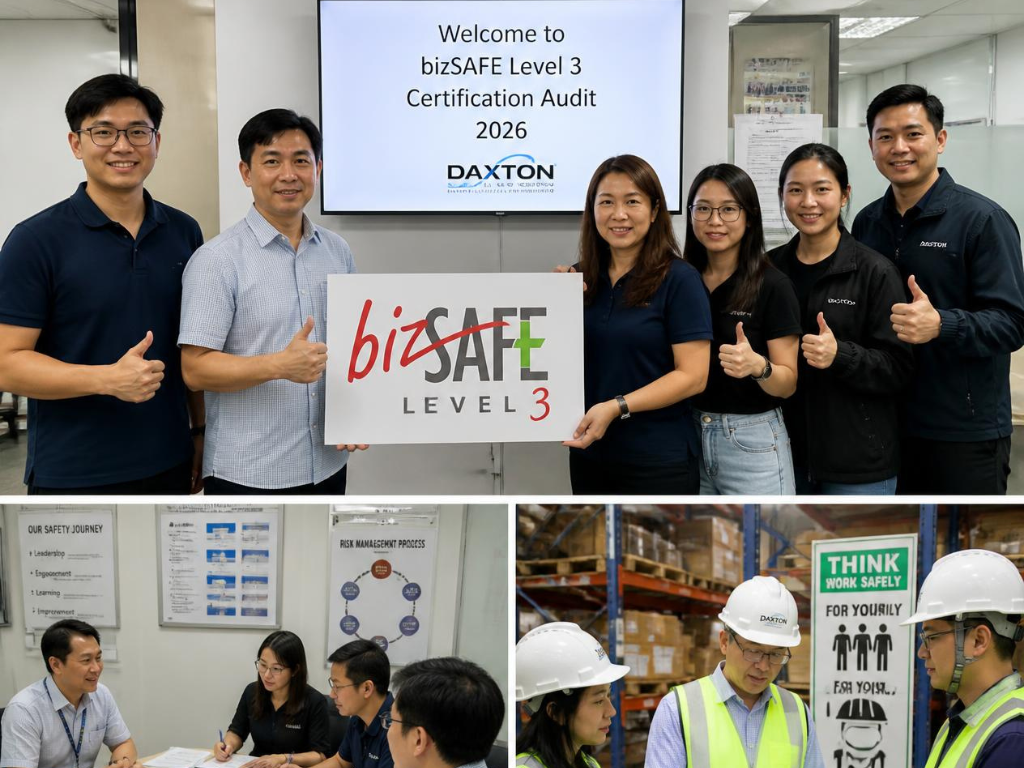
bizSAFE Level 3 cost in Singapore splits into three lines: the training fee for the prerequisite levels, the audit fee paid to an Auditing Organisation, and optional consultancy to get the documentation ready. Applying to the WSH Council is free. Around 43,000 companies now hold bizSAFE recognition. This blog walks you through each line, starting with the Level 2 risk management course that gates the whole process.
What does bizSAFE Level 3 actually cost in Singapore in 2026?
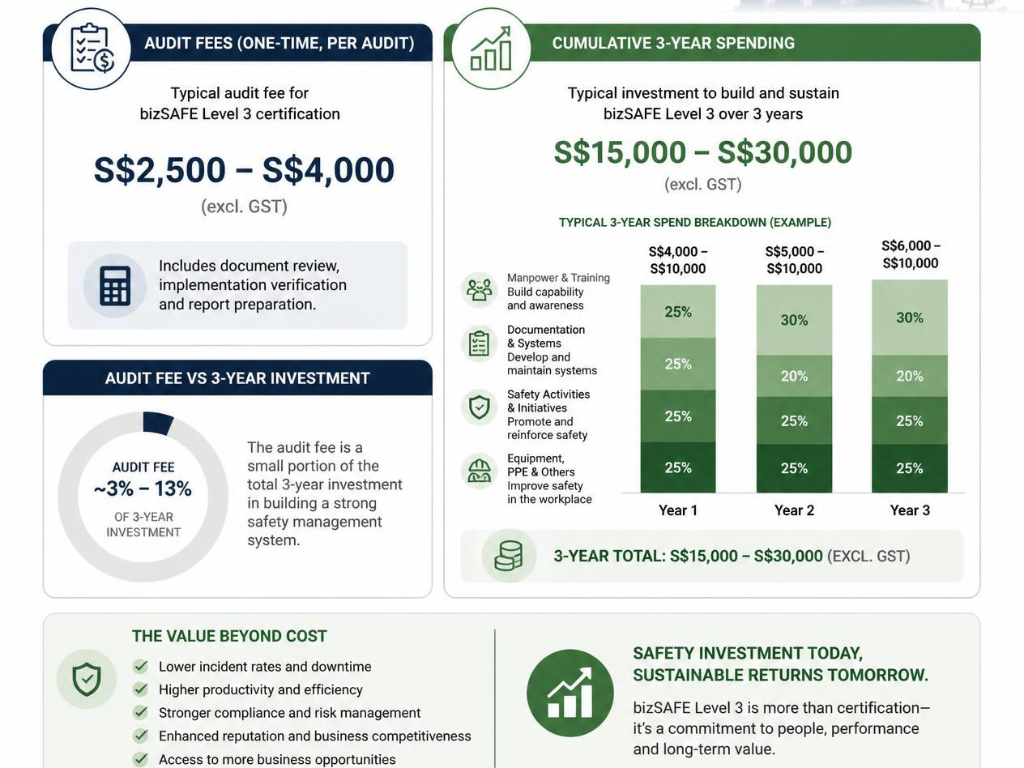
Between S$1,800 and S$5,300 all-in for a first-time SME, based on publicly advertised 2026 pricing across Singapore training providers, consultancies and Auditing Organisations. The spread is wide because two of the three lines are quoted per company, not per certificate.
The three lines break down like this. Training for the prerequisite levels runs roughly S$50 to S$300 for the Top Executive WSH Programme and S$150 to S$600 for the two-day Level 2 course before subsidies. The Risk Management audit fee sits between S$800 and S$2,000. Consultancy, where engaged, runs S$1,200 to S$3,000.
A company with existing risk assessments, a trained RM Champion and one site pays the audit fee and little else. A logistics operator with four sites, no written safe work procedures and a CEO who has never attended the workshop pays across all three lines. Both companies get the same certificate, valid for three years.
The number most companies quote each other is the audit fee, because it is the only line with an invoice attached to a fixed deliverable. Treating it as the cost of bizSAFE Level 3 is the mistake that produces budget overruns.
Is there a fee to apply for bizSAFE with the WSH Council?
No. The WSH Council states plainly that it is free to apply for bizSAFE at every level, and that costs arise only from training and auditing. There is no certificate fee, no logo licence fee and no renewal application fee.
This matters for two reasons. Any quote that itemises a “WSH Council submission fee” or “certification fee payable to WSHC” is charging you for something that does not exist. Ask what that line is.
The Council also advises companies to submit the bizSAFE application themselves rather than delegating it to a consultant, citing the risk of fraud or forgery. Applications are tagged to your UEN and the e-certificate goes to your senior management representative by email. Processing takes 10 working days from submission, and renewal applications should go in two months before your existing status expires.
Handing your application to a third party saves perhaps thirty minutes of admin. It also removes your only direct sightline into what was submitted on your behalf.
What does the audit fee cover, and who do you pay it to?
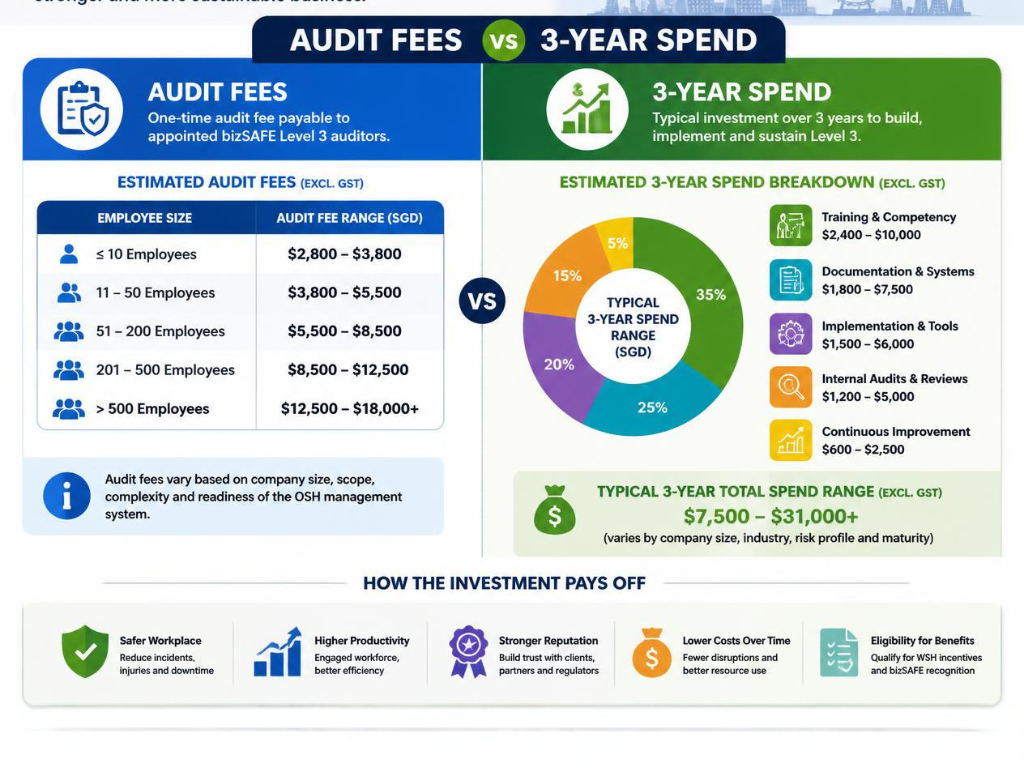
The Auditing Organisation, directly. The audit fee covers document review, the on-site audit, the written Risk Management audit report, and the auditor’s recommendation to the WSH Council. It does not cover fixing anything the auditor finds.
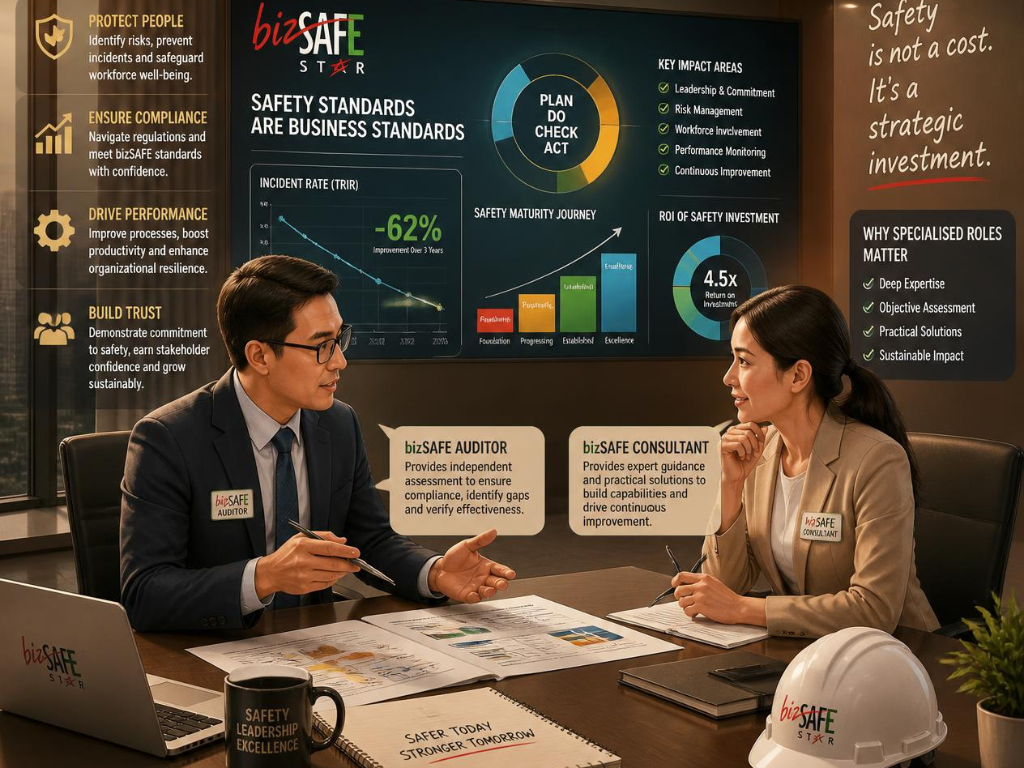
The auditor must hold MOM approval as a WSH Auditor and work through an Auditing Organisation accredited by the Singapore Accreditation Council. MOM publishes the list of registered WSH auditing services. Advanced Safe Consultants prepares companies for that audit and does not conduct it, because the accreditation framework separates the two roles deliberately.
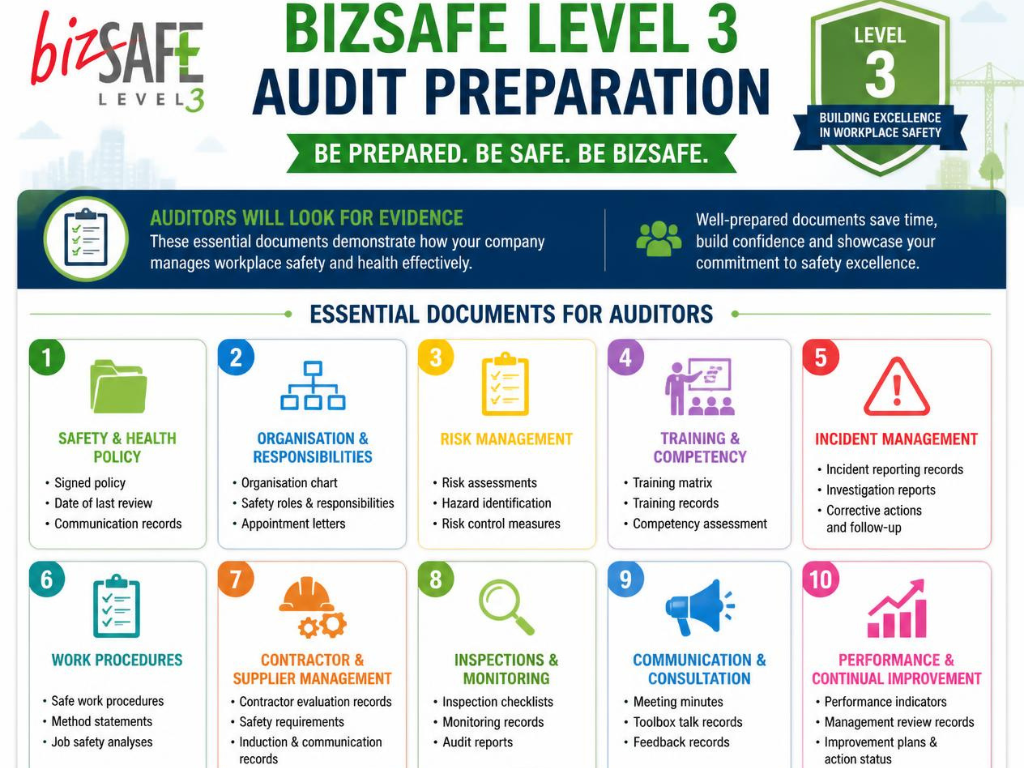
What sets the price is auditor hours. The Risk Management Audit Checklist moved to Revision V3.3 on 1 July 2026 and carries 28 main audit questions across five sections, plus five Audit Highlights covering vehicular safety, machinery safety, slips trips and falls, work at height, and health promotion. Roughly a third of those questions require the auditor to interview three people or physically inspect the workplace. Interviews and walkthroughs consume time in a way that document review does not, which is why a 12-person office and a 90-person yard get very different quotes off the same checklist.
Why is one bizSAFE Level 3 audit quote higher than another?
Four variables move the number: employee headcount, the number of work activities in your inventory, the number of sites in scope, and the risk profile of the sector. Ask any Auditing Organisation to itemise against those four and the quotes become comparable.
Headcount drives interview volume. The checklist repeatedly instructs the auditor to interview three employees per question, and on a multi-shift operation those three cannot all come from the day shift. The inventory of work activities drives sampling depth, because the auditor pulls risk assessments and safe work procedures from that list. A warehouse with 14 listed activities is a different job from a marine contractor with 60.
Multi-site scope is the variable companies underestimate most. Each site in scope needs its own walkthrough. A cleaning contractor operating across six client premises is quoting six inspections, not one.
Sector risk profile then sets how hard the Audit Highlights bite. A company running a lorry fleet faces speed limiter verification, which the WSH Council added to the checklist in its December 2025 revision. A company with work at height faces a Fall Prevention Plan check and a physical look at anchorage points.
Do you need a consultant, or can you do this in-house?
In-house works when you already have a trained RM Champion, written risk assessments covering every work activity, and implementation records. Everyone else buys the documentation work, either as a consultancy fee or as staff time nobody costed.
The honest comparison is not consultancy fee against zero. It is consultancy fee against the internal hours of a safety coordinator or operations manager writing risk assessments for the first time, plus the cost of a failed audit if the output misses. Publicly advertised timelines in 2026 show 2 to 4 weeks to certification with consultancy support against 3 to 6 months without. Advanced Safe Consultants puts the range at one to three months depending on documentation readiness.
Where this breaks down is companies that engage a consultant to write documents and then never implement them. Section 4 of the checklist carries eight implementation questions, and every one pairs document review with a physical inspection or an interview. A risk assessment naming a control that does not exist on the floor fails on the walkthrough regardless of who wrote it. Understanding what consultants actually do prevents that mismatch.
What does the consultancy fee actually buy?
Gap analysis, the inventory of work activities, risk assessments across those activities, safe work procedures for high-risk tasks, implementation tracking, and a pre-audit check. Advanced Safe Consultants lists risk management services for bizSAFE 3 certification, documentation preparation, gap analysis and audit readiness under its risk management consultancy scope.
Scope is where quotes diverge. A S$1,200 package usually means template risk assessments adapted to your activity list. A S$3,000 package usually means a consultant walking your site, interviewing supervisors, and writing assessments against what people actually do. The second costs more and survives the walkthrough.
Ask for the deliverable list in writing before signing. Specifically: how many work activities are covered, how many site visits are included, whether safe work procedures are in scope or extra, and whether a pre-audit mock is included. In practice, the pre-audit mock is the line that pays for itself, because closing a finding before the auditor arrives costs nothing and closing one afterwards costs a re-visit.
What sits outside the quote?
The corrective actions, the physical controls, the training refreshers, and the internal time. None of these appear on an audit quote or a consultancy quote, and together they often exceed both.
Corrective actions come first. If the auditor finds that machine guarding is missing, the fix is a guard, not a document. Audit Highlight 3 checks that company-issued safety footwear is on a regular inspection and replacement regime, which means a footwear budget. Audit Highlight 5 requires at least one programme managing a health risk named in your risk register plus one supporting well-being, which means a health screening or a programme with a real cost line.
Training refreshers sit outside too. Auditors review competency records for the roles named in your risk assessments, and expired first aid or trade certificates surface as findings. The wider safety audit expectations that apply during a MOM inspection overlap heavily here, so the spend is not wasted.
Internal time is the largest uncosted item. Building an inventory of work activities across a 40-person operation takes an operations manager several days. Worth noting: that time gets spent whether or not you engage a consultant. The consultant changes who does it, not whether it happens.
What happens to the cost if the audit fails or you get picked for verification?
A failed audit means closing findings and paying for the auditor to re-verify, and the WSH Council will not process your application until all findings are closed. A verification inspection is a separate risk, and it can cost you a second full audit.
The Council states that Auxiliary Enforcement Officers conduct sample verification onsite inspections on Risk Management audits as part of the application process, on a random sampling basis. Those checks test whether the Auditing Organisation followed the bizSAFE audit checklist and audited stringently. If the verification is unsatisfactory, you must re-conduct another Risk Management audit.
Read that carefully, because it is the cost line nobody quotes. The trigger is your auditor’s rigour, not your own performance. Pick an Auditing Organisation on price alone and you carry the risk of paying twice for the same audit, plus an application delay beyond the standard 10 working days.
The WSH Council’s own position is that applicants face no issues with verification inspections provided they have “engaged a responsible AO to do the audit.” That sentence is a pricing instruction in disguise.
How much of the training cost can actually be subsidised?
Up to 70% of the Level 2 course fee for eligible SMEs and older Singaporeans, plus absentee payroll at S$4.50 per hour capped at S$100,000 per enterprise per calendar year. The audit fee and consultancy fee carry no equivalent subsidy.
At Advanced Safe Consultants, the bizSAFE Level 2 course under course code TGS-2024052143 runs 2 days and 16 hours at S$320 before 9% GST. After a 50% subsidy the net fee is S$188.80, and after a 70% subsidy for SMEs or participants aged 40 and above it drops to S$124.80. SkillsFuture Credit applies for Singapore Citizens aged 25 and above. SME eligibility runs to 200 employees at group level or S$100 million annual turnover, and what Level 2 training costs across the wider market sets the benchmark for comparison.
The asymmetry matters when you plan the spend. Training is the most heavily funded line and the smallest in absolute terms. The audit and the corrective actions are the largest lines and attract nothing. Companies that budget from the subsidised training number and assume similar relief on the audit are working from a false floor. Checking nominee eligibility first also stops a subsidised seat being wasted on someone who cannot meet the course entry standard.
What does bizSAFE Level 3 cost over three years, not one?
The certificate is valid for three years, so the honest number is the first-year spend plus one renewal audit plus the maintenance work in between. For a single-site SME that lands somewhere between S$2,600 and S$7,300 across the cycle.
Renewal is not a lighter version of the same audit. Section 5 of the checklist carries six review questions, and five of them apply only to renewal applications. The auditor asks for meeting minutes proving risk assessments were reviewed within three years, evidence of revision after any workplace injury, records of significant changes to work practices, sources of new WSH information and their effect on at least one risk assessment, and communication records showing changes were consulted on. Those records cannot be reconstructed in the week before the audit.
There is a sequencing trap in the middle of this. The WSH Council sets the validity of bizSAFE Levels 1 and 2 at 6 months from date of approval, and both are non-renewable once they expire. A company that takes eight months to get its documentation ready has to re-buy training it already paid for. That is a self-inflicted cost line, and it is the most common one.
Speaking at the WSH Awards 2025 on 24 September 2025, Minister of State for Manpower Dinesh Vasu Dash said MOM and the WSH Council were reviewing how bizSAFE could become “even more effective and reflective of good WSH performance.” Budgeting to today’s minimum standard is a poor bet against a programme being tightened.
Where does the cheap quote come from, and why should you avoid it?
Underscoped audits, template documentation, and in the worst cases, certificates that were never audited at all. The WSH Bulletin of 5 August 2025 reported a company director sentenced for issuing forged bizSAFE certificates.
That case sets the floor. A quote well below the S$800 mark for a full Risk Management audit is either scoping out sites and activities that belong in the audit, or it is not an audit. Both routes end at the same place, because bizSAFE status is verifiable through the Council’s bizSAFE Self-Help service and a forged certificate surfaces the moment a main contractor checks.
The legitimate version of a cheap quote is a genuinely small scope. One site, twelve work activities, eighteen employees, low-risk sector. Nothing wrong with that price. Ask the Auditing Organisation to write the scope into the quote, then check that the scope matches your operations rather than the part of your operations that is easy to audit.
Verifying provider accreditation before you compare prices is the cleaner sequence. It takes ten minutes against MOM’s published list of registered WSH auditing services and removes most of the risk from the decision.
Budget the cycle, not the certificate
The audit fee is the visible number and the smallest part of the real spend for most companies. What decides your total is scope: how many work activities you list, how many sites the auditor walks, and how much of your documentation already exists before anyone quotes. Companies that scope honestly at the start pay once. Companies that scope for the cheapest quote pay for corrective actions, re-verification, and sometimes a second audit they never planned for.
Request a scoped bizSAFE Level 3 quote from Advanced Safe Consultants with your work activity count, site count and headcount, and get the consultancy line and the audit line separated before you commit.
FAQs About BizSAFE Level 3 Cost Singapore
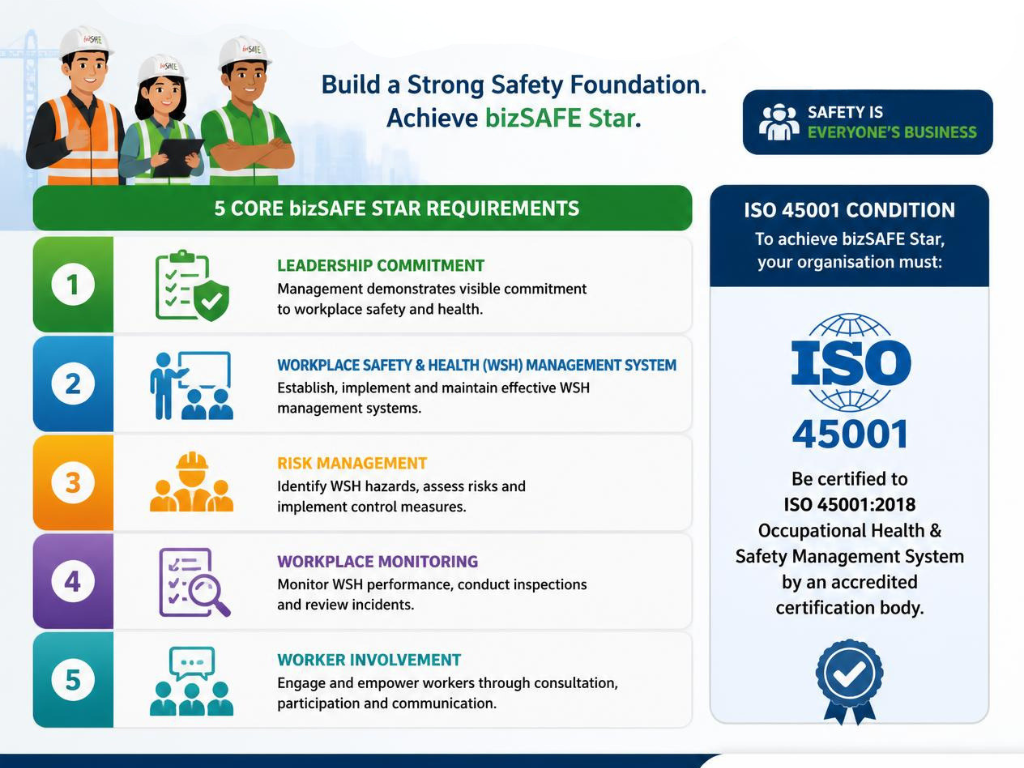
How long is bizSAFE Level 3 valid, and when do I pay again?
Three years from the date of approval, or until the expiry of a relevant external certification such as ISO 45001 or SS 651, whichever comes first. The WSH Council asks for renewal applications two months before expiry, so the next audit fee falls due at roughly month 32 of the cycle.
Do bizSAFE Levels 1 and 2 expire before I reach Level 3?
Yes. The WSH Council sets both at 6 months from date of approval and neither is renewable. A Level 3 project running past that window forces a repeat of the Top Executive WSH Programme or the two-day Level 2 course, so sequence the training to finish close to your audit date.
Can I claim absentee payroll for the bizSAFE Level 2 course?
Yes. Absentee payroll is claimable at S$4.50 per hour, capped at S$100,000 per enterprise per calendar year. For the 16-hour Advanced Safe Consultants course, that offsets a meaningful share of the S$124.80 net fee an eligible SME pays after a 70% subsidy.
What happens to my bizSAFE cost if my company changes its UEN?
You start again. bizSAFE applications are tagged to the Unique Entity Number, and the WSH Council cannot transfer records to a new UEN. A restructure or re-incorporation means a fresh bizSAFE Enterprise application, which for Level 3 means a fresh Risk Management audit and a fresh audit fee.
Is the bizSAFE Level 3 audit fee negotiable?
The scope is negotiable, the rate rarely is. Auditing Organisations price on auditor hours, so reducing sites in scope or tightening your inventory of work activities moves the number. Removing sites that genuinely operate is not a saving, because Auxiliary Enforcement Officer verification checks target exactly that gap.