- 22 Nov 2026
bizSAFE Star requires two documents, a Risk Management Implementation Audit Report and an accredited ISO 45001:2018 or SS 651:2019 certificate, and its validity follows that certificate rather than a fixed three years. This page is for Singapore companies holding Level 3 who are deciding whether the management system behind Star is worth building.
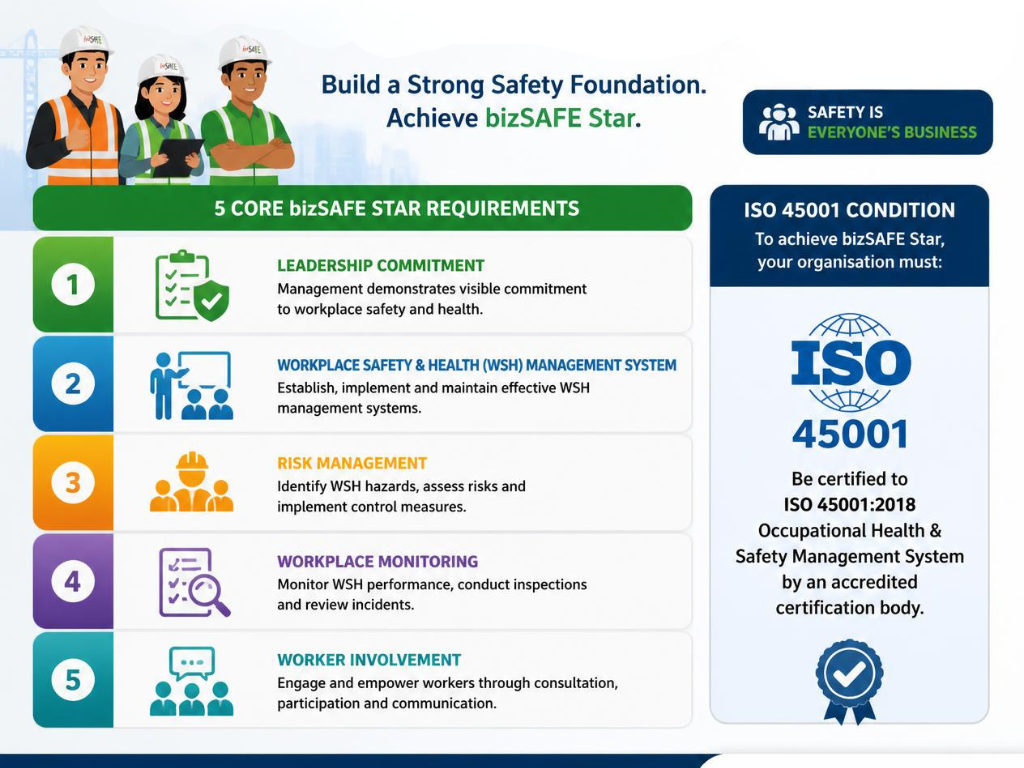
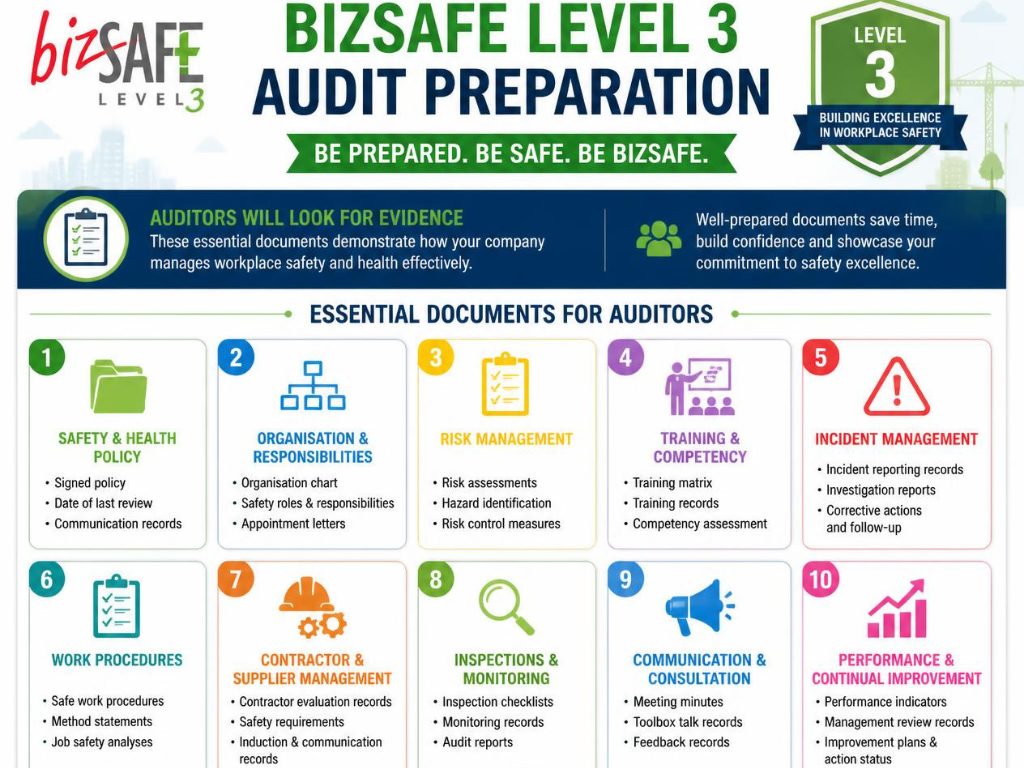
bizSAFE Star is the highest tier of the WSH Council’s bizSAFE programme, awarded to companies that hold both a current Risk Management Implementation Audit Report and an ISO 45001:2018 or SS 651:2019 certificate from a certification body accredited by the Singapore Accreditation Council. The WSH Council updated the requirements list in December 2025. This page covers the system behind it, starting with the WSH course catalogue beneath it.
What bizSAFE Star requires, in documents
Two documents, both issued in the company’s name. A Risk Management Implementation Audit Report from an accredited Auditing Organisation, and an ISO 45001:2018 or SS 651:2019 certificate from a certification body accredited by SAC or by an accreditation body recognised under a Mutual Recognition Arrangement.
That is the complete documentary requirement, set out in the Council’s supporting documents list. No course certificate appears on the Star row, and applying to the WSH Council is free at every level, with processing taking 10 working days.
The list is short and the project behind it is not. One of those two documents is a certified management system that takes most companies 9 to 18 months to build and certify. The other is an audit against a checklist your ISO 45001 auditor never opened.
Star sits above roughly 43,000 bizSAFE-recognised companies in Singapore. The number holding Star is a small fraction of that, and the certification condition is why.

What a WSH management system has to contain
Fifteen elements. The WSH Council’s WSHMS framework, used across its implementation guidelines and its WSHMS 2020 audit checklist, scores a management system against fifteen elements covering policy, organisation, risk management, training, operational control, emergency preparedness, performance monitoring and review.
The Council publishes a performance benchmark alongside it. Its SHARP 2025 application guidelines require a total element score of at least 70% for Band III in the WSHMS 2020 or ConSASS 2020 checklist, and the same threshold appears in the WSH Performance Awards criteria. Band III at 70% is the closest thing Singapore has to a published definition of a working management system.
Two of those fifteen elements account for most first-audit failures. The management review, where top management examines WSH performance, objectives, incident data and audit findings on a defined cycle and records its decisions. And the internal audit programme, which has to cover the whole system across the cycle with trained auditors and findings that were closed rather than logged.
The rest follow from those two. A signed WSH policy nobody reviews is a document. A hazard register nobody revises after an incident is a spreadsheet, which is why HIRADC review cycles matter more at Star than at Level 3.

Which checklist applies to your industry
WSHMS 2020 for marine, manufacturing and general industry. ConSASS 2020 for construction. The Council’s award criteria split them that way, and construction companies audited under ConSASS from October 2024 onwards were allowed to self-check rather than engage an approved Auditing Organisation for certain award applications.
That split matters when you scope the project. A manufacturer building toward Star works to WSHMS 2020 elements. A main contractor works to ConSASS. The ISO 45001 certification audit runs separately from both.
Is bizSAFE Level 4 a prerequisite for Star?
No. The WSH Council’s supporting documents list names only the audit report and the accredited certificate on the Star row, and the Council states that a company may apply for a level directly as long as it meets that level’s requirements.
Several widely-read guides state the opposite. Check the Council’s own document list before committing to a four-day course on the assumption that Star depends on it.
Level 4 remains worth doing on its own terms. It requires a WSQ Statement of Attainment for Develop a WSHMS Implementation Plan or WSH System Management, under course code MF-COM-403E-1 or WPH-WSH-4086-1.1, and it trains the person who will run the system. Building ISO 45001 without that capability in-house is harder, and the risk management course at Level 2 is where that capability starts.
The distinction is between useful and mandatory. Level 4 is a capability level, Star is an outcome level. Level 4 runs three years from approval. Star runs to the ISO 45001 expiry date.
How companies step up from Level 3 to Star
By converting a risk management system into a management system, which is a change of scope rather than a change of paperwork. Level 3 proves you assess and control risk. Star proves you run a governed system that sets objectives, measures them and corrects itself.
The practical sequence runs in four stages. Gap-assess your current Level 3 documentation against the fifteen WSHMS elements, because most Level 3 companies already satisfy the risk management elements and almost none satisfy management review or internal audit. Build the missing elements and run them long enough to generate records. Engage an SAC-accredited certification body for ISO 45001:2018. Hold a current Risk Management Implementation Audit Report at the same time.
Stage two is where timelines slip. An ISO 45001 auditor wants to see a management review that happened, an internal audit cycle that completed, and corrective actions that closed. None of that can be produced retrospectively, and a certification body will not accept a system with no operating history.
Worth noting: the RM audit and the ISO 45001 certification audit are separate engagements with separate auditors. Safety audit document expectations overlap between them, and the RM plan foundation built at Level 2 carries straight into the WSHMS risk management elements.
Why ISO 45001 does not remove the Risk Management audit
Because the two audits assess different standards. The WSH Council states that the Risk Management Implementation Audit focuses on the Code of Practice on WSH Risk Management, which “has additional coverage on addressing risks from terrorism, disease outbreaks and mental health.”
ISO 45001:2018 requires hazard identification and risk assessment. It does not specifically require terrorism threat assessment, disease outbreak planning or mental well-being as hazard categories. The bizSAFE Level 3 Risk Management Audit Checklist does, at Question 3.4, and it tests employee awareness of SGSecure tenets at Question 4.8.
The current RM checklist edition is Revision V3.3, in force from 1 July 2026, carrying 28 main audit questions across five sections and 5 Audit Highlights covering vehicular safety, machinery safety, slips trips and falls, work at height, and health promotion.
Budget two audits on two timelines. Companies that assume the ISO 45001 certificate closes the whole application discover the second requirement late.
Does your ISO 45001 certificate actually qualify?
Only if the issuing certification body is accredited by the Singapore Accreditation Council, or accredited by a body recognised under a Mutual Recognition Arrangement. A certificate from an unaccredited certification body does not qualify.
The Council drew this line explicitly in its requirements for bizSAFE Level 3, 4 and STAR, stating it will not accept OHSAS 18001 or non-accredited ISO 45001 certification approved after 31 March 2021. OHSAS 18001 was withdrawn internationally in March 2021 after a three-year migration window.
Check the accreditation mark on the certificate rather than the certification body’s marketing. Where this breaks down in practice is companies that certified years ago through a body that has since lost accreditation. The certificate still reads ISO 45001:2018. The accreditation behind it has lapsed.
Scope is the second check. ISO 45001 scope statements are precise and often narrower than companies remember, while the bizSAFE application covers the whole UEN.
Can you use SS 651 instead of ISO 45001?
Only if you operate in the chemical industry. The WSH Council lists SS 651 as the safety and health management system standard for the chemical industry, alongside SS ISO 45001 and SS 679:2021 for construction worksites.
Several guides present SS 651 as an interchangeable local alternative for any company. It is not, and SS 679 does not appear on the Star document list at all.
A second correction is worth making. Pages published as recently as mid-2026 still name SS 506 as the Star standard. The Council’s December 2025 supporting documents list names ISO 45001:2018 and SS 651:2019. A consultant quoting SS 506 is working from a superseded reference.
For a Jurong Island process operator, SS 651:2019 is a genuine route. For everyone else, ISO 45001:2018 is the path.
How long bizSAFE Star lasts
As long as your ISO 45001 certificate, and no longer. The Council sets Star validity as aligned to the certificate expiry date, and its validity table applies three years or the expiry of the relevant external certification, whichever falls earlier.
Two clocks run against each other. The RM audit report carries its own life of three years from the date of audit. The ISO 45001 certificate runs on its own cycle, typically three years with annual surveillance audits. Star ends when the first of the two ends.
A company that certifies to ISO 45001 in January, then takes 14 months to complete its RM audit and apply, receives Star with roughly 22 months on it. The certificate looks new and expires early.
Schedule the RM audit close to your ISO 45001 recertification rather than mid-cycle, and Star runs a full term. Renewal applications go in two months before expiry.
Who actually needs bizSAFE Star
Companies whose clients or regulators already require a certified management system, and companies in the workplace categories where MOM mandates periodic SHMS audits. For most SMEs, Level 3 held continuously is the better position.
MOM requires an SAC-accredited WSH Auditing Organisation or MOM-approved auditor to audit the safety and health management system in specific workplaces. Any worksite with a contract sum of $30 million or more is audited at least once every 6 months, and any shipyard employing 200 or more people falls on a 12-month cycle.
A 24-month cycle applies to factories processing petroleum or petrochemicals, premises storing 5,000 or more cubic metres of toxic or flammable liquids, and factories manufacturing pharmaceutical products or semiconductor wafers.
Smaller sites carry an internal review duty instead. A worksite with a contract sum under $30 million reviews its SHMS at least once every 6 months, and a shipyard employing fewer than 200 people reviews at least once every 12 months. That review can be run by a staff member who has passed an established audit course, which is where WSH consultancy and audit services usually enter before certification does.
BCA adds a procurement trigger. Its Construction Workhead registration requirements name ISO 45001 or bizSAFE Star at grades B1 and A1, while grades C1 and C2 accept bizSAFE Level 3 or ISO 45001. A contractor moving up the CRS grades hits the Star condition at B1.
What a bizSAFE Star consultant should actually deliver
Gap analysis against the fifteen WSHMS elements, then implementation support, then pre-certification readiness. A consultant who delivers a manual and leaves has sold you the part the auditor tests least.
Scope separates quotes. A documentation package produces a WSH manual, procedures and forms. An implementation engagement produces a management review that happened, an internal audit cycle that completed, and corrective actions that closed with evidence. Certification bodies audit the second.
Your consultant cannot be your certification body or your Auditing Organisation. SAC CT 17 adopts ISO/IEC 17021-1, under which a certification body and any part of the same legal entity are barred from offering management system consultancy, with a further two-year bar on personnel who consulted for the client.
Advance Safe Consultants prepares companies for the Risk Management audit and does not conduct it. Comparing WSH consultancies on implementation depth rather than deliverable count produces a different shortlist.
What breaks a bizSAFE Star application
A mismatch between the ISO 45001 certificate scope and the applying company. The certificate covers one site or one business unit, the application covers the whole UEN, and the two do not reconcile.
Two other failures recur. Certificates issued to a related entity with a different UEN, since bizSAFE applications are tagged to the UEN and cannot be transferred. And RM audit reports with open findings, since the audit report template instructs applicants not to submit until all findings are closed.
Auxiliary Enforcement Officers also conduct random onsite verification inspections of Risk Management audits as part of the application process. An unsatisfactory verification means re-conducting the audit and waiting beyond the standard 10 working days.
Speaking at the National WSH Campaign launch on 15 May 2026, WSH Council Chairman Abu Bakar Mohd Nor said companies must “go beyond systems and processes.” Star applications are read with that standard in mind.
Build the system, then collect the certificate
bizSAFE Star has the shortest requirement list in the programme and the longest build behind it. The documents are two. The work is fifteen WSHMS elements running long enough to produce records, an accredited certification body willing to certify them, and a Risk Management audit covering ground ISO 45001 does not reach. Companies that reach Star by building the system hold it. Companies that reach it by assembling documents lose it at the first surveillance audit or the first certificate lapse.
Book a Star readiness review with Advance Safe Consultants to have your Level 3 documentation gap-assessed against the WSHMS elements before you approach a certification body.
FAQs About Bizsafe Star Singapore
Can I apply for bizSAFE Star directly from Level 3?
Yes. The WSH Council allows direct application to any level whose requirements are met, and the Star row names only a Risk Management Implementation Audit Report and an accredited ISO 45001:2018 or SS 651:2019 certificate. Level 4 is not a documentary prerequisite, though its WSHMS training supports the build.
What happens to bizSAFE Star if my ISO 45001 certificate lapses?
Star status ends with it. The WSH Council aligns Star validity to the ISO 45001 expiry date, so a lapsed, suspended or withdrawn certificate removes the basis for the recognition. Restore the certification first, then reapply with a current Risk Management audit report.
Does bizSAFE Star exempt me from the mandatory SHMS audit?
No. The audit duty comes from the WSH (Safety and Health Management System and Auditing) Regulations and applies by workplace type, such as every 6 months for worksites with a contract sum of $30 million or more. bizSAFE Star recognition is separate and grants no exemption.
Is OHSAS 18001 still accepted for bizSAFE Star?
No. The WSH Council stated it would not accept OHSAS 18001 or non-accredited ISO 45001 certification approved after 31 March 2021. OHSAS 18001 was withdrawn internationally in March 2021, so companies still holding it must migrate to ISO 45001:2018 through an accredited certification body.
How long does it take to go from bizSAFE Level 3 to Star?
Nine to eighteen months for most companies, driven by the ISO 45001 build rather than the paperwork. A certification body needs to see a completed internal audit cycle, a management review that happened, and closed corrective actions, none of which can be produced retrospectively.