- 19 Nov 2026
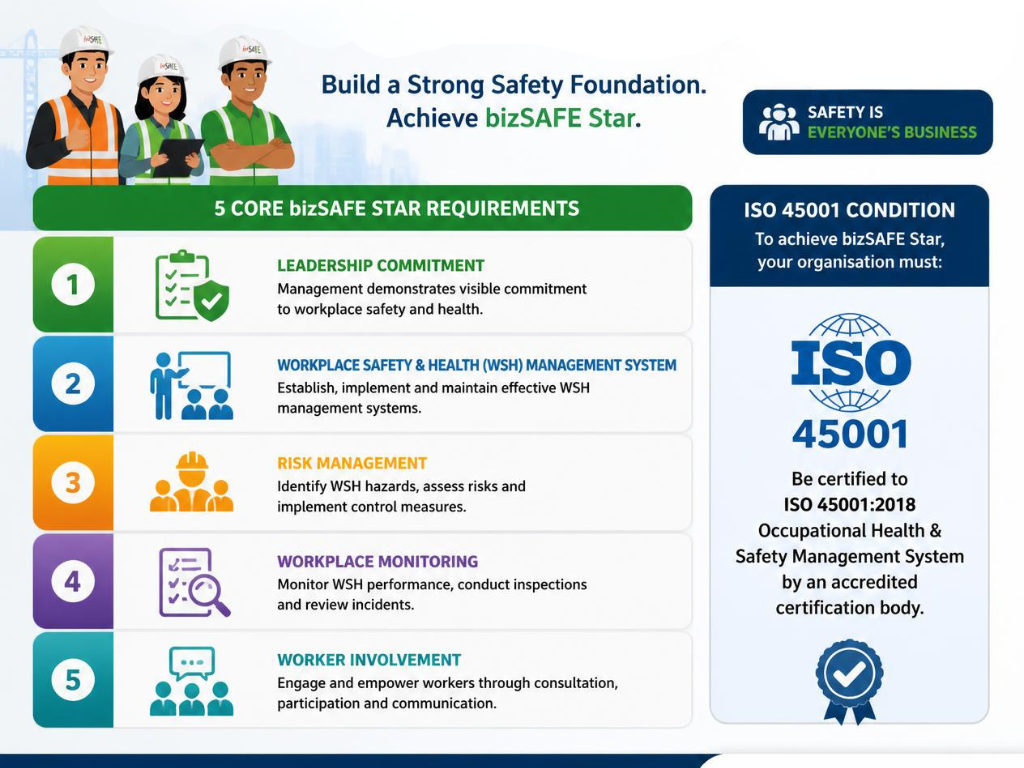
bizSAFE runs five levels, and the WSH Council’s own documents list sets out exactly what each one requires. Levels 1 and 2 last 6 months and cannot be renewed. Level 3 and above last 3 years. This page is for Singapore SME owners, HR managers and WSH coordinators deciding which level to aim for.
bizSAFE certification in Singapore is a five-level recognition programme run by the Workplace Safety and Health Council that scores a company on risk management capability, from a top management workshop at Level 1 to a certified management system at Star. Applying is free at every level. Around 43,000 companies hold bizSAFE recognition. This page walks the ladder, starting with the workplace safety course catalogue that covers the training rungs.
What bizSAFE is, and who decides whether you get it
The WSH Council awards bizSAFE status. MOM sits behind it, registering the auditors and enforcing the underlying law, but the Council processes the applications and issues the e-certificates.
bizSAFE recognises risk management capability rather than a safety record. A company with zero incidents and no written risk assessments does not qualify. A company with a documented, implemented and audited risk management system does, regardless of size.
Applying costs nothing. Processing takes 10 working days from submission. The certificate arrives by email to your senior management representative, and your status appears on the Council’s bizSAFE Self-Help listing, which refreshes fortnightly.
The cost sits in training and auditing, not the application. That distinction matters because quotes itemising a “WSH Council certification fee” are charging for something that does not exist.

The five bizSAFE levels and what each one requires
Each level is defined by the documents the Council accepts, not by a description of capability. The supporting documents list, last updated December 2025, is the authoritative version.
|
Level |
What it recognises |
Documents required |
Validity |
|
Level 1 |
Top management commitment |
Top Executive WSH Programme (TEWP) Certificate of Completion, in the attendee’s name |
6 months, non-renewable |
|
Level 2 |
A trained Risk Management Champion |
TEWP certificate plus WSQ Statement of Attainment for Develop a Risk Management Implementation Plan or WSH Control Measures (MF-COM-402E-1 / WPH-WSH-4075-1.1) |
6 months, non-renewable |
|
Level 3 |
An implemented RM system, independently audited |
Both of the above plus a Risk Management Implementation Audit Report from an accredited Auditing Organisation, issued to the company |
3 years, renewable |
|
Level 4 |
Capability to build a WSH management system |
RM Implementation Audit Report plus WSQ Statement of Attainment for Develop a WSHMS Implementation Plan or WSH System Management (MF-COM-403E-1 / WPH-WSH-4086-1.1) |
3 years, renewable |
|
Star |
A certified WSH management system |
RM Implementation Audit Report plus ISO 45001:2018 or SS 651:2019 certificate from a certification body accredited by SAC or recognised under a Mutual Recognition Arrangement |
Aligned to the certificate expiry date |
Two details on that table are worth reading twice. Levels 1 and 2 expire after 6 months and cannot be renewed, so a slow Level 3 project means buying training again. And every document above Level 1 that names a course is issued to an individual, not the company, so staff turnover breaks the chain.
The alternative entry routes most overviews leave out
Three external certifications give direct entry at Level 3, and the same three plus the WSHMS Statement of Attainment give direct entry at Level 4. A Singapore List of Trade Sub-Contractors membership certificate together with a Safety and Green Management Assessment Scheme audit certificate. A Joint Commission International certificate, for healthcare institutions. A Responsible Care Award Winner Letter from the Singapore Chemical Industry Council.
Validity on these routes follows the external certificate’s expiry date, not a flat 3 years. A construction subcontractor holding SLOTS with 14 months left has a bizSAFE clock of 14 months.
Do you have to climb the levels in order?
No. The WSH Council states that a company may apply for a level directly as long as it meets that level’s requirements. The five-step structure is a learning sequence, not a procedural gate.
In practice this changes two decisions. A company that already holds accredited ISO 45001 can apply for Star without ever holding Level 4, since the Star documents list names only the audit report and the certificate.
A company that has run risk management properly for years can go to Level 3 directly, provided its top management completes TEWP and someone holds the Level 2 Statement of Attainment first, because those two documents still appear on the Level 3 list.
Where this breaks down is companies treating Level 1 and Level 2 as certificates to collect. They are inputs to the Level 3 application. Collecting them more than six months before your audit wastes them.

Which bizSAFE level does your company actually need?
Level 3 for most companies, Level 2 only as a stepping stone, and Star only when a client, licence or regulation requires a certified management system. The decision should follow a named external trigger, not ambition.
Three triggers are documented and verifiable. Main contractors in construction routinely require subcontractors to hold Level 3 before awarding work. NEA requires a valid bizSAFE Level 3 for renewal of both Class 1 and Class 2 Cleaning Business Licences, alongside paid-up capital of $250,000 and $25,000 respectively. And MOM mandates periodic safety and health management system audits in specific workplaces, which pushes those companies toward Level 4 and Star.
Those MOM categories are specific. Any worksite with a contract sum of $30 million or more is audited at least once every 6 months. Any shipyard employing 200 or more people falls on a 12-month cycle. Factories processing petroleum or petrochemicals, premises storing 5,000 or more cubic metres of toxic or flammable liquids, and factories manufacturing pharmaceutical products or semiconductor wafers sit on a 24-month cycle.
A 25-person facilities contractor with none of those triggers is well served by Level 3 held continuously. The cleaner approach is to pick the level a named buyer or regulator asks for, then hold it without lapsing, rather than climbing for positioning.
A note on government tenders
bizSAFE is not a GeBIZ registration requirement. GeBIZ states that where a registration or qualification criterion applies, it is specified in that tender’s notice and documentation. Individual agencies and tenders do use bizSAFE as an evaluation criterion, and sector licences like NEA’s make it mandatory. Check the tender document rather than assuming a portal-wide rule.
How long does each bizSAFE level last?
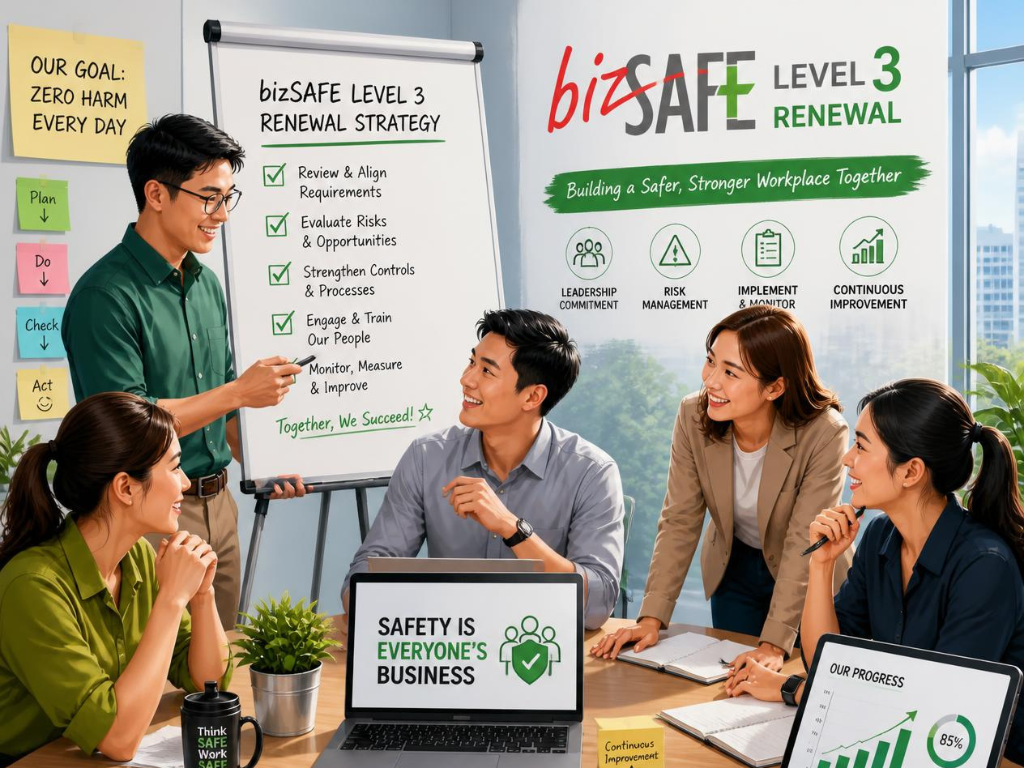
Levels 1 and 2 run 6 months from the date of approval and cannot be renewed. Levels 3, 4 and Star run 3 years, or until the expiry of a relevant external certification, whichever falls earlier.
That second clause catches companies out. A company holding Star through ISO 45001 has a bizSAFE status that dies with the certificate. A company holding Level 3 through SLOTS has a status tied to its SgMA certificate.
Renewal applications go in two months before expiry. There is no grace period and no retroactive renewal. A lapsed certificate means a fresh application supported by a current audit report, and your company drops off the Council’s listing in the meantime.
Your status can also end early. Placement on MOM’s Business Under Surveillance programme suspends bizSAFE status, removes the company from the bizSAFE Marketplace, and bars use of the logo. Reinstatement requires MOM’s Exit Notification letter and a current Risk Management audit report.
How to get bizSAFE certified, step by step
Six steps, running roughly 2 to 4 months for a company with existing documentation and 3 to 6 months without.
First, send your CEO or a top management representative to the Top Executive WSH Programme. The TEWP replaced the older Workshop for CEOs and Top Management, and Certificates of Attendance from that older workshop are accepted only if issued before 31 March 2024.
Second, send your Risk Management Champion to the two-day Level 2 course. Check Level 2 entry requirements before booking, because a wasted seat costs more than the fee.
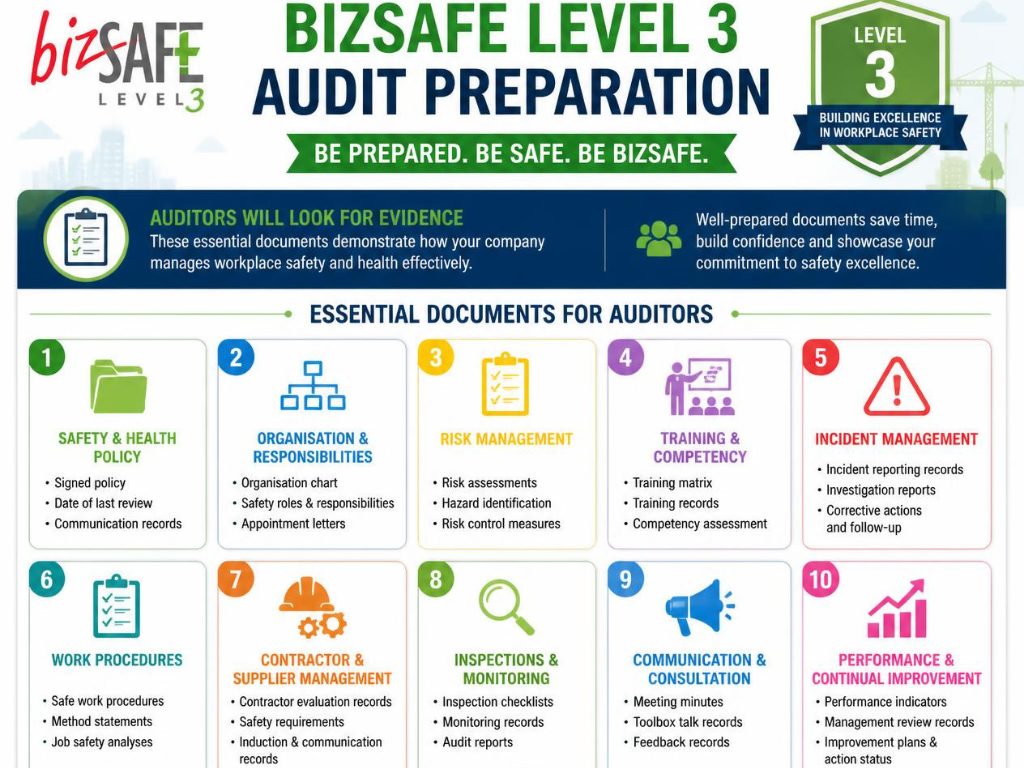
Third, build the system. Inventory of work activities, risk assessments covering every activity, safe work procedures for high-risk tasks, implementation records with named persons and due dates. This is the longest step and the one companies underestimate. Writing the RM plan properly here is what makes the audit short.
Fourth, engage an Auditing Organisation and complete the Risk Management Implementation Audit. Fifth, close every finding. The audit report template instructs applicants not to submit until all findings are closed.
Sixth, submit the application yourself through the Council’s portal. The Council advises against delegating this step to a consultant, citing fraud and forgery risk. A WSH Bulletin dated 5 August 2025 reported a company director sentenced for issuing forged bizSAFE certificates.
What does bizSAFE certification cost?
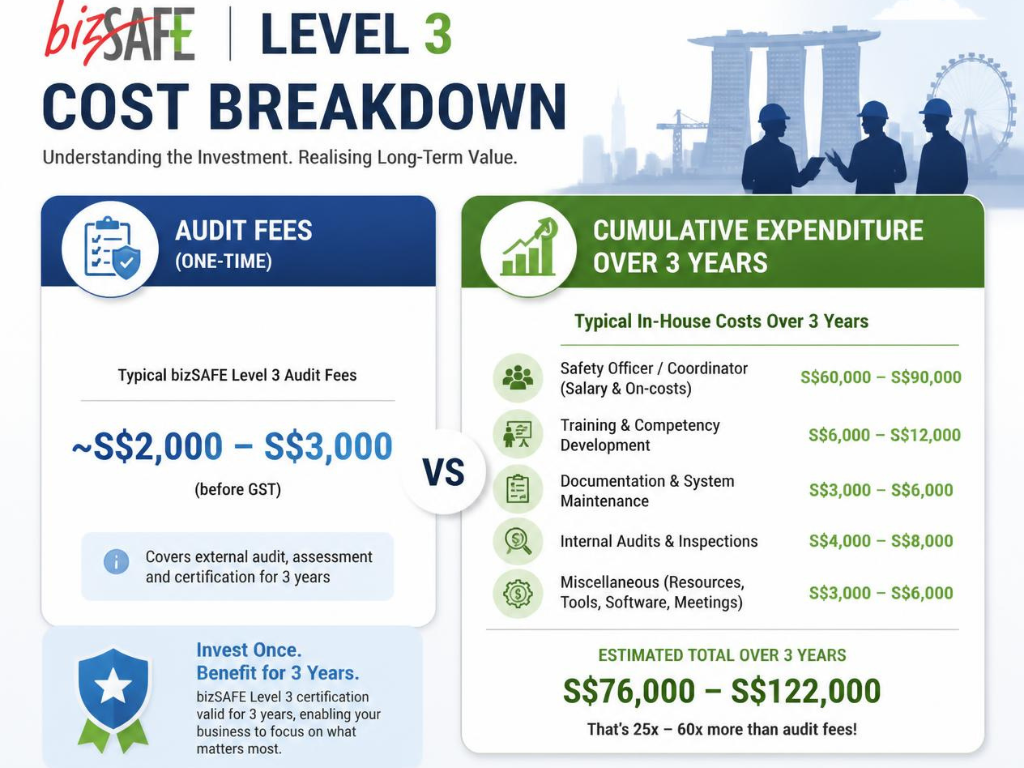
Between S1,800andS5,300 all-in for a first-time SME reaching Level 3, based on advertised 2026 pricing across Singapore training providers, consultancies and Auditing Organisations. The application itself is free.
Training is the most heavily subsidised line and the smallest. The bizSAFE Level 2 course at Advance Safe Consultants runs 2 days and 16 hours under course code TGS-2024052143 at S320before9%GST,droppingtoS188.80 after a 50% subsidy and S124.80aftera70%subsidyforeligibleSMEsorparticipantsaged40andabove.AbsenteepayrollisclaimableatS4.50 per hour, capped at S$100,000 per enterprise per calendar year.
The audit fee attracts no equivalent subsidy and typically runs S800toS2,000, driven by headcount, the number of work activities in your inventory, and the number of sites in scope. The Level 2 fee breakdown covers the training line in detail.
The line nobody quotes is corrective action. If the auditor finds missing machine guarding, the fix is a guard.
Who can audit your company for Level 3 and above?
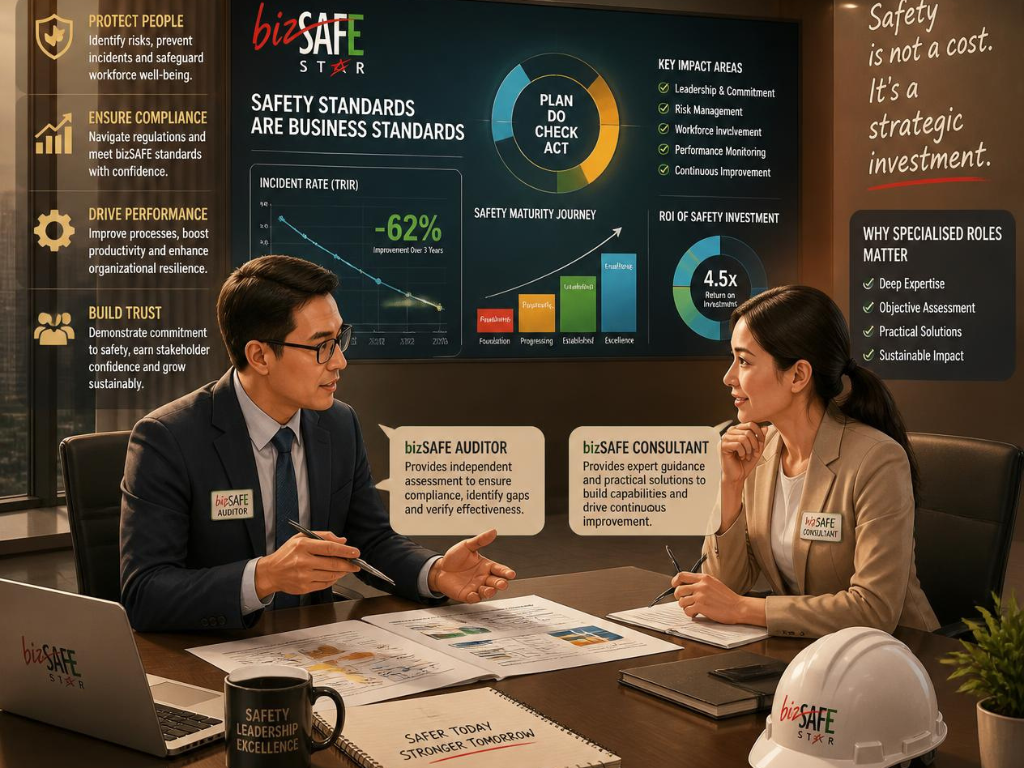
A WSH auditor approved by the Commissioner for Workplace Safety and Health, working through an auditing organisation accredited by the Singapore Accreditation Council under SAC CT 17 and registered with MOM. Nobody else can produce a report the Council accepts.
MOM’s published list of accredited SAC-AOs, updated 28 August 2026, names 39 organisations. All 39 carry a bizSAFE Risk Management audit scope. 38 cover construction worksites, 14 cover metalworking, 13 cover shipyards, and only 9 cover oil refinery or petrochemical work. A petrochemical operator is choosing from nine firms, not thirty-nine.
Your consultant cannot be your auditor. SAC CT 17 adopts ISO/IEC 17021-1, under which the certification body and any part of the same legal entity are barred from offering management system consultancy, with a further two-year bar on individual personnel who consulted for the client. Any provider offering to both prepare you and certify you is describing an arrangement the accreditation framework does not permit.
Advance Safe Consultants prepares companies for the audit and does not conduct it. Checking what the audit covers before engaging either party saves a round of rework.
What makes a bizSAFE application fail or get delayed?
Open audit findings, expired prerequisite certificates, and random verification inspections. The first two are self-inflicted and the third is not.
Auxiliary Enforcement Officers conduct sample verification onsite inspections of Risk Management audits as part of the application process, on a random basis, checking whether the Auditing Organisation followed the checklist and audited stringently. An unsatisfactory verification means re-conducting the audit and waiting beyond the standard 10 working days.
The trigger there is your auditor’s rigour, not your performance. Choosing an Auditing Organisation on price alone carries the risk of paying twice for the same audit.
The current audit standard is Revision V3.3 of the bizSAFE Level 3 Risk Management Audit Checklist, in force from 1 July 2026, carrying 28 main audit questions across five sections and 5 Audit Highlights covering vehicular safety, machinery safety, slips trips and falls, work at height, and health promotion. Ask your auditor which revision they are working to.
One more failure recurs. Applications are tagged to your UEN and cannot be transferred, so a restructure or re-incorporation means starting again.
Do you need a bizSAFE consultant?
Only if you lack internal capacity to write risk assessments and implement controls. A company with a trained RM Champion, documented activities and working controls can run the whole process in-house.
The honest comparison is consultancy fee against internal hours plus the cost of a failed audit, not consultancy fee against zero. A consultant typically covers gap analysis, the inventory of work activities, risk assessments, safe work procedures, implementation tracking and a pre-audit check.
Scope is where quotes diverge. Template risk assessments adapted to your activity list cost less than a consultant walking your site and interviewing supervisors. The second survives the walkthrough, because Section 4 of the checklist pairs document review with physical inspection on all eight implementation questions.
Speaking at the National WSH Campaign launch on 15 May 2026, WSH Council Chairman Abu Bakar Mohd Nor said companies must “go beyond systems and processes.” A consultant who delivers documents and leaves is selling you the half the auditor does not accept. Risk management consultancy is worth buying for implementation support, not paperwork.
Where the programme is heading
Singapore recorded 36 workplace fatalities in 2025 at a rate of 0.96 per 100,000 workers, the lowest on record, according to MOM’s Workplace Safety and Health Report 2025 published on 25 March 2026. Vehicular incidents, falls from height and collapse or failure of structures accounted for 28 of those 36 deaths.
Three of the five Audit Highlights in the current checklist map directly onto those three causes, which is not a coincidence. The December 2025 revision added speed limiter verification for vehicle fleets and removed the Safe Management Measures question entirely.
Speaking at the WSH Awards on 24 September 2025, Minister of State for Manpower Dinesh Vasu Dash said MOM and the WSH Council were reviewing how bizSAFE could become “even more effective and reflective of good WSH performance.” Companies budgeting to today’s minimum standard are betting against a programme being tightened.
Pick the level someone is asking you for
bizSAFE rewards companies that hold a level continuously more than companies that climb quickly and lapse. Level 3 is the working standard for most Singapore SMEs, and it is the level main contractors, NEA licensing and most tender evaluations actually ask about. Levels 1 and 2 are inputs with a 6-month shelf life, not achievements to bank. Star is worth the commitment only when a certified management system is already required of you. Decide from the trigger, then hold the level without letting it expire.
Book a bizSAFE level assessment with Advance Safe Consultants to map your current documentation against the level your clients or licence conditions require, before you commit to a training or audit spend.
FAQs About Bizsafe Certification Singapore
Is bizSAFE certification mandatory in Singapore?
No. bizSAFE is a voluntary WSH Council programme, not a statutory requirement. It becomes mandatory through contracts and licences: NEA requires valid bizSAFE Level 3 for Class 1 and Class 2 Cleaning Business Licence renewal, and many main contractors require Level 3 from subcontractors before awarding work.
What replaced the bizSAFE Level 1 top management workshop?
The Top Executive WSH Programme (TEWP). Certificates of Attendance from the older Workshop for CEOs and Top Management remain acceptable only where they were issued before 31 March 2024. Everyone attending from that date onward receives a TEWP Certificate of Completion, issued in the attendee’s name rather than the company’s.
Can I skip straight to bizSAFE Level 3?
Yes, provided you hold the documents Level 3 requires. The WSH Council allows direct application to any level whose requirements are met, but the Level 3 documents list still includes the TEWP certificate and the Level 2 Statement of Attainment, so both must be in hand and unexpired.
How do I check whether a company holds valid bizSAFE status?
Use the WSH Council’s bizSAFE Self-Help service, which lists each enterprise’s level, status and expiry date and refreshes every two weeks. Verify there rather than accepting a PDF certificate, since a company director was sentenced in 2025 for issuing forged bizSAFE certificates.
Does bizSAFE certification transfer if my company changes its UEN?
No. bizSAFE applications are tagged to the Unique Entity Number and the WSH Council cannot move records to a new one. A restructure or re-incorporation means submitting a fresh bizSAFE Enterprise application, which at Level 3 and above means a fresh Risk Management audit.