- 20 Nov 2026
bizSAFE Level 3 is the first level that requires an independent audit, and it is the level BCA names in its Contractors Registration System at grades C1, C2 and across M&E grades L2 to L6. This page is for Singapore firms deciding whether Level 3 is worth the spend, and what the spend buys.
bizSAFE Level 3 is the WSH Council recognition awarded after an approved Auditing Organisation audits your implemented risk management system against the WSH (Risk Management) Regulations. It is the first level assessed by an independent party rather than a course certificate, and it is valid for three years. This page covers the audit, the cost and the eligibility rules, starting with the workplace safety training catalogue that covers the training rungs beneath it.
What the bizSAFE Level 3 audit actually assesses
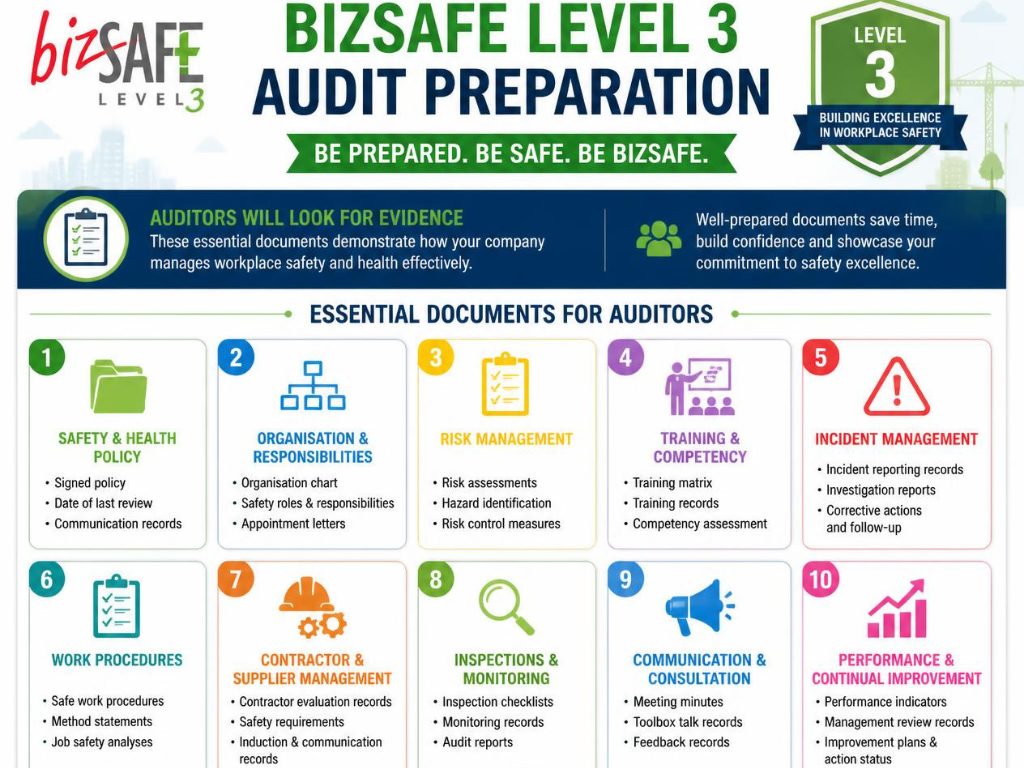
Whether the risk controls you wrote down exist on your floor. An approved auditor reviews your documents, walks your workplace, interviews your employees, then recommends or declines.
The audit runs against the bizSAFE Level 3 Risk Management Audit Checklist. The current edition is Revision V3.3, in force from 1 July 2026, carrying 28 main audit questions across five sections plus five Audit Highlights covering vehicular safety, machinery safety, slips trips and falls, work at height, and health promotion.
Document review alone does not get you through. Most of the checklist pairs document review with a physical inspection or an employee interview, so a risk assessment naming a control that is absent from the workplace produces a finding.
The reference standards are the WSH (Risk Management) Regulations and the Code of Practice on WSH Risk Management. That second document is why the audit reaches terrain ISO 45001 does not specifically cover, including terrorism threats, disease outbreak and mental well-being. How safety audits run in Singapore more broadly sets the context.

Who is allowed to conduct the Level 3 audit
A WSH auditor approved by the Commissioner for Workplace Safety and Health, working through an auditing organisation accredited by the Singapore Accreditation Council under CT 17 and registered with MOM. No other party can produce a report the WSH Council accepts.
MOM’s published list of accredited SAC-AOs, updated 28 August 2026, names 39 organisations, each with an SAC certificate number. All 39 carry a bizSAFE Risk Management audit scope. Sector scope narrows the field fast: 38 cover construction worksites, 14 cover metalworking, 13 cover shipyards, and 9 cover oil refinery or petrochemical work.
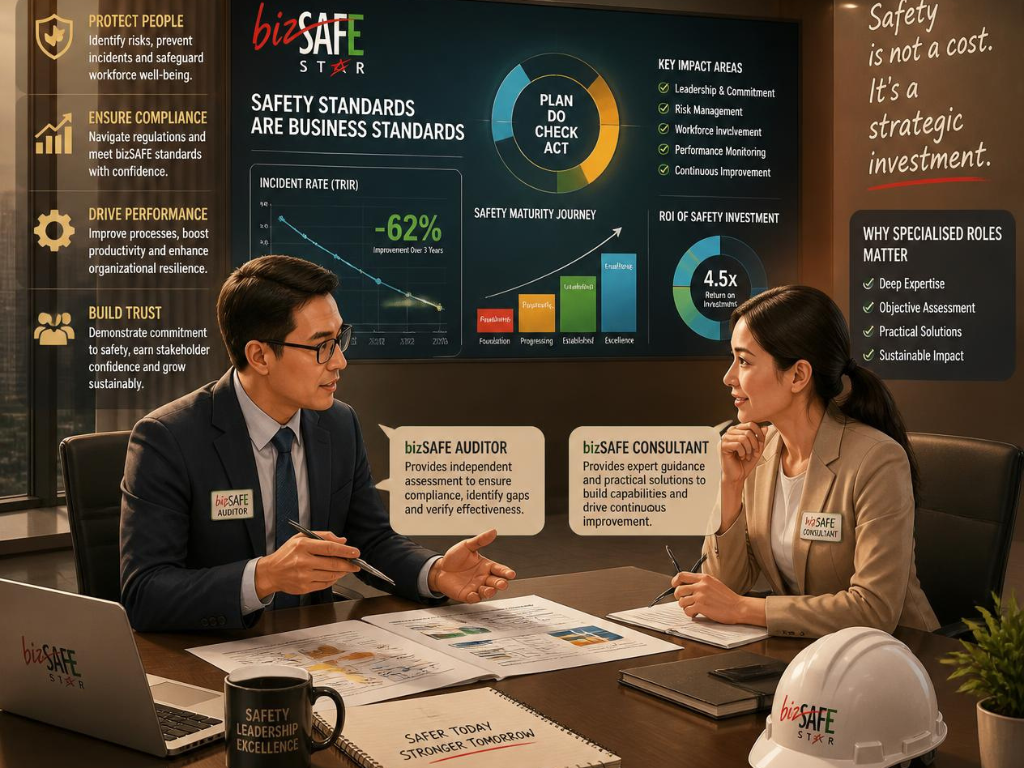
Your consultant cannot be your auditor. SAC CT 17 adopts ISO/IEC 17021-1, which bars an auditing organisation and any part of the same legal entity from offering management system consultancy. Advance Safe Consultants prepares companies for the audit and does not conduct it.
Check the AO’s scope line before checking its price. A petrochemical operator is choosing from nine firms.

What bizSAFE Level 3 costs
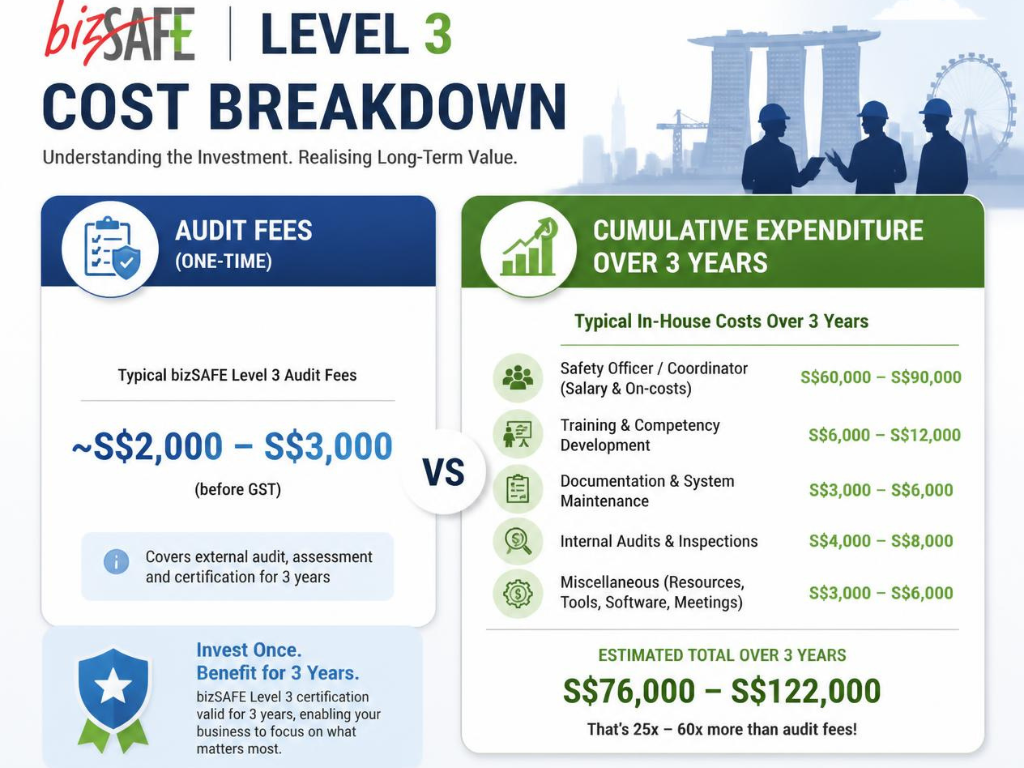
Between S1,800andS5,300 all-in for a first-time SME, based on advertised 2026 pricing across Singapore training providers, consultancies and auditing organisations. Applying to the WSH Council is free at every level.
Three lines make up the spend. Training for the prerequisite levels, the audit fee paid to the Auditing Organisation, and consultancy where engaged. The audit fee typically runs S800toS2,000 and attracts no subsidy, while training is the most heavily subsidised line and the smallest in absolute terms.
Four variables move the audit quote: employee headcount, the number of work activities in your inventory, the number of sites in scope, and sector risk profile. Headcount drives interview volume, because the checklist repeatedly instructs the auditor to interview three employees per question.
The cost line nobody quotes is corrective action. A finding on missing machine guarding is closed with a guard, not a document.
Which tenders and registrations actually require Level 3
BCA’s Contractors Registration System, and sector licensing. bizSAFE is not a GeBIZ requirement, and the distinction matters because firms budget against the wrong rule.
GeBIZ states that where a registration or qualification criterion applies to a tender, it is specified in that tender’s notice and documentation. There is no portal-wide bizSAFE condition. What exists instead is harder: CRS registration is the precondition for tendering on public sector construction work and for acting as a first-level subcontractor on public sector projects, and CRS names bizSAFE in its registration requirements.
Since 1 June 2025, CRS registration also became mandatory for any firm hiring construction S Pass or Work Permit holders, regardless of whether the project is public or private. That change pulled firms into CRS who had never tendered publicly.
NEA runs the other hard requirement. Renewal of a Class 1 or Class 2 Cleaning Business Licence requires a valid bizSAFE Level 3, alongside paid-up capital of $250,000 and $25,000 respectively, and only licences issued before 1 January 2024 can renew into the Class 3 licence that carries no bizSAFE condition.
Which BCA grades require Level 3, and which require Star
Level 3 or ISO 45001 at the lower and middle grades, bizSAFE Star or ISO 45001 at the top. BCA publishes this in its Specific Registration Requirements, one document per workhead category.
The Construction Workhead requirements, August 2024 edition, state at Note 12 that bizSAFE Level 3 or ISO 45001 is required for grades C1 and C2. Grade C1 carries a paid-up capital requirement of $300,000 and a three-year track record of $3.0m. At the top of the same table, grades B1 and A1 require ISO 45001 or bizSAFE Star, with A1 adding the Green and Gracious Builders Scheme.
The Construction-Related Workhead requirements, May 2025 edition, carry the same Level 3 or ISO 45001 condition at Note 13, and single out CR10A at Note 14 as requiring bizSAFE Star or ISO 45001 together with SCI Precaster Accreditation Scheme PC1A.
The Mechanical and Electrical requirements, June 2022 edition, carry bizSAFE Level 3 or ISO 45001 across grades L2 through L6, from $50,000 paid-up capital and $1.0m track record at L2 up to $1.5m and $30.0m at L6.
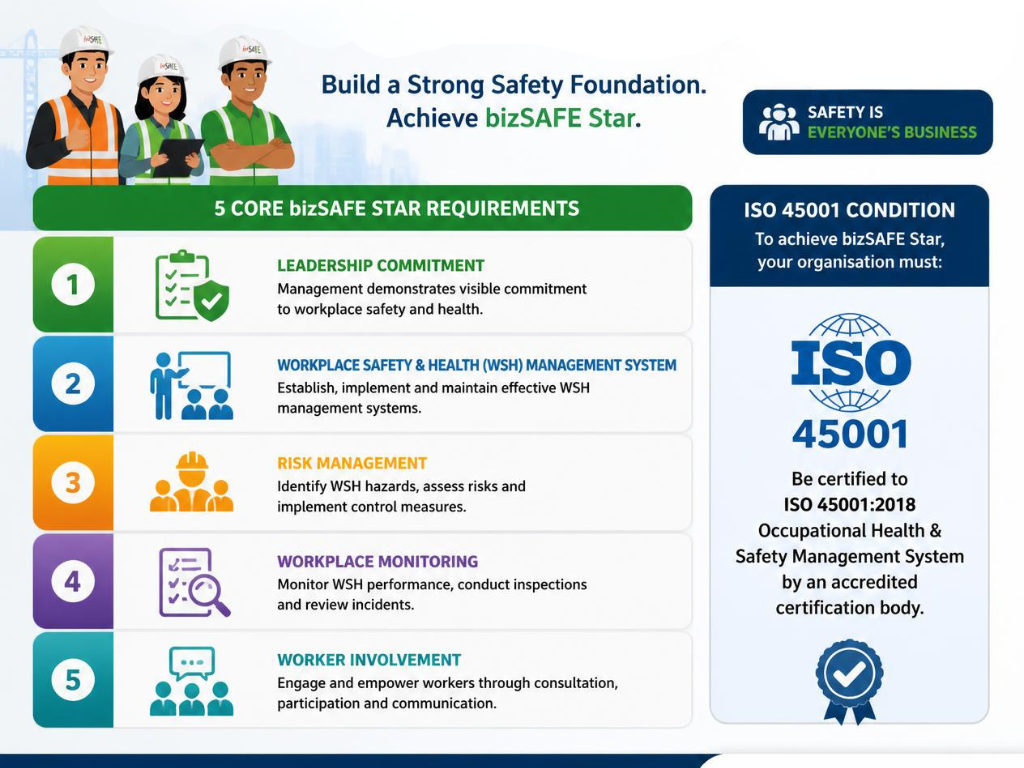
Read the word “or” carefully. A firm already holding accredited ISO 45001 satisfies the BCA condition without bizSAFE. Firms without it find Level 3 the cheaper route by a wide margin, which is the honest reason most take it.
How long bizSAFE Level 3 takes
Two to four months for a company with existing risk assessments, three to six months starting from nothing. Applications take 10 working days to process once submitted.
The sequence has fixed dependencies. Top management completes the Top Executive WSH Programme. A Risk Management Champion completes the two-day Level 2 training. The system gets built and implemented. An Auditing Organisation audits it. Every finding is closed. Then the application goes in.
The step companies underestimate is implementation, not paperwork. Writing twenty risk assessments takes a week. Getting the named control measures actually in place, with implementation persons and due dates recorded, takes longer.
Watch the shelf life on the inputs. Levels 1 and 2 are valid for 6 months from approval and cannot be renewed, so prerequisite certificates collected too early expire before the audit happens.
How long the certificate lasts
Three years from the date of approval, renewable. Renewal applications go to the WSH Council two months before expiry.
There is no grace period. A lapsed certificate means a fresh application supported by a current audit report, and your company drops off the Council’s bizSAFE listing while that runs. For a firm holding a CRS grade or an NEA licence that depends on Level 3, a lapse is a registration problem, not a marketing one.
Status can also end early. Placement on MOM’s Business Under Surveillance programme suspends bizSAFE status and bars use of the logo, and reinstatement requires MOM’s Exit Notification letter plus a current audit report.
One route runs on a shorter clock. Companies that entered Level 3 through SLOTS, Joint Commission International or a Responsible Care Award hold a status pinned to that external certificate’s expiry rather than a flat three years.
What happens if the audit finds non-conformances
You close them before you apply. The audit report template instructs applicants not to submit the bizSAFE application until all findings are closed, so findings delay the application rather than fail it outright.
Closing a finding means evidence, not explanation. A missing fall prevention plan is closed with a plan and a briefing record. A risk assessment approved by the wrong person is closed by routing it to the manager of that work activity. The auditor verifies closure, and a site revisit carries a cost.
A second risk sits outside your control. Auxiliary Enforcement Officers conduct random onsite verification inspections of Risk Management audits as part of the application process, checking whether the Auditing Organisation audited stringently. An unsatisfactory verification means re-conducting the audit and waiting beyond the standard 10 working days.
The trigger there is your auditor’s rigour, not your performance. Choosing an AO on price alone carries the risk of paying for the same audit twice.
Do you need a bizSAFE Level 3 consultant
Only if you lack internal capacity to write risk assessments and get controls implemented. A firm with a trained RM Champion, a documented activity inventory and working controls can run Level 3 in-house.
The comparison worth making is consultancy fee against internal hours plus the cost of a delayed audit, not consultancy fee against zero. Published 2026 timelines show two to four weeks to certification with consultancy support against three to six months without.
Scope is where quotes diverge. A package of template risk assessments adapted to your activity list costs less than a consultant walking your site and interviewing supervisors. The second survives the walkthrough.
Ask what the deliverable list contains before signing: how many work activities, how many site visits, whether safe work procedures are in scope, and whether a pre-audit mock is included. Audit readiness support that stops at documentation leaves the half the auditor tests.
What a Level 3-ready company looks like
An inventory that matches the work, risk assessments with named implementation persons and due dates, and employees who can answer for their own activity. Auditors find the gap between those three faster than any document review.
The inventory of work activities has to cover routine, non-routine and new activities, and the auditor validates it by walking the site. A warehouse listing eleven activities while running seventeen fails on physical inspection.
Risk assessments need approval by the manager of the work activity, not by the RM Champion signing everything. Each control measure needs an implementation person and a due date, and the auditor interviews three of those named people.
Employees get interviewed on policy awareness, their own risk assessment, and SGSecure tenets. Briefing them is a real task with a real record. Drafting the RM plan sets the structure, and keeping HIRADC current between audits is what stops the register drifting from the work.
Buy the level your registration grade asks for
Level 3 earns its place when a named condition requires it: a BCA workhead grade, an NEA licence class, a main contractor’s onboarding rule, or an insurer’s bind condition. BCA accepts ISO 45001 as an alternative at every grade where it names bizSAFE, so firms already certified have a decision to make rather than a purchase. For everyone else, Level 3 is the cheaper route to the same eligibility, and holding it continuously matters more than reaching it quickly.
Book a Level 3 gap analysis with Advance Safe Consultants to have your work activity inventory, risk assessments and site controls checked against Revision V3.3 before you engage an Auditing Organisation.
FAQs About Bizsafe Level 3 Singapore
Is bizSAFE Level 3 mandatory in Singapore?
No. bizSAFE is a voluntary WSH Council programme. It becomes compulsory through registration and licensing conditions: BCA requires bizSAFE Level 3 or ISO 45001 at Construction Workhead grades C1 and C2, and NEA requires a valid Level 3 for Class 1 and Class 2 Cleaning Business Licence renewal.
Can I get bizSAFE Level 3 without doing Levels 1 and 2 first?
No. The WSH Council’s supporting documents list requires the Top Executive WSH Programme certificate and the Level 2 Statement of Attainment alongside the audit report for a Level 3 application. Both are valid for 6 months, so they must still be unexpired on the day you submit.
What happens if my bizSAFE Level 3 lapses during a tender?
Your company drops off the WSH Council’s bizSAFE listing, which is where buyers check. For a BCA-registered contractor at grade C1 or C2, or an NEA Class 1 or Class 2 licensee, a lapse puts a registration condition out of compliance. There is no retroactive renewal.
Does ISO 45001 replace bizSAFE Level 3 for BCA registration?
Yes, at every CRS grade where BCA names bizSAFE. The Construction Workhead requirements, August 2024 edition, write the condition as bizSAFE Level 3 or ISO 45001 for grades C1 and C2. Accreditation matters: the certificate must come from a SAC-accredited certification body.
How do clients verify that our bizSAFE Level 3 is genuine?
Through the WSH Council’s bizSAFE Self-Help service, which lists each enterprise’s level, status and expiry date and refreshes every two weeks. Buyers check there rather than accepting a PDF, after a company director was sentenced in 2025 for issuing forged bizSAFE certificates.