- 23 Nov 2026
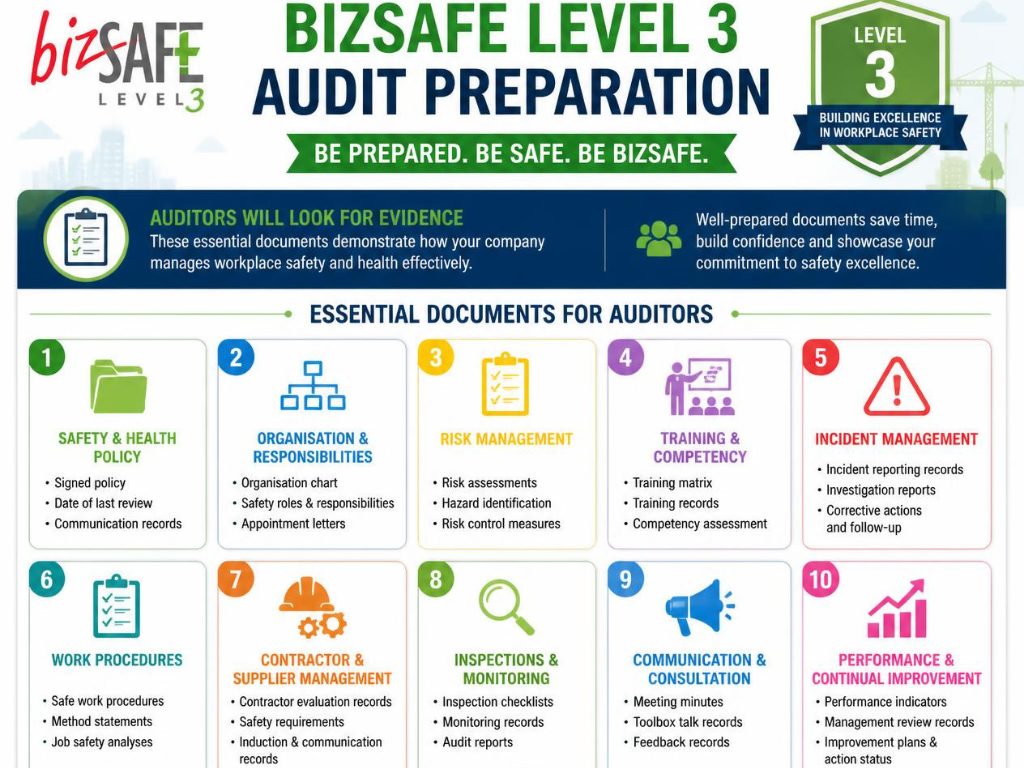
bizSAFE Level 4 recognises a company whose WSHMS Champion has completed the WSQ Develop a WSHMS Implementation Plan course and whose risk management system has been independently audited. The course now teaches to ISO 45001 rather than SS 506. This page is for Level 3 companies deciding whether to send someone, and who.
bizSAFE Level 4 is the WSH Council tier awarded to companies holding a Risk Management Implementation Audit Report plus a WSQ Statement of Attainment for Develop a WSHMS Implementation Plan, issued in the attendee’s name under code WPH-WSH-4086-1.1. The Council last refreshed the course technical notes on 3 May 2024. This page covers the course and the decision, starting with the workplace safety course range beneath it.
What bizSAFE Level 4 recognises
Capability, not implementation. Level 4 says your company has a trained WSHMS Programme Lead and a plan for a management system. Star says a certification body audited the system and found it running.
The documents the Council accepts are two: a Risk Management Implementation Audit Report from an accredited Auditing Organisation, issued to the company, and a WSQ Statement of Attainment for Develop a WSHMS Implementation Plan or WSH System Management, issued to the attendee.
Level 4 status runs three years from the date of approval and is renewable. Applying to the Council is free, and processing takes 10 working days.
The audit report is the same document a Level 3 application uses. A company moving from Level 3 to Level 4 inside the same three-year window adds a course, not a second audit.

What the WSHMS Implementation Plan course covers
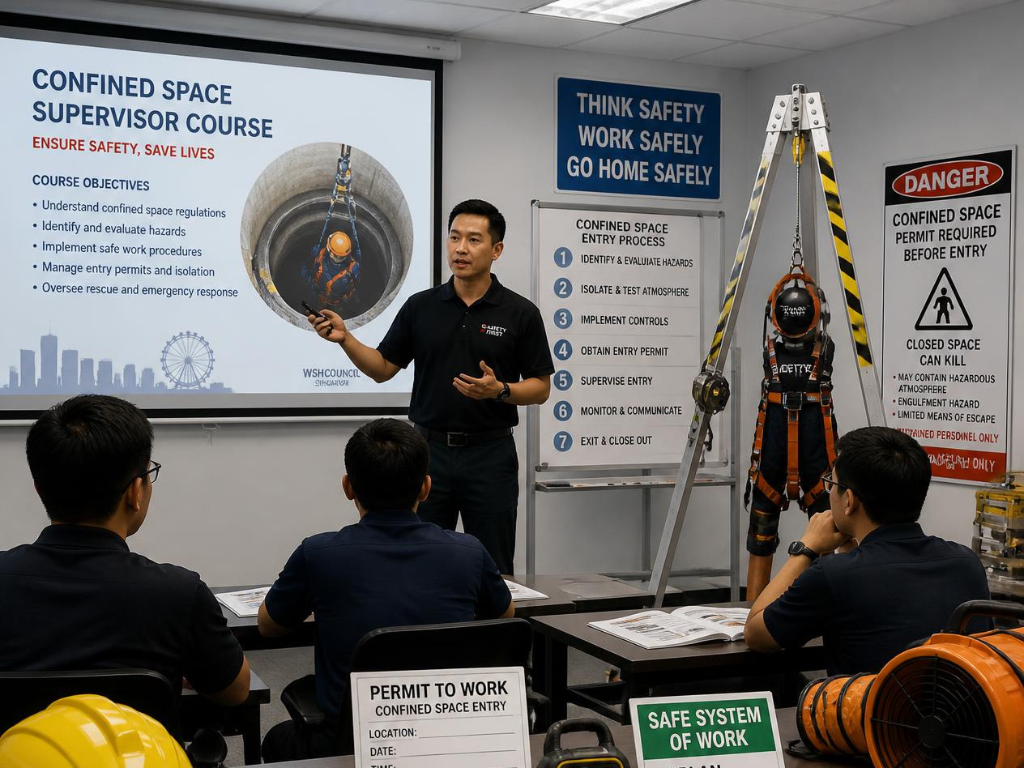
Building a management system on paper, element by element, then presenting it. The course trains a WSHMS Programme Lead to review the company’s existing WSH policy, risk management plan and objectives, find the gaps against the standard, and write an implementation plan that closes them.
The published learning outcomes run through a consistent sequence. Reviewing current policy and risk management plan for deficiencies. Establishing a WSH management programme framework. Establishing an emergency preparedness and response framework. Developing operational control consistent with the hierarchy of controls. Building processes for accident and incident investigation. Establishing an internal audit programme. Conducting a management review. Presenting the plan to stakeholders.
Two of those carry most of the weight after the course ends. The internal audit programme and the management review are the elements that certification auditors test hardest, and the ones most Level 3 companies have never run.
The plan is written against your own operations, so what you bring matters. A company arriving with the RM plan it builds on already maintained, and with HIRADC in operation rather than filed, writes a usable plan. A company arriving with a dormant register writes an aspiration.

Who should attend the bizSAFE Level 4 course
The person who will actually run the management system, with the authority to convene a management review. Sending a junior coordinator who can compile documents but cannot call a meeting with top management wastes the seat.
Published provider entry assumptions put learners at Workplace Literacy and Numeracy level 5 or equivalent, and the typical attendee is a WSH Officer, WSH Coordinator, operations manager or EHS manager. Line supervisors attend where they hold real system responsibility.
There is a second reason to choose carefully. MOM’s WSH Officer professional review write-up template names the Develop a WSH Management System Implementation Plan course among the training it asks applicants to declare, alongside the Advanced Certificate in WSH and the Level 2 risk management course. For a staff member on a WSHO track, Level 4 is a career input and not just a company requirement.
The practical test is the same one that applies at Level 2. Picking the right attendee means choosing by authority and tenure, not by who has a free week.
What changed: the course runs on ISO 45001 now
The reference standard moved from SS 506 to SS ISO 45001, and the qualification moved to a new code. Current syllabi open at ISO 45001 High-Level Structure and the requirements relevant to organisational context.
The Technical Skills and Competencies title is now Workplace Safety and Health System Management, code WPH-WSH-4086-1.1. The older WSQ competency code MF-COM-403E-1 still appears on the Council’s accepted documents list, so Statements of Attainment under either code remain valid.
Guides published as recently as mid-2026 still describe a course built on SS 506. A provider quoting SS 506 as the current standard is working from a superseded syllabus, which is worth checking before booking, because the plan you write in class is the plan you take to a certification body.
The Council refreshed the course technical notes on 3 May 2024 and publishes them to approved training providers rather than to the public.
How long the course runs and how it is assessed
Four days, with recommended learning hours of 30 including assessment. Published provider schedules range from 28 to 36 hours, so the figure varies by provider rather than by Council mandate.
Assessment combines written work, case study or project work, and an oral or presentation component where the learner presents the implementation plan. Providers set minimum attendance, commonly 75% or full attendance depending on the provider.
Delivery is predominantly classroom-based across consecutive days, because the assessment includes group exercises and a presentation. Synchronous e-learning versions exist and run slightly longer.
The output is a Statement of Attainment for WPH-WSH-4086-1.1, issued in the attendee’s name. That document, not a company certificate, is what the bizSAFE Level 4 application attaches.
What bizSAFE Level 4 costs and what funding applies
Course fees are set by individual training providers and SSG funding applies to eligible learners and employers, as it does across the WSQ framework. Applying to the WSH Council for Level 4 recognition is free.
Advance Safe Consultants does not deliver the Level 4 course. The WSH Council maintains a list of bizSAFE approved training providers, and that list is the right place to compare fees, schedules and delivery modes.
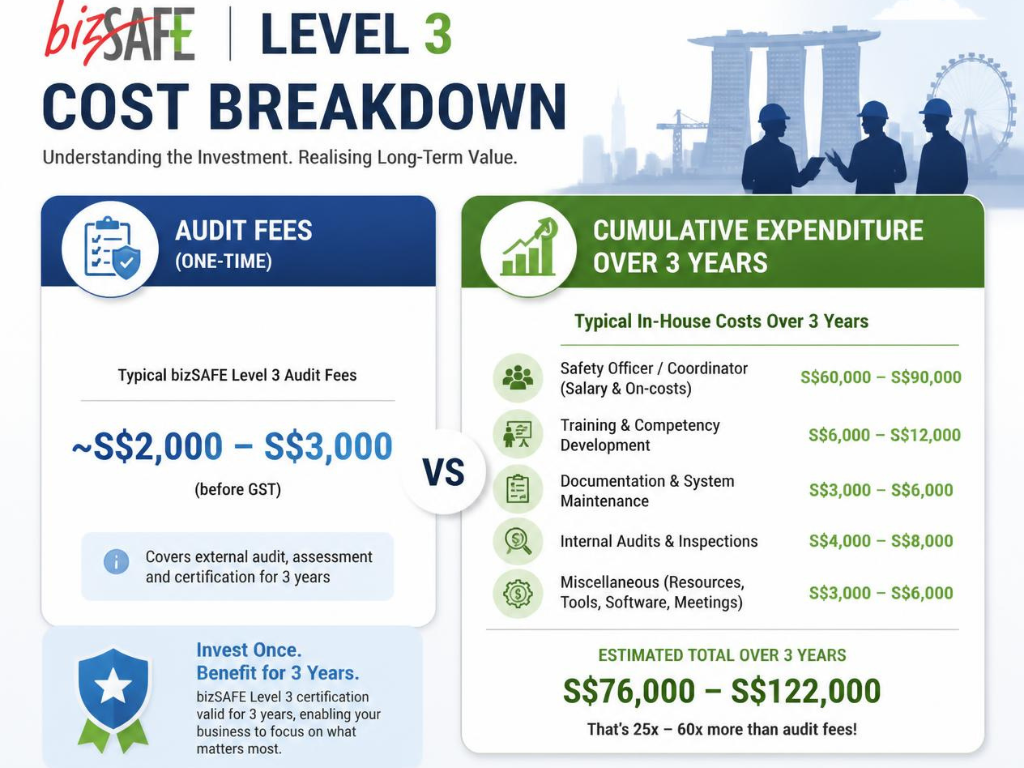
Worth noting on budget: the Risk Management Implementation Audit Report is the larger line, not the course. A company sequencing Level 3 and Level 4 within one audit cycle pays once for the audit and once for the course, rather than twice for either.
Do you need bizSAFE Level 3 before Level 4?
No, as a matter of documents. The Council’s Level 4 row names the audit report and the WSHMS Statement of Attainment, and the Council states that a company may apply for any level directly as long as it meets that level’s requirements.
As a matter of sequence, almost everyone does Level 3 first, because the audit report that Level 4 requires is the same Risk Management Implementation Audit that Level 3 requires. Holding Level 3 means you already have the document.
The course assumes it too. Reviewing your existing risk management plan for deficiencies is the first learning outcome, and a company without one spends the first day building what it should have brought. The Level 2 risk management training and a working register are the real prerequisites, whatever the documents list says.
Is bizSAFE Level 4 required for Star?
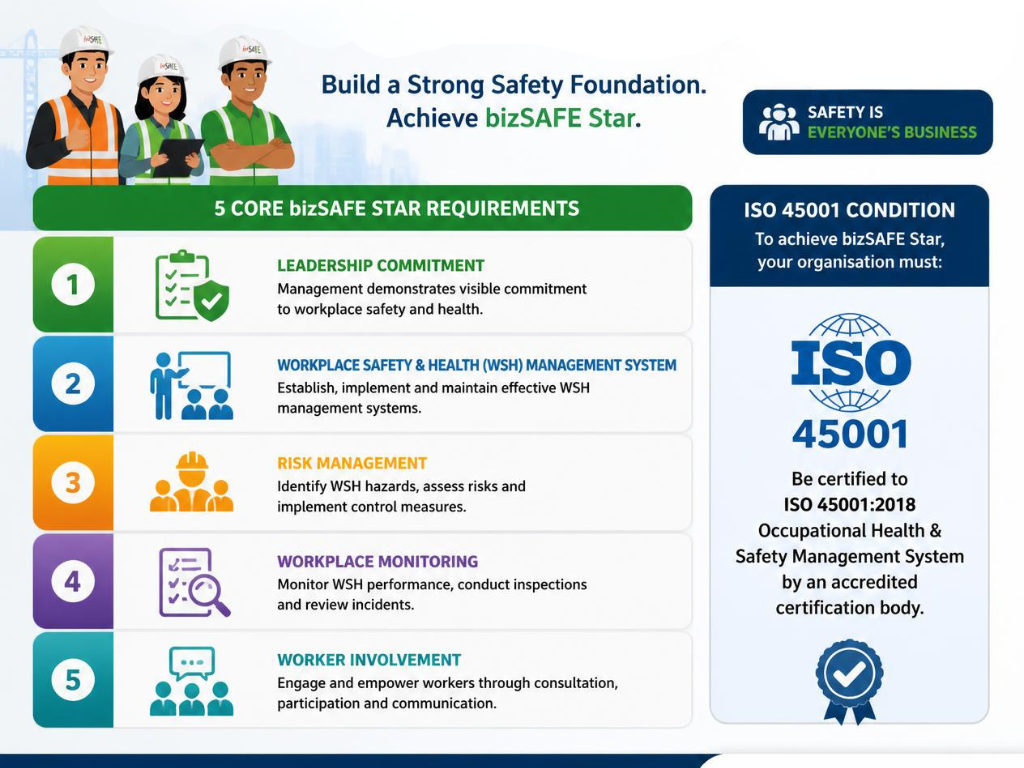
No. The Council’s Star row names only a Risk Management Implementation Audit Report and an accredited ISO 45001:2018 or SS 651:2019 certificate. No course certificate appears.
Several widely-read guides state that Level 4 gates Star. Check the Council’s document list before booking a four-day course on that assumption.
Level 4 still earns its place for most companies taking the Star route, because it trains the person who will build the system an ISO 45001 auditor comes to inspect. Building that system without in-house capability means buying the capability from a consultant instead.
The two tiers also differ in what they survive. Level 4 runs three years from approval regardless of staff changes to the company. Star ends with your ISO 45001 certificate. Understanding the safety audit expectations that sit under both clarifies which document is doing the work.
What happens when your WSHMS Champion leaves
The Statement of Attainment leaves with them. The Council issues it in the attendee’s name, not the company’s, so a departing Champion takes the qualification that supported your Level 4 application.
Three years is long enough for that to happen. A company renewing Level 4 needs a current employee holding a valid Statement of Attainment under MF-COM-403E-1 or WPH-WSH-4086-1.1, and a certificate belonging to someone who left in year two does not supply it.
The cleaner approach is to train two people rather than one, and to check the roster well before the renewal window rather than during it. A second trained person also gives the management review a quorum when the first is on leave.
Several approved training providers state that a change of WSHMS Champion requires the new Champion to attend the Level 4 course regardless of the company’s current bizSAFE level. Treat that as the working assumption and confirm the position with the Council before relying on it.
When a company should skip Level 4
When ISO 45001 certification is already funded and scheduled. A company heading straight to certification can apply for Star on the audit report and the certificate, and the four days spent in a classroom are better spent on the system itself.
That position is not one you will hear from a training provider, and it is the right call for a narrow group: companies with an existing certified system in another standard, companies with an in-house WSH Officer who already runs management reviews, and companies where a consultant is building the system under contract.
Everyone else benefits from the course, because the alternative is paying someone else to understand your management system. WSHMS implementation support works best alongside internal capability rather than instead of it.
Where this breaks down is companies that send someone to Level 4, collect the status, and never implement the plan. Level 4 status with no running system is a certificate, and the first certification audit finds that out.
Train the person who will run it
bizSAFE Level 4 is worth doing when you have identified the person who will own your management system and want them to understand it rather than inherit a consultant’s binder. The course now teaches to ISO 45001, the qualification sits with the individual under code WPH-WSH-4086-1.1, and the audit report it needs is the one your Level 3 application already produced. Choose the attendee by authority, train a second as cover, and treat the implementation plan as a work programme rather than a submission.
Book an implementation plan review with Advance Safe Consultants to have your WSHMS plan pressure-tested against your actual operations before you take it into a certification cycle.
FAQs About Bizsafe Level 4 Singapore
How long is bizSAFE Level 4 valid?
Three years from the date of approval, renewable. The WSH Council asks for renewal applications two months before expiry, and renewal requires a current Risk Management Implementation Audit Report alongside a valid WSQ Statement of Attainment held by a current employee.
Can I take the bizSAFE Level 4 course online?
Classroom delivery is standard because assessment includes group exercises and a presentation of the implementation plan. Synchronous e-learning versions exist and run around 30 hours. Check the delivery mode with the provider before booking, since assessment components differ between formats.
Does the Level 4 course count toward becoming a WSH Officer?
MOM’s WSH Officer professional review write-up template names the Develop a WSH Management System Implementation Plan course among the training applicants declare. It sits alongside the Advanced Certificate in WSH and the bizSAFE Level 2 course, and applicants describe how they applied the learning at their workplace.
How do I choose a bizSAFE Level 4 training provider?
Use the WSH Council’s bizSAFE approved training providers list, then check which standard the syllabus teaches. A provider still describing the course against SS 506 rather than SS ISO 45001 is working from a superseded reference, which matters because the plan you write in class goes to a certification body.
How long does the WSHMS implementation plan take to finish after the course?
Two to four weeks of work for a company with maintained Level 3 documentation, longer where the risk register, emergency response plan and WSH committee records need rebuilding first. The plan is written against your own operations, so existing documentation quality sets the pace.